
Symbols
33 Symbols of Friendship and What They Truly Mean
Discover 33 powerful symbols of friendship — from the Claddagh ring to yellow roses — and the loyalty, trust, and love each one re…
 KnowMastery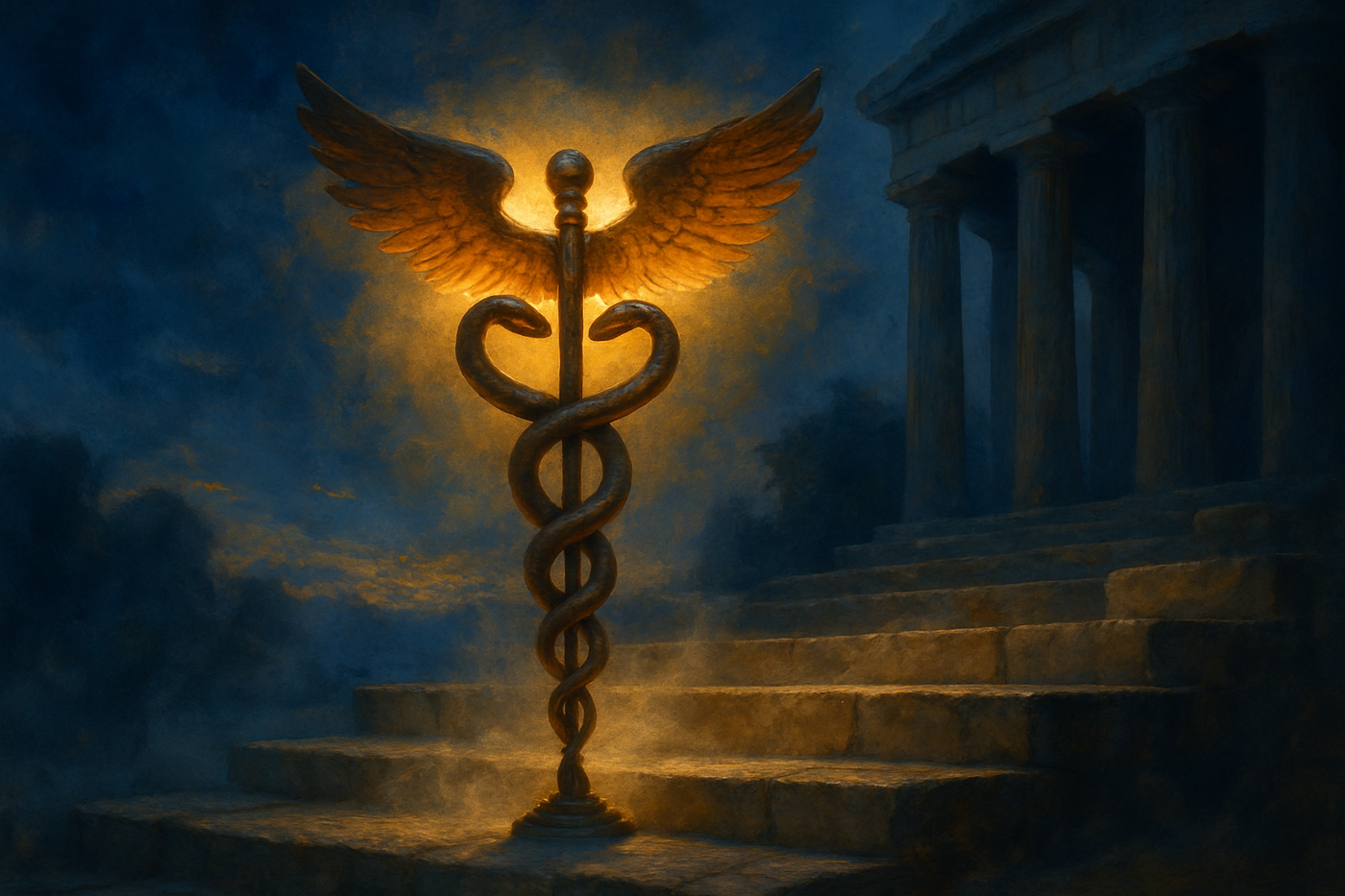
The caduceus is a short staff entwined by two serpents and topped with a pair of wings, originally carried by the Greek god Hermes (Mercury in Roman mythology) as the emblem of his role as divine messenger. At its core, the caduceus meaning centers on communication, negotiation, commerce, and safe passage between worlds—including the boundary between the living and the dead. Though widely mistaken today for a medical emblem, the true symbol of medicine is a related but distinct staff called the Rod of Asclepius, which carries only one serpent and no wings.
There is something magnetic about a symbol that has kept its exact shape for nearly three thousand years. Picture a marketplace in ancient Athens: merchants haggling under an olive tree, coins changing hands, when a herald arrives carrying a slim staff wrapped in two snakes. The noise drops instantly. Everyone understands, without a word, that the message he carries is protected—untouchable, sacred, backed by the gods themselves.
That same hush still lingers whenever we glimpse the caduceus stamped on an ambulance door or engraved into a pharmacy sign. We sense authority, urgency, even healing—though few could explain exactly why. Understanding the caduceus meaning means tracing a symbol that has quietly shape-shifted across gods, empires, and professions, carrying its original power intact the entire way.
In Greek mythology, Hermes received his kerykeion (the Greek word for caduceus, meaning "herald's staff") either from Apollo in exchange for the lyre, or as a divine gift marking his role as messenger of Mount Olympus. Hermes used it to guide souls to the underworld, lull mortals to sleep, or wake them—an object of transition rather than combat.
One popular myth explains the twin serpents: Hermes threw his staff between two fighting snakes, and they wrapped themselves around it in peaceful stillness. From that moment, the caduceus became a symbol of reconciliation and balance between opposing forces—a theme echoed in other dual symbols, such as the interplay of opposites explored in Yin Yang philosophy.
When Rome absorbed Greek mythology, Hermes became Mercury, god of trade, travelers, and eloquence, and the caduceus followed him. Roman merchants and diplomats adopted it as a badge of neutrality; carrying it meant you traveled under divine protection and could not legally be harmed, much like a modern diplomatic passport.
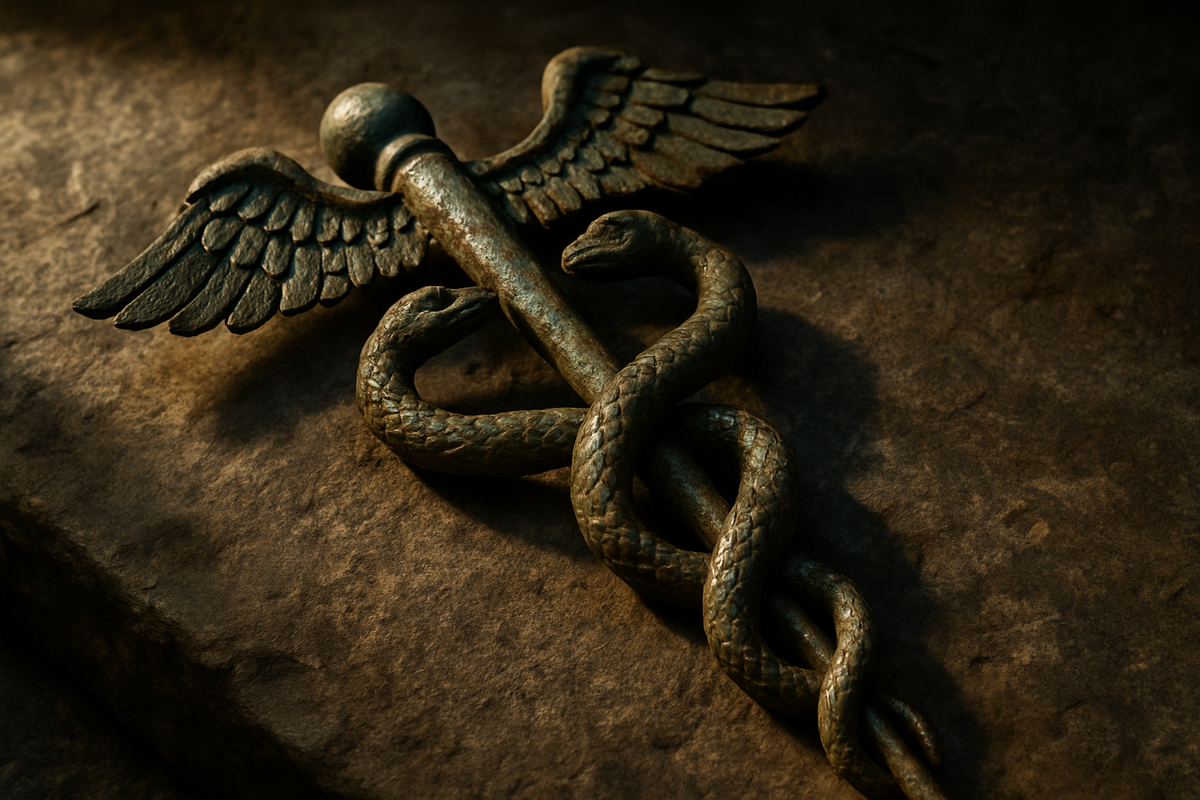
Nearly every modern debate about the caduceus meaning circles back to one question: why is it on hospitals if it isn't the real medical symbol? The confusion traces to 1902, when U.S. Army officer Captain Frederick P. Reynolds mistakenly proposed the caduceus—rather than the single-serpent Rod of Asclepius—as the insignia for the Army Medical Department. The error was adopted, and it spread through American hospitals, pharmacies, and ambulance branding for the next century.
| Feature | Caduceus (Hermes/Mercury) | Rod of Asclepius |
|---|---|---|
| Number of serpents | Two | One |
| Wings | Yes, at the top | No |
| Deity | Hermes/Mercury, god of messengers and trade | Asclepius, god of healing and medicine |
| Core meaning | Communication, commerce, negotiation, guidance of souls | Healing, medicine, restoration of health |
| Common modern use | Commercial logos, some military medical corps, misused as a medical symbol | World Health Organization, American Medical Association, most physician bodies |
So when you see the caduceus on a pharmacy sign, you're actually looking at a symbol of trade and messaging that got tangled with medicine through a 20th-century clerical mistake—yet the mix-up became so widespread that today the two meanings coexist comfortably in the public imagination.
Serpents shed their skin and appear to be reborn, making them ancient symbols of transformation, cyclical time, and hidden knowledge across Mediterranean cultures. Two serpents in balance—rather than one, as with Asclepius—suggest duality held in harmony: life and death, sickness and health, chaos and order.
Wings signify swiftness, transcendence, and the ability to move between realms—sky, earth, and underworld. For Hermes, wings meant he could deliver messages faster than mortal thought, bridging the human and divine.
The vertical staff itself represents an axis connecting different planes of existence, a motif that appears in many world symbols of connection and growth, including the branching structure explored in Tree of Life symbolism.
In Greek city-states, heralds (kerykes) carrying the kerykeion were granted diplomatic immunity even in wartime. Killing a herald was considered a grave offense against the gods, so the staff functioned almost like an ancient version of a UN flag—an object that guaranteed safe conduct across enemy lines.
Roman merchants stamped caduceus imagery onto coins and trade documents to invoke Mercury's protection over business dealings. This is why the symbol still appears today on some financial, shipping, and logistics logos, echoing its ancient association with safe, honest trade.
Some scholars trace the visual roots of the caduceus to earlier Near Eastern imagery, including Mesopotamian staffs entwined with serpents dedicated to the god Ningishzida around 2100 BCE—suggesting the serpent-staff motif predates Greek mythology by well over a thousand years. This layered history mirrors how other protective symbols, like the Hamsa hand, absorbed meaning across multiple ancient cultures before settling into their familiar modern forms.
Beyond mythology, several esoteric traditions read the caduceus as a map of the human energy system. The two serpents winding around the central staff have been compared to the ida and pingala channels described in yogic philosophy, spiraling around the central sushumna, with the wings symbolizing awakened consciousness at the crown.
Spiritually, the caduceus is often interpreted as a reminder that healing requires balance—not the elimination of opposing forces, but their reconciliation. To see it as a personal talisman is to embrace negotiation over conflict: between body and mind, ambition and rest, speech and silence.

Dreaming of a caduceus, winged staff, or intertwined serpents often points to themes of communication and unresolved tension. Consider these common dream contexts:
You don't need to be a physician or classicist to draw meaning from the caduceus. Consider these practical applications:
Not originally—the true medical symbol is the Rod of Asclepius, which has one serpent and no wings. The caduceus, with two serpents and wings, belonged to Hermes/Mercury and represented messages, trade, and negotiation, but a 1902 mix-up by a U.S. Army officer caused many American institutions to adopt it for medicine anyway.
The two intertwined serpents symbolize balance between opposing forces, such as life and death or conflict and peace, stemming from a myth in which Hermes' staff separated two fighting snakes that then coiled around it peacefully. They also relate to transformation, since serpents shed their skin and were seen as symbols of renewal in ancient Mediterranean cultures.
The caduceus has two serpents and wings and belongs to Hermes, symbolizing communication and commerce. The Rod of Asclepius has a single serpent, no wings, and belongs to the god of healing, making it the accurate symbol for medicine, though the two are frequently confused in modern logos and signage.
Spiritually, the caduceus is often read as a symbol of balance, transformation, and the reconciliation of opposites, with some traditions comparing the coiled serpents to energy channels rising toward higher consciousness, represented by the wings. It encourages resolving inner conflict through negotiation rather than domination.
Discover 33 powerful symbols of friendship — from the Claddagh ring to yellow roses — and the loyalty, trust, and love each one re…

In this enlightening journey, we are set to explore the profound depth and beauty encapsulated in 59 symbols of hope that grace ou…

Discover 50+ symbols of kindness and compassion — from the heart and dove to Guan Yin and the lotus — and what each one truly mean…