
Spiritual
Demon Names: Ultimate List of Female & Male Demon Names & Meanings
Explore 60+ female and male demon names from Lilith to Beelzebub, with their origins, meanings, and mythology explained in this co…
 KnowMastery
Dreaming about snakes usually means your subconscious is processing change you haven't fully faced yet. A snake that threatens or chases you points to fear, avoidance, or a truth you're resisting. A calm snake, or one shedding its skin, signals transformation, healing, or intuition already at work beneath the surface of your waking life.
You wake up at 3 a.m. with your heart hammering, the ghost-image of a snake still coiled across the sheets in your mind. Dreams about snakes are among the most common dreams humans report — and among the most loaded with meaning. Across psychology and spiritual tradition alike, a snake in a dream almost always signals transformation happening beneath the surface of your waking life: something is shedding, awakening, or finally demanding your attention. The exact message shifts with the snake's color, its behavior toward you, and the emotion you felt while it happened — fear, awe, or an oddly calm curiosity.
For some, the dream feels like a threat: fangs bared, coiled and ready to strike, every muscle screaming to run. For others, the snake glides past almost gently, shedding its skin right in front of them, as if showing them something about their own life they haven't admitted yet.
Either way, your subconscious rarely brings up a snake by accident. This creature has been carved into temple walls, painted onto pottery, and whispered about in scripture for thousands of years — and your dreaming mind is tapping into that same ancient well of meaning.
Strip away the specifics, and most snake dreams boil down to one theme: change you haven't fully processed yet. Use this as a fast reference before diving into the details below:
Because a snake literally sloughs off its old skin to grow, spiritual traditions treat it as a living metaphor for personal metamorphosis. Dreaming of a snake shedding is frequently read as a sign that you're releasing an old identity, relationship, or belief system to make room for something new — the dream equivalent of outgrowing a container.
In many energy-based traditions, the snake is the visual form of dormant spiritual power rising through the body. This idea connects closely to Kundalini energy, sometimes described through the lens of the seven chakras, where a coiled serpent resting at the base of the spine is said to awaken and travel upward as consciousness expands. A snake climbing your spine or rising vertically in a dream is often read this way — less a warning, more an awakening.
Snakes hide in tall grass, under rocks, in dark corners — and so do the parts of ourselves we'd rather not look at directly. A snake dream can surface repressed anger, unspoken jealousy, or a truth you've been avoiding. If the snake feels threatening rather than sacred, it's worth asking what you've been refusing to confront in daylight hours.
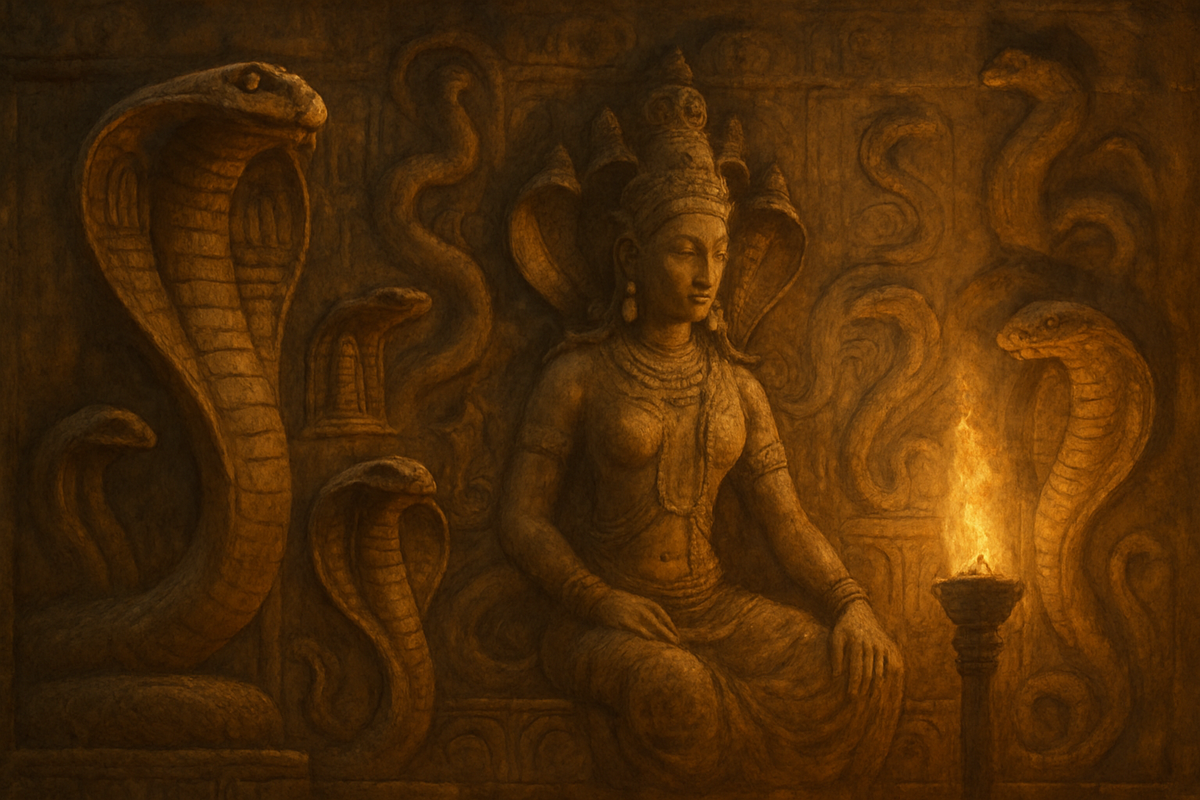
Long before dream dictionaries existed, psychologists were already trying to explain why snakes show up so often in sleep. Sigmund Freud, in The Interpretation of Dreams, read the snake almost exclusively through a sexual lens, treating its shape as a stand-in for repressed desire or anxiety. Carl Jung took a broader view, calling the snake an archetype of the unconscious itself — a symbol capable of representing healing, danger, wisdom, or the "shadow" self depending on the dreamer's own psychological terrain. Building on Calvin S. Hall's pioneering content-analysis method, some dream researchers have noted that animals, including snakes, appear as a recurring category in dream reports, though a specific ranking of snakes among the most universal dream images across cultures and eras is not clearly established in his published findings. That consistency is part of why the snake resists a single, tidy meaning: it's a symbol flexible enough to hold fear, sexuality, and transformation all at once.
This overlap between vivid, meaning-heavy imagery and ordinary neuroscience isn't unique to snake dreams. A related but separate phenomenon worth exploring is the spiritual meaning of déjà vu, another moment where the subconscious mind seems to be communicating something the waking mind hasn't caught up to yet.
To understand why snakes carry such heavy symbolic weight, it helps to look at how different civilizations have treated them for millennia — not as pests, but as messengers.
The cobra was sacred in Ancient Egypt, represented by the Uraeus — the rearing serpent worn on the crowns of pharaohs. It symbolized royal authority and the protective eye of the goddess Wadjet. A snake in this tradition wasn't feared; it was a guardian, and dreaming of one could be interpreted as a call for protection or a reminder of your own authority.
In Hindu cosmology, Nagas are semi-divine serpent beings associated with fertility, water, and the underworld, while Shiva himself is often depicted with a snake coiled around his neck, symbolizing mastery over ego and death. Dreaming of a snake in this framework can point toward spiritual discipline or the taming of a powerful, primal instinct rather than a threat to escape.
The Rod of Asclepius, a staff entwined by a single serpent, is the original and proper symbol of medicine; the two-snake, winged caduceus is a separate emblem of Hermes that only became linked to medicine through a widely noted historical mix-up between the two symbols. Snakes were linked to healing partly because they were observed shedding their skin and "renewing" themselves, and partly through their association with the oracle at Delphi, once guarded by the serpent Python. A snake in a dream, in this lens, can signal physical or emotional healing already underway.
The Book of Genesis casts the serpent as the tempter in the Garden of Eden, forever linking snakes in Western thought with deception, temptation, and the loss of innocence. Someone raised in this tradition may instinctively read a snake dream as a warning against dishonesty — either their own or someone else's — rather than a message of growth. See the FAQ below for a deeper look at biblical interpretations specifically.
Among several Indigenous nations of the Americas, the snake is tied to earth medicine, fertility, and transformation. The Hopi Snake Dance, for example, is performed as a prayer for rain and renewal, treating the snake not as a solitary omen but as part of a larger relationship between humans, land, and cyclical time.
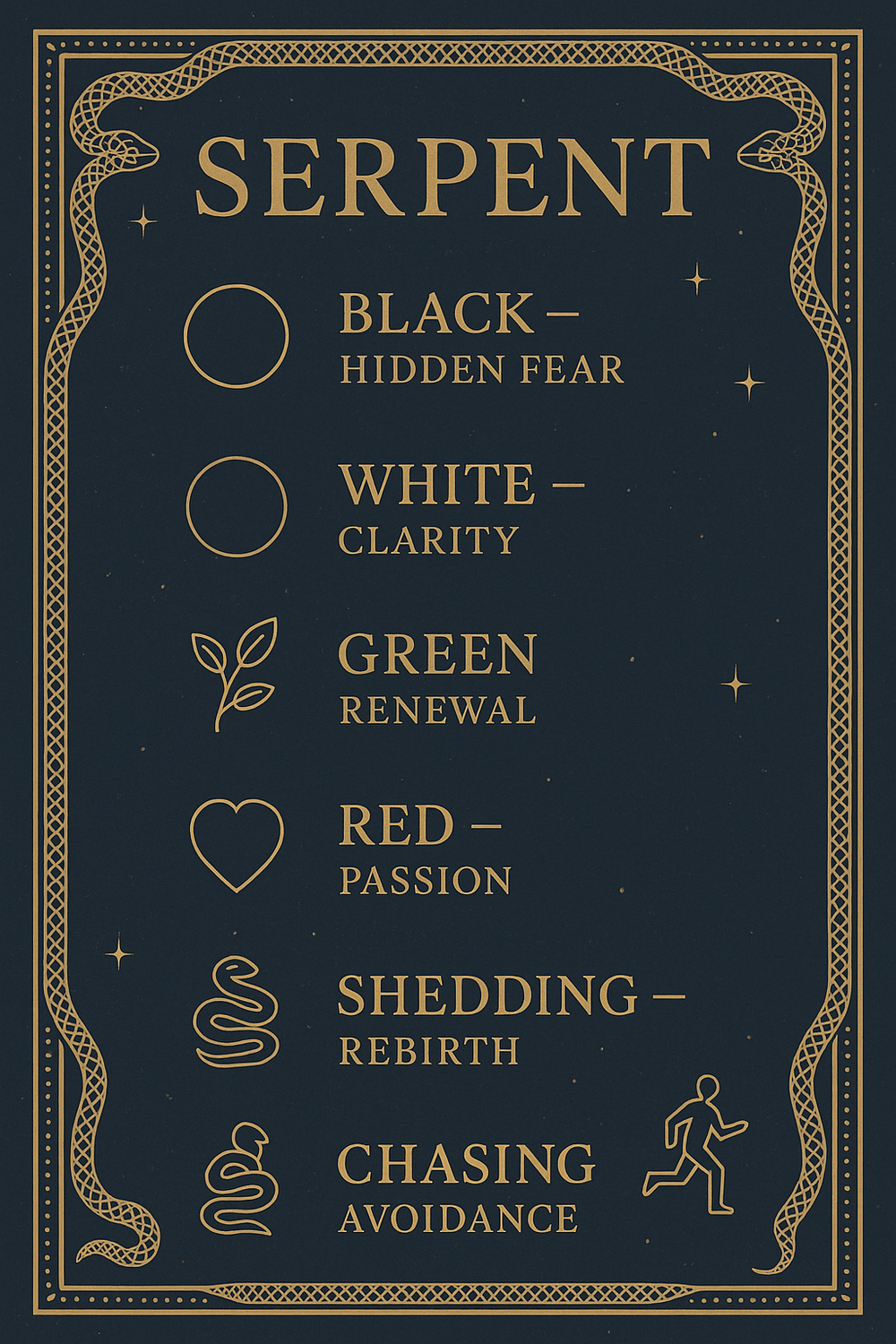
The specific details of your dream — the snake's color, its behavior, and your own reaction — change the message significantly. Use this table as a quick-reference guide.
| Snake Detail | Likely Symbolic Meaning |
|---|---|
| Black snake | Unconscious fears, the unknown, or a hidden aspect of the self demanding attention |
| White snake | Spiritual clarity, purity of intention, or a message from a spirit guide |
| Green snake | Growth, healing, money, or renewal tied to health |
| Red or orange snake | Passion, anger, or intense sexual or creative energy demanding release |
| Snake biting you | A painful truth, sudden realization, or a situation that finally forces you to change |
| Snake chasing you | Avoiding a problem or emotion that is catching up with you regardless |
| Snake shedding skin | Personal transformation, release of an old identity or relationship |
| Dead snake | A resolved fear, an ended conflict, or a threat that has finally lost its power over you |
| Multiple snakes | Overwhelm, chaos, or several unresolved issues surfacing at once |
| Snake in the water | Emotional undercurrents, intuition, or something surfacing from the subconscious |
| Snake wrapped around you | Feeling controlled, or alternatively, being embraced by a powerful transformative force |

Snake dreams often surface during periods of intense emotional bonding or upheaval — including the kind of intense, mirror-like connection sometimes described as a twin flame relationship. A snake shedding its skin near a romantic partner can suggest the relationship itself is transforming, while a snake biting a loved one may point to buried resentment or a truth waiting to be spoken. Because dreams speak in symbols rather than plain language, it's worth pairing the snake's behavior with whatever emotional chapter you're currently living through.
A vivid snake dream deserves reflection rather than panic. Here's a practical approach for working with the message instead of just reacting to the fear.
No — and this is the most common misconception. While the fight-or-flight instinct triggered by dream-snakes makes them feel ominous, most spiritual frameworks treat the snake as a neutral messenger rather than a villain. The same way a dream catcher is meant to filter meaning from chaos rather than block it entirely, a snake dream is best understood as raw symbolic material — its ultimate meaning is shaped by your own life context, not a fixed, universal doom sign.
Snake dreams are just one piece of a much larger symbolic language your subconscious speaks in every night. If this interpretation resonated, you may also want to explore what it means when you dream about flying, a dream often linked to freedom and control, or the surprisingly common dream of teeth falling out, which tends to surface anxiety about appearance, aging, or loss of control.
Being chased by a snake in a dream usually reflects an issue, emotion, or truth you've been avoiding in waking life. The dream suggests that whatever you're running from is catching up with you and can no longer be ignored.
No — snake dreams are more often about transformation, healing, or hidden emotions than they are literal bad omens. The tone of the dream, fear versus curiosity, threat versus calm, is a far more reliable clue than the snake's mere presence.
A black snake often represents something hidden in your unconscious mind — a fear, secret, or unresolved emotion you haven't fully acknowledged. It's less about literal darkness and more about the parts of yourself operating outside your awareness.
A snake bite in a dream frequently symbolizes a sudden realization, painful truth, or a wound that forces immediate change. It can also point to feeling "stung" by betrayal or criticism that you haven't fully processed while awake.
A white snake is generally read as a sign of spiritual clarity, purity of intention, or a message arriving from a spirit guide or higher self. A green snake, by contrast, tends to point toward growth, physical healing, or renewal, and is sometimes tied specifically to money or career shifts rather than emotional ones.
Recurring snake dreams usually mean the underlying issue the first dream pointed to hasn't been resolved yet, so your subconscious keeps returning to it. Rather than treating each dream as a new omen, track the snake's color and behavior over time — the pattern across dreams is often more revealing than any single one.
In biblical symbolism, rooted in the Genesis account of the serpent in the Garden of Eden, a snake in a dream is traditionally interpreted as a warning about temptation, deception, or sin, either your own or one directed at you. Many modern readers of scripture soften this to mean a call toward discernment: the dream is prompting you to look closely at a person or situation that may not be what it appears.
Explore 60+ female and male demon names from Lilith to Beelzebub, with their origins, meanings, and mythology explained in this co…

Discover what dreams about water really mean spiritually - from oceans to floods - and how to interpret their emotional and symbol…
Learn how to set powerful new moon intentions, why this lunar ritual works, and step-by-step practices to align your goals with th…