
Spiritual
New Moon Intentions: How to Set Them & Why
Learn how to set powerful new moon intentions, why this lunar ritual works, and step-by-step practices to align your goals with th…
 KnowMastery
Dreams about teeth falling out most often symbolize anxiety, a loss of control, or fear about your appearance, voice, or authority in some area of your life. Psychologically, they tend to surface during stress or major transitions; spiritually, they're read as symbols of release, transformation, or a call to speak your truth. The exact meaning shifts depending on how the teeth fall out — bleeding, painless, one at a time, or all at once — which is why the details matter more than the image alone.
Quick answer: Losing teeth in a dream almost never predicts real dental trouble. It typically reflects stress, a fear of losing control, or an emotional shift you're subconsciously processing — and the specific way it happens (bleeding versus painless, one tooth versus all) changes the nuance considerably.
You run your tongue along your teeth and one simply comes loose. Then another. Soon you're holding a fistful of enamel in your palm, heart pounding, mouth strangely numb, and you wake up gasping and instinctively checking your own mouth with your fingers.
It's one of the few dreams that almost everyone has had at least once, and almost everyone remembers vividly. There's something primal about it—teeth are one of the few hard, permanent parts of us. Losing them in a dream feels like losing a piece of your own solidity, your own certainty about who you are.
Across dream traditions, teeth are rarely just teeth. They represent your power to bite back, your ability to speak up, and the confidence you project to the world. Because teeth are visible when you smile, laugh, or talk, they're closely tied to self-image and how you believe others perceive you. When teeth fall out in a dream, the unconscious mind is often flagging a fear that this power, voice, or attractiveness is slipping away.
This is why the dream shows up so often during major life shifts: a new job where you feel unqualified, a breakup that shakes your confidence, aging milestones, or public speaking anxiety. The dream isn't warning you of physical decay—it's dramatizing an emotional one.

Spiritually minded dream readers, from modern intuitive dream workers to older esoteric traditions, tend to frame tooth-loss dreams in one of three ways:
Many practitioners connect this symbolism to the throat chakra, or Vishuddha, the energy center governing communication and authentic expression. If you want to understand how blocked energy in this area might be feeding these dreams, the 7 chakras guide is a useful next read, since chronic throat-chakra imbalance is often linked to recurring dreams about the mouth, teeth, and voice.
Christian dream interpretation sites and devotional writers have built an extensive folk tradition around teeth falling out, even though the Bible never addresses the image directly. The most common reading ties it to Psalm 3:7 ("For you have struck all my enemies on the cheek; you have broken the teeth of the wicked") and Job 4:10, both of which associate broken teeth with a loss of power, pride, or the ability to attack and defend oneself. In this framework, dreaming that your own teeth are breaking or falling out can be interpreted as a spiritual warning about pride, gossip, or a loss of "voice"—your testimony or influence weakening during a season of spiritual dryness.
Other devotional dream writers take a gentler, more encouraging view, framing the dream as a call to release fear and lean on faith rather than self-reliance, since teeth in this symbolic system often stand in for human strength as opposed to divine strength. A smaller strand of charismatic and Pentecostal dream teaching treats vivid, recurring tooth-loss dreams as potentially prophetic, warning the dreamer to guard their words, watch for gossip aimed at them, or prepare for a financial shift. Most mainstream Christian counselors, however, caution against reading too literally into any single dream, encouraging believers to weigh it against prayer, scripture, and their current emotional state rather than treating it as a fixed prediction.
The second-century Greek dream interpreter Artemidorus of Daldis, author of the Oneirocritica, one of the oldest surviving dream dictionaries, wrote extensively about teeth. In popular retellings of Artemidorus's dream lore, teeth are sometimes said to represent relatives — with upper teeth linked to wealthier family members and lower teeth to poorer ones, tooth loss foretelling the loss of that person or resource — though this specific scheme is not confirmed in standard reference accounts of the Oneirocritica and should be treated as a later popular attribution rather than an established textual detail. His system was detailed enough to assign meaning to which side of the mouth the tooth came from.
In Chinese folk dream interpretation, rooted in Confucian ideas of filial piety and family bonds, a dream of teeth falling out (掉牙) is traditionally tied to worry about the health or safety of one's parents or elders. Losing a front tooth was often read as concern for a close family member, while losing several teeth at once was seen as a warning to pay closer attention to household matters or unresolved family tension.
In one well-known Talmudic story (Berakhot 55b-56a), a sage recounts dreaming that his front and back teeth fell out, and the dream interpreter bar Haddaya reads this as an unfavorable omen (the death of his children) rather than a good sign, so any claim that the Talmud treats total tooth loss as auspicious should be understood as a popular reinterpretation rather than the text's own meaning. The Talmudic passage itself does not draw a distinction between partial and complete tooth loss; it records only one tooth-related dream image, which the interpreter reads unfavorably, so any modern good/bad split between full and partial tooth loss is a later popular gloss rather than something stated in the source. This nuance shows how, even within a single tradition, context changes everything.
Ibn Sirin, a scholar who lived from the mid-7th to early 8th century, is traditionally credited as the source behind popular dream manuals like Tafsir al-Ahlam — though scholars note the surviving text was compiled centuries after his death — and in this tradition tooth dreams are commonly said to relate to family, longevity, and provision. In his framework, a loosened or fallen tooth without pain could signal relief from a burden, while teeth falling out accompanied by pain or blood was more often tied to worry over a relative's wellbeing or a loss of income. Like the Talmudic reading, Ibn Sirin's system treated the emotional texture of the dream—not just the tooth loss itself—as the real key to interpretation.
Tooth-loss dreams consistently rank among the most frequently reported "typical dreams" in sleep research. Dream researchers, including Tore Nielsen (who co-created the widely used Typical Dreams Questionnaire), have found that tooth-loss dreams are counted among the common, universal dream themes alongside falling, being chased, and flying, though Nielsen's own most cited findings focus specifically on being chased as the most prevalent of these themes. Calvin Hall and Robert Van de Castle's landmark dream content-analysis system, still cited by researchers today, likewise flags tooth imagery as a recurring anxiety marker rather than a rare or idiosyncratic symbol.
In some cultures, a longstanding folk belief also links these dreams to pregnancy, though there's no scientific evidence supporting the connection. It's more likely tied to genuine physical changes some pregnant people experience, including hormonal shifts and increased dental sensitivity during sleep. In short, if this dream unsettles you, you're in very good company—much like the strange, hard-to-explain sense of déjà vu, it's a near-universal experience that spiritual traditions have tried to make sense of for centuries.
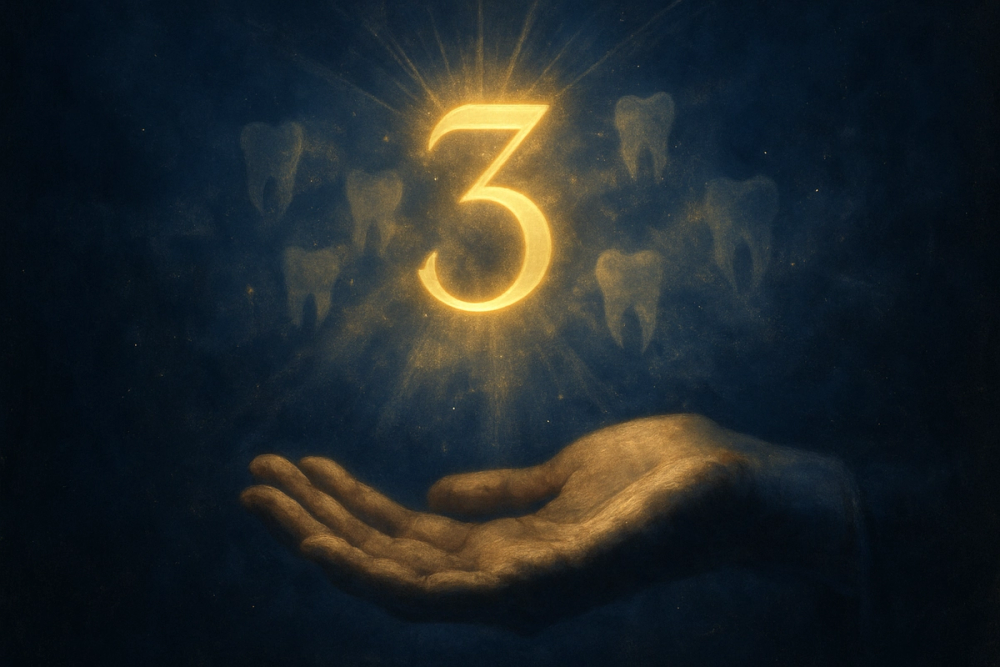
Some dreamers notice a specific number attached to the dream—exactly three teeth crumbling, or eleven falling out in a row—and wonder if that detail carries its own message. In numerology and angel-number traditions, the number itself is treated as a layer of meaning stacked on top of the dream's symbolism. Losing three teeth is often linked to mind-body-spirit alignment, suggesting the dream is nudging you toward balance across those three areas of your life. Losing exactly eleven, a master number associated with intuition and spiritual awakening, is sometimes read as a sign that the "loss" in the dream is actually clearing space for heightened awareness or a coming insight.
If numbers keep showing up in your dreams—not just in tooth-loss dreams but in recurring digits you notice throughout the day—it may be worth exploring how numerology assigns meaning to those patterns more broadly. Like tooth-loss dreams themselves, angel-number interpretation works best as a prompt for reflection rather than a literal forecast.
The specific way teeth fall out in a dream often carries the clearest clue to its meaning. Here's a quick reference, starting with the two most commonly searched variations:
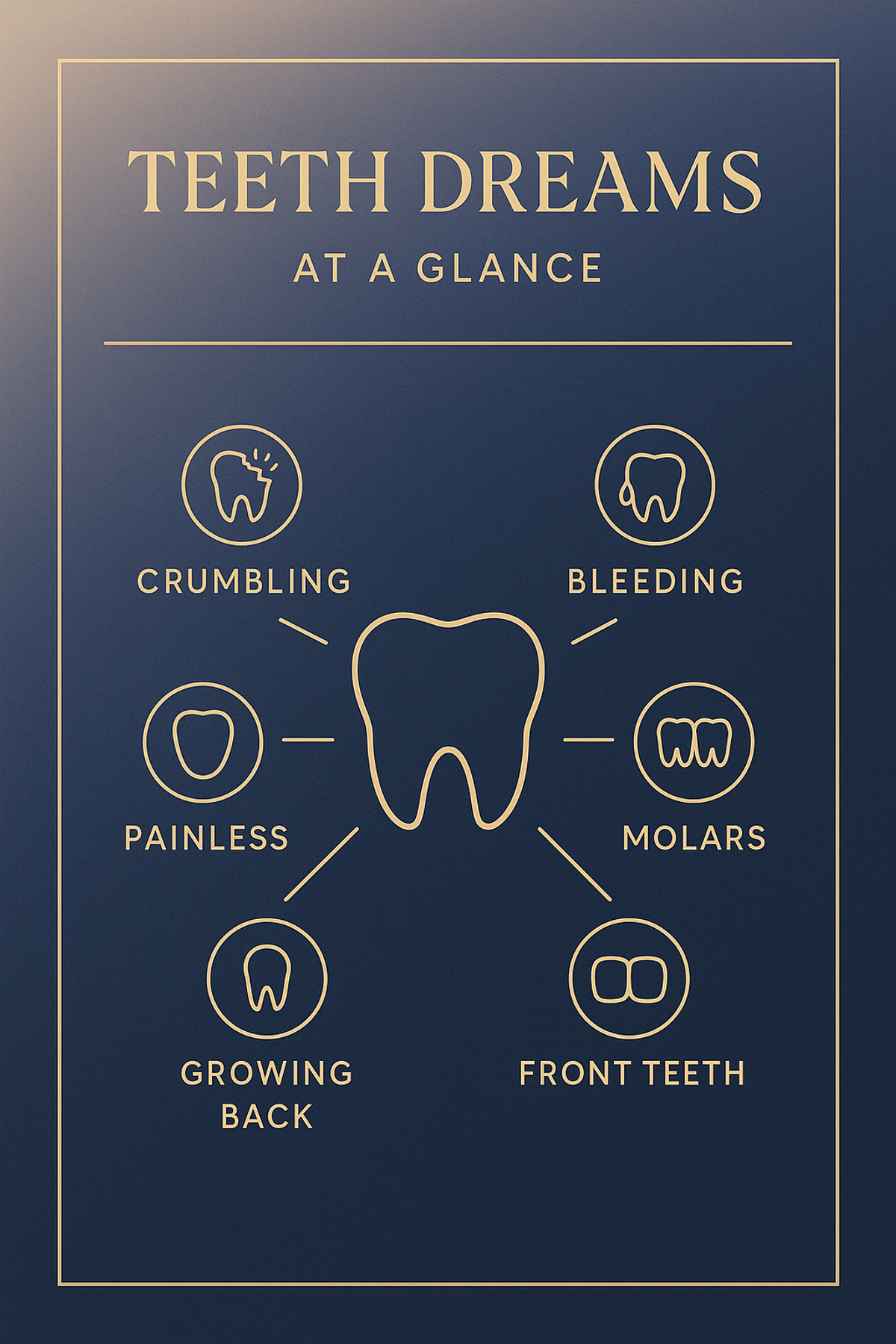
| Dream Detail | Likely Meaning |
|---|---|
| Teeth falling out with blood | Fear of financial loss, health scares, or a painful transition |
| Teeth falling out painlessly | Releasing outdated beliefs, habits, or identities |
| Teeth crumbling to dust | Deep anxiety or feeling powerless in a current situation |
| Pulling out your own teeth | A need for control, or self-sabotage around a decision |
| Someone else's teeth falling out | Concern for that person's wellbeing or your relationship with them |
| Rotten or decayed teeth | Guilt, neglect of self-care, or avoided responsibilities |
| Losing front teeth | Fear about public image or how others perceive you |
| Losing back molars | Hidden, private worries you haven't voiced to anyone |
| Teeth falling out then growing back | Renewal after a hard period; anxiety giving way to resolution |
Sigmund Freud famously (and controversially) linked tooth-loss dreams to repressed anxieties, sometimes sexual in nature, though modern sleep researchers take a more grounded view. Contemporary studies on anxiety dreams show that tooth-loss imagery correlates strongly with periods of high stress, upcoming major decisions, and even physical jaw tension like nighttime teeth grinding (bruxism), which can bleed directly into dream content. In other words, your brain may be dramatizing real, physical clenching as symbolic loss.
This dream sits in the same broad category as other universally recognized anxiety and transformation dreams, such as dreams about flying, which reflect freedom or escape, and dreams about snakes, which often symbolize hidden fears or transformation. Comparing the emotional tone of your teeth dream to these other common dream types can help you triangulate what your subconscious is actually processing.
Rather than treating the dream as an omen to fear, treat it as data. Here's a practical approach:
For those who track dream symbols regularly as part of a broader spiritual practice, comparing patterns across dreams—much like exploring the symbolism behind a dream catcher—can reveal a personal dream language unique to you over time.
In Christian folk dream interpretation, teeth falling out is often connected to Psalm 3:7 and Job 4:10, both of which link broken teeth to a loss of strength, pride, or the ability to "bite back." Many devotional readings treat it as a nudge to examine your words, your reliance on self versus faith, or a season of spiritual vulnerability rather than a literal prophecy.
Despite an old superstition connecting tooth-loss dreams to death, most dream researchers and spiritual traditions reject a literal link. It's far more consistently tied to symbolic loss—of control, identity, or confidence—than to mortality itself, though the Talmud does treat losing all your teeth as a sign that an old difficulty is ending.
This variation often points to feeling dependent on someone else—a partner, mentor, or authority figure—to restore your confidence or "fix" a situation you feel powerless over. It can also reflect genuine gratitude for support you're currently receiving during a stressful chapter of life.
Not according to most modern interpreters, though older folk superstitions in several cultures did treat it as an omen. Today it's more widely understood as a stress-processing dream, with the emotional tone of the dream—panic versus relief—mattering far more than any predicted outcome.
Learn how to set powerful new moon intentions, why this lunar ritual works, and step-by-step practices to align your goals with th…

The spiritual meaning of the deer is one that transcends borders in myths and teachings worldwide. Every culture adds its unique f…
Discover the spiritual meaning behind deja vu, what ancient cultures believed about it, and what it might be telling you about you…