
Animal Symbolism
Otter Symbolism: Spiritual Meaning & Significance
Discover what otters symbolize spiritually—joy, playfulness, feminine energy, and community—across cultures, dreams, and totem ani…
 KnowMastery
Raven symbolism centers on transformation, prophecy, and the threshold between life and death. Across Norse mythology, Native American creation stories, and Judeo-Christian scripture, the raven is treated as a liminal messenger - a bird that moves between worlds, carries hidden knowledge, and marks the ending of one chapter so another can begin. The raven spiritual meaning behind a sighting is generally read as an omen urging you to trust your intuition, prepare for a revelation, or release something whose time has passed. Its exact meaning shifts with number, location, and behavior.
There is something unforgettable about the moment a raven locks eyes with you. The croak, low and guttural, seems to come from somewhere older than language. Its black feathers absorb the light instead of reflecting it, and for a heartbeat you feel watched by something far more aware than an ordinary bird has any right to be.
That feeling is not superstition without substance. For thousands of years, across continents that never shared a single word or trade route, people independently arrived at the same conclusion: the raven is not just a bird. It is a threshold creature, standing at the border between worlds - between the living and the dead, the seen and the unseen, chaos and creation.
At its core, raven symbolism centers on three intertwined ideas: transformation, prophecy, and the shadow self. Ravens are scavengers by nature, present at death, which is why nearly every culture that encountered them linked the bird to endings that make room for new beginnings. But ravens are also famously intelligent - they solve puzzles, remember human faces for years, and even appear to plan for the future - which is why they became symbols of hidden wisdom rather than mere doom.
In modern spiritual practice, a raven sighting is often read as a raven omen nudging you to pay attention to your intuition, to release something that has run its course, or to prepare for a revelation that has been forming beneath the surface of your life.
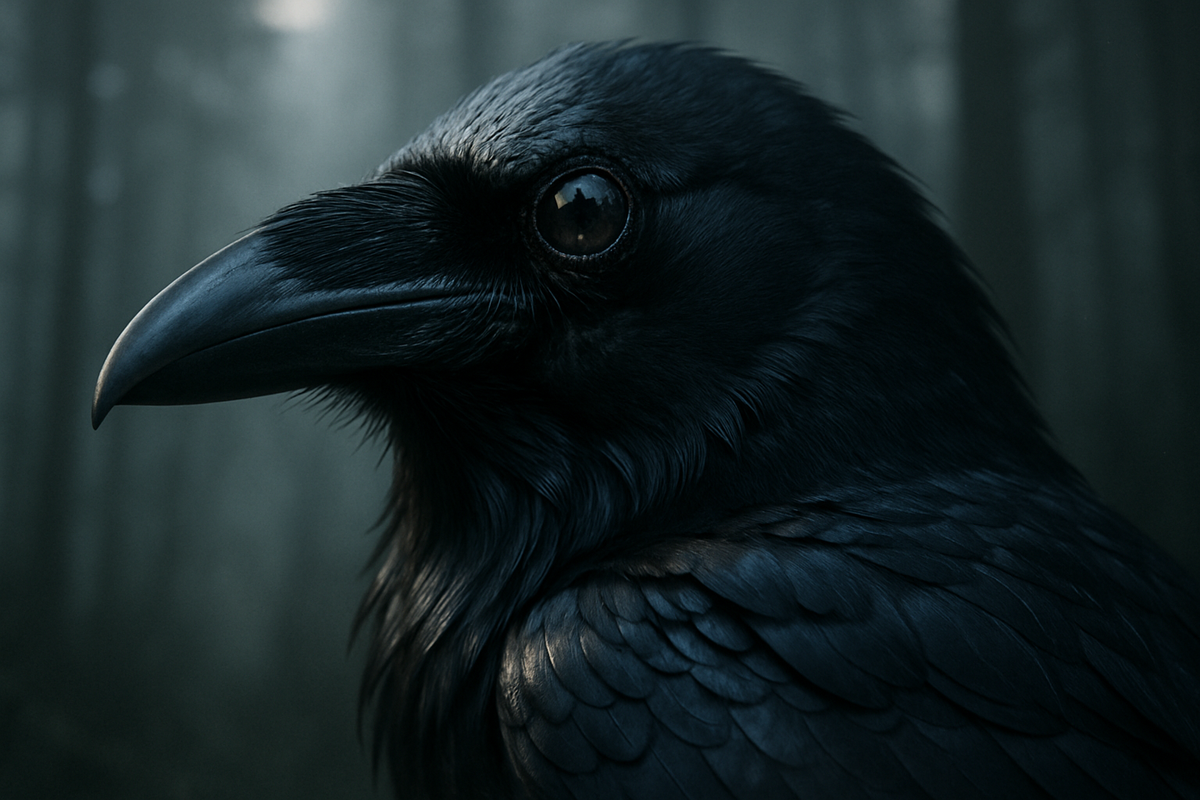
Raven symbolism did not develop in a vacuum. It was shaped, retold, and reinforced by specific myths, deities, and belief systems that still influence how we interpret the bird today.
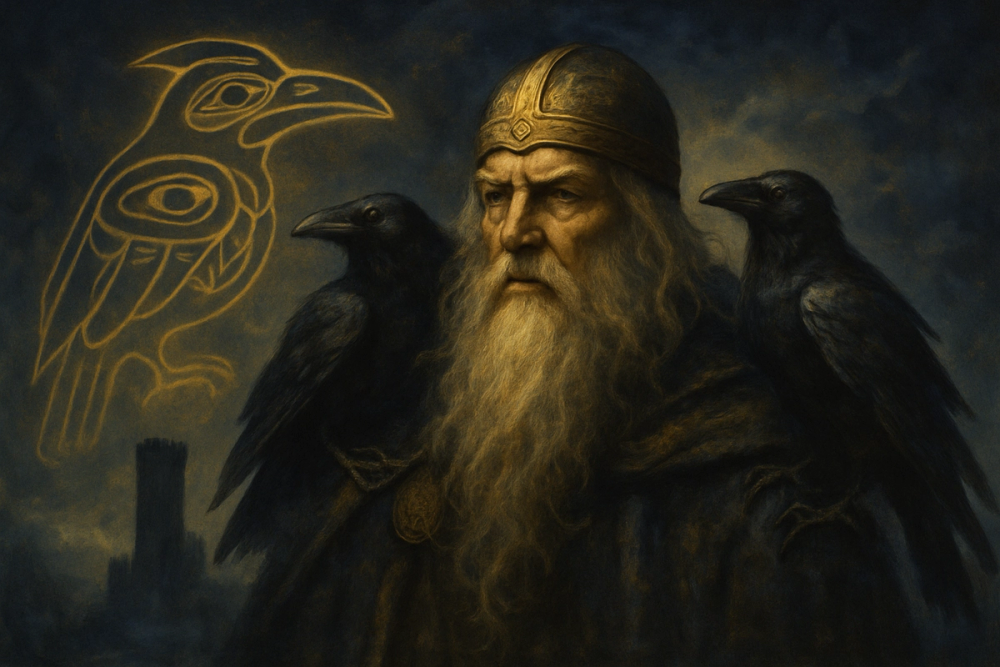
In Norse tradition, the god Odin kept two ravens, Huginn ("thought") and Muninn ("memory"), who flew across the nine realms each dawn and returned each evening to whisper everything they had seen into his ears. Odin was even called Hrafnaguð, the "raven god." This myth cemented the raven's role as a messenger of hidden knowledge and cosmic awareness - a symbol of a mind that sees beyond the immediate horizon.
Among the Haida, Tlingit, and other Pacific Northwest peoples, Raven is a central culture-hero: a trickster who is also credited with stealing sunlight and stars from a hoarding chief to give light to the world, and in some stories with helping shape the very landscape. Raven in these traditions is clever, mischievous, and morally ambiguous - neither wholly good nor bad, but essential to the balance of creation, and widely regarded as one of the most important totem animals in the region.
The Celtic goddess Morrígan, associated with war and fate, was frequently depicted transforming into or accompanied by ravens on the battlefield, feeding the belief that the birds could foresee - or even influence - who would die in combat. Today the Tower of London keeps at least six ravens on its grounds in keeping with a popular legend that the kingdom will fall if they ever leave, though historians note that this now-famous tradition likely dates only to the Victorian era rather than centuries earlier as often assumed.
In Genesis 8:6-7, Noah releases a raven from the ark to search for dry land, but unlike the dove that later returns with an olive branch, the raven never comes back - an early symbol of restless searching rather than resolution. Later, in 1 Kings 17, ravens feed the prophet Elijah while he hides from King Ahab, casting the bird as an unlikely instrument of divine providence despite being labeled ritually unclean under Levitical law. That tension - unclean yet chosen - reinforced the raven's paradoxical reputation throughout Western religious thought.
These omen associations sit alongside those of other dark-feathered birds. If you want to compare how a close relative is interpreted, the symbolism of crows shares many overlapping themes but carries subtler, more social connotations, while nocturnal birds like the owl lean further into mystery - explored in depth in this guide to owl symbolism and totem meaning.
| Feature | Raven | Crow |
|---|---|---|
| Size | Larger, with a heavier beak | Smaller, sleeker build |
| Sound | Deep, low croak | Sharper, higher-pitched caw |
| Social behavior | Often solitary or in pairs | Highly social, large flocks |
| Primary symbolism | Prophecy, transformation, the unknown | Community, adaptability, communication |
| Famous myth | Odin's Huginn and Muninn | Trickster tales across Aesop and folklore |
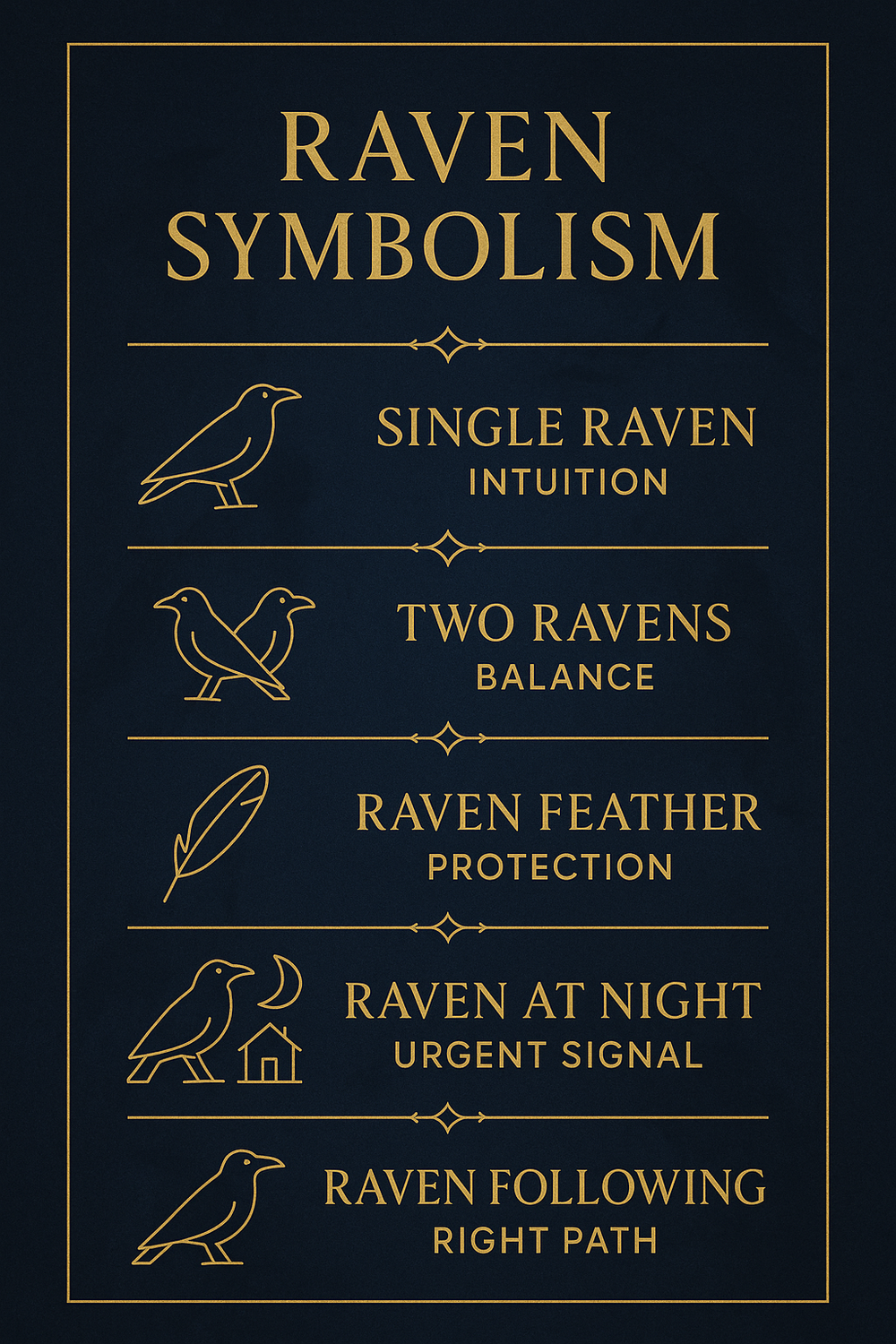
The seeing-a-raven meaning changes considerably depending on the context of the encounter. Consider these common scenarios:
Dream interpretation traditions, from folk dream dictionaries to modern Jungian analysis, generally treat the raven as a shadow figure - a symbol of the parts of yourself or your circumstances that remain hidden from conscious awareness.
People who resonate with the raven as a totem animal are often drawn to complexity: they are comfortable holding paradox, curious about what lies beneath the surface of things, and unafraid of transformation even when it involves loss. Like the raven itself, they tend to move fluidly between the practical and the mystical, able to solve problems with sharp intelligence while remaining tuned to intuitive signals others miss.
This duality is shared by other creatures associated with sharp perception and liminal awareness. Those who feel a pull toward the raven often also feel connected to birds of prey - see how that instinct is discussed in this piece on what it means when a hawk appears - or to creatures associated with weaving fate and patience, like the themes explored in spider spirituality and creativity.
Rather than treating a raven sighting as something to fear, spiritual traditions generally encourage a more active response:
If you regularly encounter symbolic birds and are trying to build a broader sense of what nature is communicating to you, it can help to compare interpretations across species - the graceful, transformative energy discussed in swan symbolism and spiritual power offers an interesting contrast to the raven's darker, more mysterious tone.
A raven visiting you is commonly interpreted as a sign that important insight or a necessary change is approaching. It often points to a message your intuition has already been trying to send you, and the raven's appearance is a nudge to finally listen.
Raven symbolism is not fixed as purely good or bad - in Norse mythology it represents divine wisdom, while in some European folklore it was linked to omens before battle. Most modern spiritual interpretations treat the raven as neutral but powerful, signaling transformation rather than fortune in either direction.
A raven cawing directly at you is generally read as an intensified version of a standard sighting - the bird is trying to get your attention rather than simply passing through. Many practitioners interpret repeated or insistent cawing as a sign that a message about change, truth, or timing needs to be acknowledged now rather than later.
A raven flying directly overhead is often interpreted as a sign of perspective - a nudge to rise above a problem and view your situation more objectively. A raven crossing your path while driving is traditionally read as confirmation that you're on the right track, even if the route ahead still feels unclear or the destination isn't yet visible.
Finding a raven feather is widely treated as a gift of protection, often appearing when you're facing a difficult decision or transition and need reassurance that you're supported. Some traditions also read a found feather as a sign that a message from the spiritual or ancestral realm has already been delivered, even if you haven't consciously recognized it yet.
Ravens are generally associated with prophecy, mystery, and solitary wisdom, while crows lean more toward community, adaptability, and clever communication due to their highly social flock behavior. Physically, ravens are larger with deeper voices, which historically made them feel more ominous and otherworldly to observers.
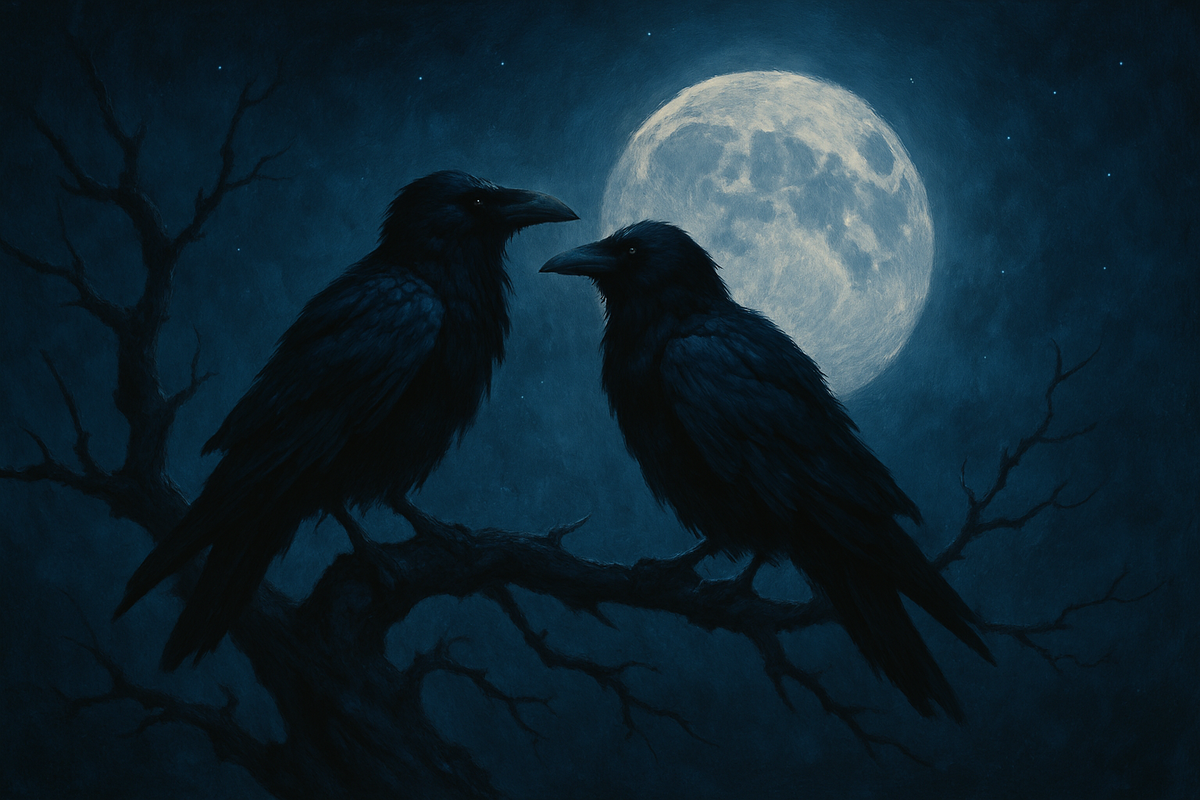
Two ravens together often echo the Norse myth of Huginn and Muninn - thought and memory - suggesting a moment where mind and intuition, or past and present, need to work together. Many spiritual practitioners see this pairing as a sign of balanced insight rather than an omen to fear.
Ravens appear in Genesis as the first bird Noah sends from the ark to check for dry land, and again in 1 Kings as the unlikely creatures God uses to feed the prophet Elijah in the wilderness. Despite being considered ritually unclean, their role as messengers and providers gave the raven a lasting, paradoxical place in Judeo-Christian symbolism.
Discover what otters symbolize spiritually—joy, playfulness, feminine energy, and community—across cultures, dreams, and totem ani…

Discover the spiritual meaning of bee symbolism - from divine feminine power to community, productivity, and messages from the uns…
Discover what the fox symbolizes spiritually—cunning, adaptability, and hidden wisdom—across cultures, dreams, and everyday encoun…