 Know
Know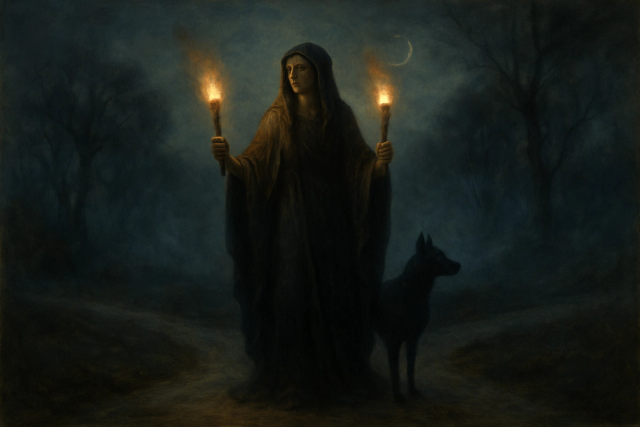
Greek Mythology
Hecate: Greek Goddess of Magic, Crossroads & the Moon
Discover Hecate, the Greek goddess of magic, crossroads, and the moon—her myths, symbols, dream meanings, and how to honor her tod…
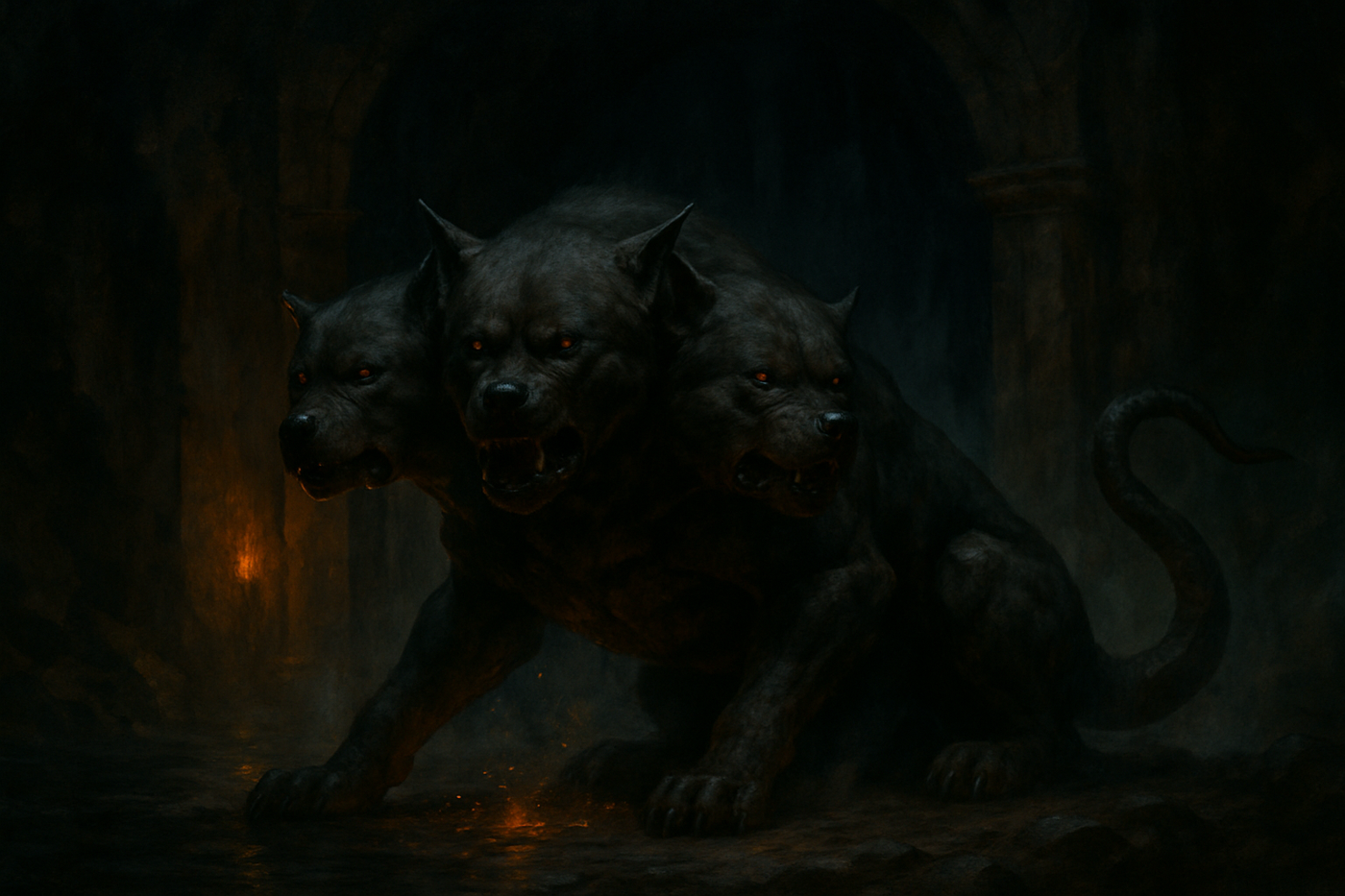
Cerberus is the monstrous three-headed dog of Greek mythology who guards the gates of the Underworld, preventing the dead from leaving and the living from entering uninvited. Born to the monstrous pair Typhon and Echidna, he serves Hades as the final threshold between the world of the living and the realm of the dead. Symbolically, Cerberus represents the boundary between life and death, the fear of mortality, and the price of transformation - a guardian who must be reckoned with, not merely defeated.
There is something primal about the image of a beast with three snarling heads crouched at the mouth of a cave that leads nowhere good. Ancient travelers imagined him in the dark, his serpent tail hissing, his eyes catching torchlight like coals. He is not evil exactly - he is duty itself, given teeth.
That is why Cerberus has outlived his myth. He shows up in tarot decks, dream journals, tattoos, and stories where someone must pass through fire to become who they are meant to be. To meet Cerberus, in legend or in symbol, is to meet the part of yourself that stands between you and the unknown.
Cerberus (from the Greek Kerberos, possibly meaning "spotted" or "demon of the pit") was the offspring of Typhon, the deadliest monster in Greek myth, and Echidna, the half-woman, half-serpent "Mother of Monsters." This makes him sibling to the Hydra, the Chimera, and the Nemean Lion - a family tree built entirely of nightmares. He was raised in the depths of the Underworld to serve Hades, god of the dead, as its eternal watchdog.
Ancient descriptions vary considerably. Hesiod's Theogony (c. 700 BCE) gave him fifty heads and a voice of bronze. By the time of the mythographer Apollodorus and the Roman poet Virgil, the standard image had settled into three heads, a mane or tail made of live snakes, and sometimes a lion's claws. Some early vase paintings show only two heads; others give him a serpent tail that strikes like a whip. What never changes across these sources is his singular job: nothing that dies is allowed to leave, and nothing living is allowed to enter without permission.
Cerberus was stationed at the entrance to the Underworld, near the river Styx, where souls arrived after crossing with the ferryman Charon. His role was strictly one-directional: he welcomed the dead with wagging tails (a detail Virgil includes with almost tender irony) and tore apart anyone foolish enough to try leaving. He answered to Hades alone, within the cosmic order established by Zeus, which placed each god over a separate domain of the world.
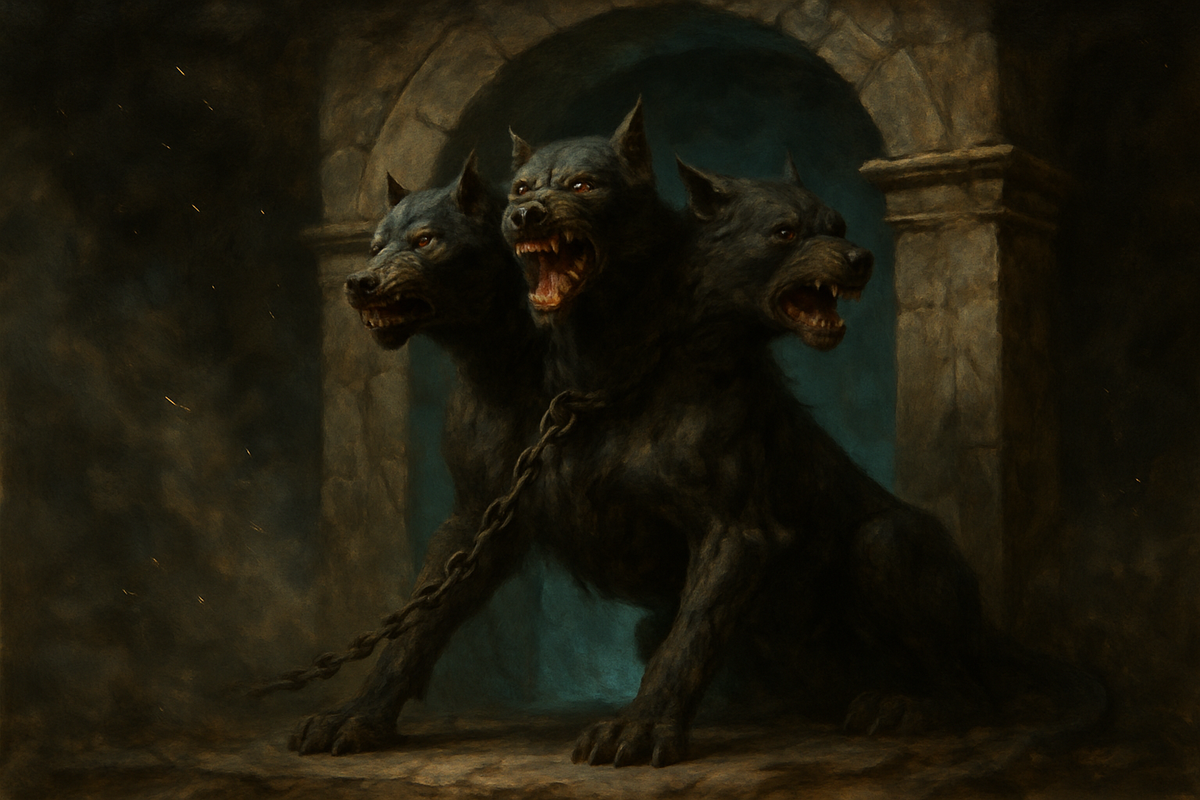
The most famous Cerberus story is his capture by Heracles, the twelfth and final labor imposed on him by King Eurystheus. It was meant to be impossible - a punishment disguised as a task. Heracles descended into the Underworld through a cave at Tainaron, guided by Hermes and by Athena, and asked Hades directly for permission to borrow the hound.
Hades agreed, on one condition: Heracles could take Cerberus only if he subdued him without weapons. Wearing his lion-skin cloak for protection against the snake-tail's bite, Heracles wrestled the beast into submission with his bare hands, dragged him to the surface, and presented him to a terrified Eurystheus, who reportedly hid inside a large storage jar at the sight. Heracles then returned Cerberus safely to his post, restoring the natural order between worlds.
Across centuries of retelling, Cerberus has come to represent several overlapping ideas rather than a single fixed meaning.
In modern spiritual and Jungian-influenced readings, Cerberus is often treated as an archetype of the "threshold guardian" - the inner resistance, fear, or self-doubt that appears right before a major transformation. Encountering a figurative Cerberus, in this sense, is not a sign of doom but a sign that something meaningful lies just beyond him. The honey-cake and lyre-song solutions in myth hint at a deeper truth: fear is rarely defeated by force alone; it is often soothed, understood, or sung to.
Dreaming of a three-headed dog, or of Cerberus by name, is commonly interpreted through a few recurring themes:
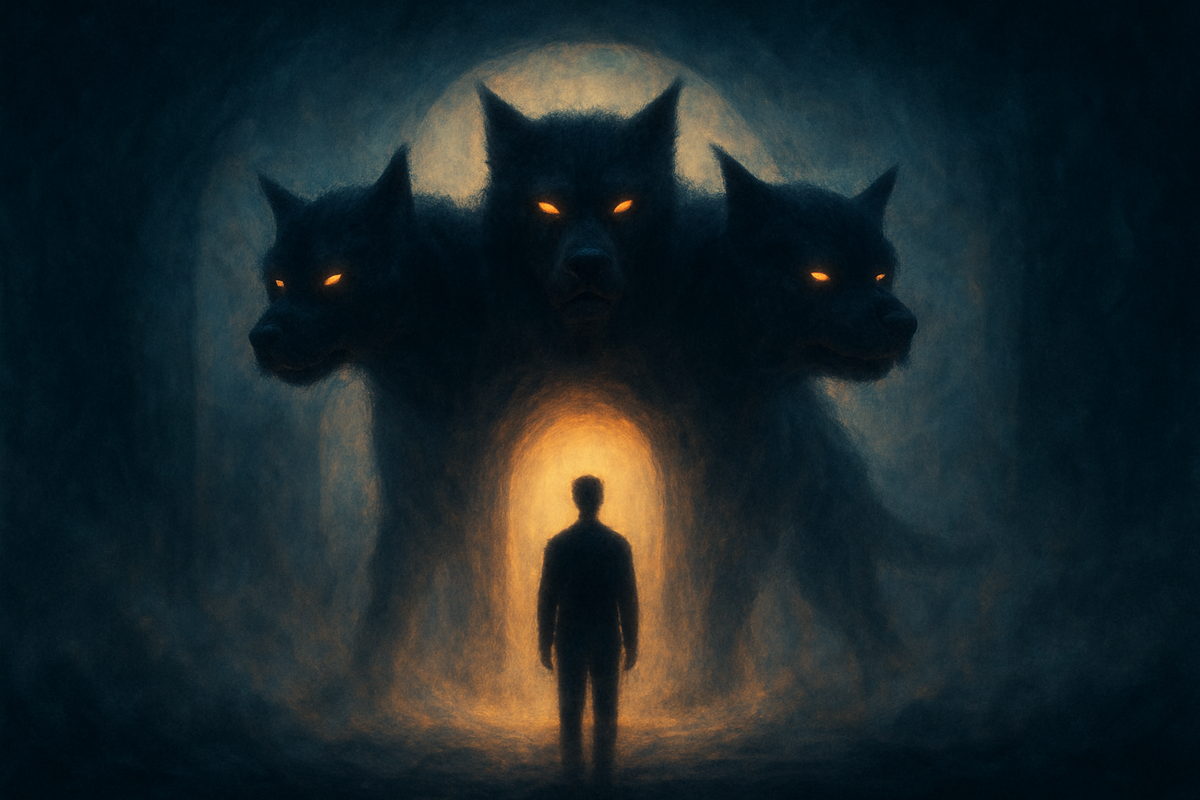
Cerberus is not the only mythic beast tasked with guarding a boundary between worlds. Comparing him to similar figures from other traditions highlights how universal this archetype really is.
| Guardian | Culture | Role | Notable Trait |
|---|---|---|---|
| Cerberus | Greek | Guards the gates of the Underworld | Three heads, serpent tail |
| Garmr | Norse | Guards the entrance to Hel | Blood-stained chest, howls before Ragnarok |
| Xolotl (as psychopomp dog) | Aztec | Guides souls through Mictlan, the underworld | Dog-headed god, a guide rather than a monster |
| Anubis (in guardianship role) | Egyptian | Oversees mummification and judgment of souls | Jackal-headed, weighs the heart against Ma'at |
| Sarameya | Hindu (Vedic) | One of Sarama's four-eyed dogs guarding the path of the dead | Messenger of Yama, god of death |
What unites these figures is not cruelty but responsibility: each stands at the edge of the unknown, and each demands a specific kind of respect - courage, cunning, or an offering - before allowing passage.
Cerberus has never really left popular imagination. He appears on ancient black-figure pottery from the 6th century BCE, in Dante's Inferno, in Renaissance paintings of Heracles' labors, and later as "Fluffy" in the Harry Potter series, a gentler nod to his gate-keeping role. Video games, tattoos, and heavy metal album covers frequently borrow his image as shorthand for danger, loyalty, and the underworld itself. This staying power is a testament to how effectively a single, vivid image - a three-headed dog - can carry centuries of meaning without needing explanation.
If you feel drawn to Cerberus symbolism - through dreams, tattoos, or a general fascination - it can help to treat him as a mirror rather than a monster. Consider these approaches:
Cerberus rarely appears alone in the broader tapestry of Greek myth - his story connects to the wider cast of Olympians who shaped the rules he enforced. To explore that larger world, see our guide to the Greek gods list.
Ancient sources are not fully consistent - Hesiod originally described up to fifty heads - but three became the standard number by the classical period. Symbolically, three heads are often read as representing past, present, and future, or birth, life, and death, watched over simultaneously by a single guardian.
Heracles is the only figure said to have physically subdued Cerberus, as his twelfth labor. He wrestled the hound bare-handed, protected by his lion-skin cloak, then returned him unharmed to the Underworld once the task was proven.
Cerberus is widely interpreted as a symbol of the threshold between life and death, unwavering guardianship, and the fears that must be faced before major transformation. In dream and archetype work, he often represents an internal obstacle that signals meaningful change is near.
No - Cerberus is not portrayed as malicious, only as fiercely loyal to his duty of guarding Hades' domain. He attacks only those trying to leave the Underworld improperly or enter without permission, making him a guardian rather than a villain.
Discover Hecate, the Greek goddess of magic, crossroads, and the moon—her myths, symbols, dream meanings, and how to honor her tod…
Discover Eros, the Greek god of love and desire—his myths, symbols, spiritual meaning, and how to invoke his passionate energy tod…
Discover Selene, the Greek Moon goddess — her myths, symbolism, Endymion legend, and spiritual meaning across ancient cultures.