 Know
Know
Greek Mythology
Helios: The Titan God of the Sun in Greek Myth
Discover Helios, the Greek Titan sun god who drove his blazing chariot across the sky—his myths, symbols, and spiritual meaning ex…
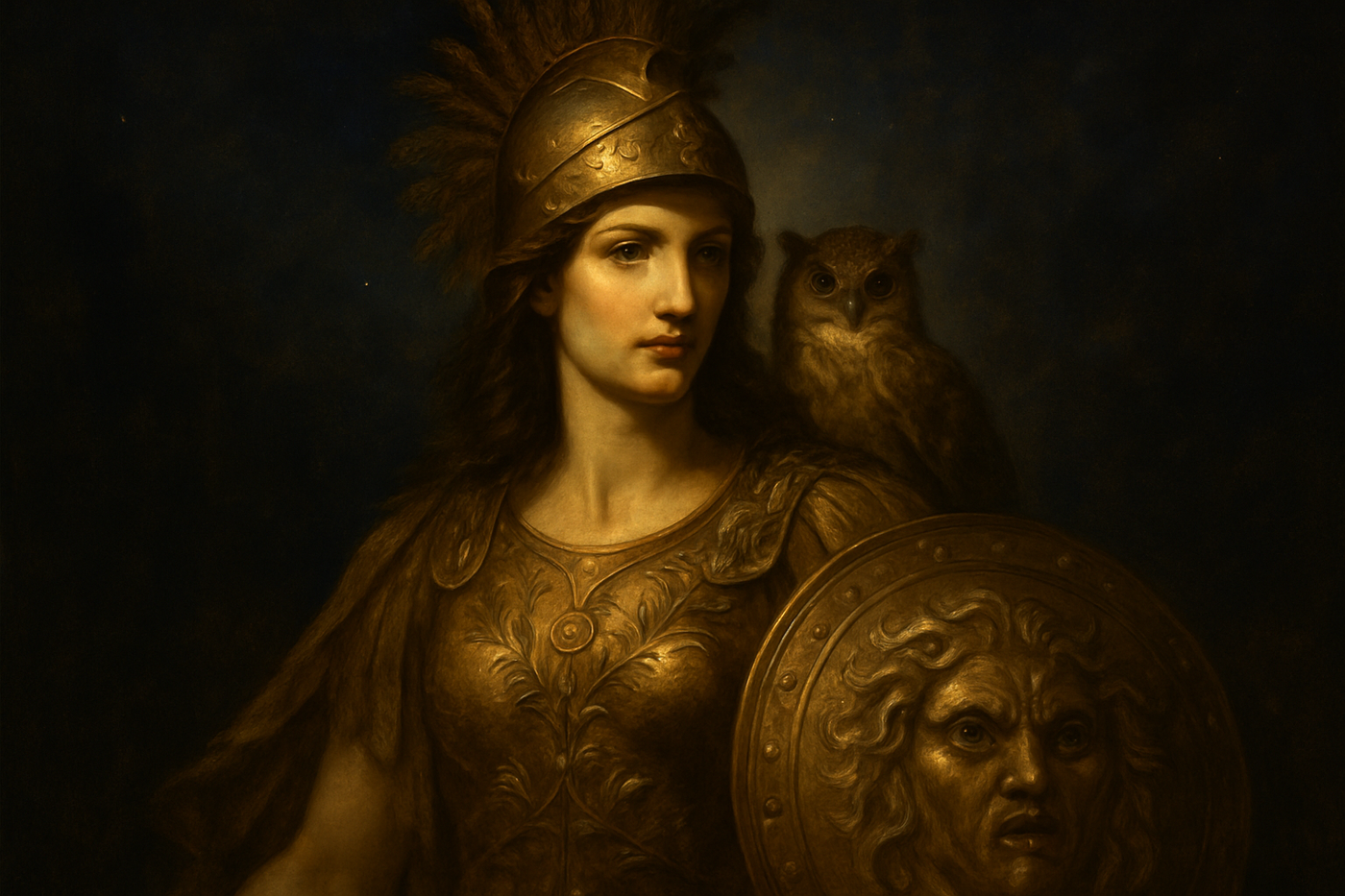
Athena is the Greek goddess of wisdom, strategic warfare, and crafts — daughter of Zeus, born fully grown and armored from his forehead. She embodies intelligence over brute force, serves as the patron protector of Athens, and is best recognized by her sacred owl, the olive tree, and her Aegis shield.
| Athena at a Glance | |
|---|---|
| Domain | Wisdom, strategic warfare, crafts and weaving |
| Roman Name | Minerva |
| Parents | Zeus (father), Metis (mother) |
| Sacred Animal | Owl |
| Key Symbols | Owl, olive tree, Aegis shield, spear |
| Sacred City | Athens |
Beyond her martial abilities, Athena is the patroness of craftspeople, particularly weavers, and is often depicted with her shield-bearing companion, the owl, a symbol of wisdom. As the protector of Athens, from which she gets her name, Athena’s influence is evident in the city’s cultural and intellectual heritage. With her iconic Aegis shield and unwavering gaze, Athena remains a timeless symbol of intelligence, strategy, and righteous warfare.
When it comes to the tales of the ancient Greek pantheon, few stories capture the imagination as vividly as the birth of Athena. Revered as the embodiment of wisdom, courage, and strategic warfare, Athena’s origin story is as unique as the attributes she represents.


Long before Athena’s birth, there was a prophecy that foretold the birth of a child more powerful than its father. This prophecy deeply troubled Zeus, the King of the Gods, as he had previously overthrown his own father, Cronus, to claim the throne of Mount Olympus. Fearing the possibility of being dethroned by his offspring, Zeus decided to take matters into his own hands when he learned that Metis, the goddess of crafty thought and wisdom, was expecting his child.
In a bold move, Zeus swallowed Metis whole, thinking it would prevent the prophecy from coming to fruition. However, this act only set the stage for one of the most dramatic births in mythology. As days turned into weeks, Zeus began to suffer from an unbearable headache. The pain grew so intense that he beseeched Hephaestus, the god of blacksmiths, to split his head open to relieve the pressure.
When Hephaestus struck Zeus’s forehead with an axe, something wondrous occurred. Instead of blood or brain, out sprung a fully grown, armored Athena, letting out a mighty war cry. Her emergence, fully formed and clad in armor, symbolized her readiness to defend wisdom and justice. The gods and goddesses of Olympus, along with the muses, celebrated her arrival with songs and dances, heralding the dawn of a new deity who would greatly influence both the mortal and immortal worlds.
Thus, from an act driven by fear, Athena emerged as a beacon of wisdom and strategy, embodying the very essence of thoughtful warfare and enlightened governance. Her unique birth story underscores the idea that wisdom can arise from the most unexpected places, even in the midst of conflict and turmoil.
Every deity in Greek mythology is often associated with specific symbols and attributes, which are emblematic representations that reveal their nature, powers, and the roles they play within the pantheon. Athena, as a multifaceted goddess, is linked with a range of symbols, each shedding light on a different aspect of her divinity.
Perhaps you’ve seen a statue of Athena with an owl perched on her arm or noticed the recurrent motif of the olive tree in ancient Greek art. Understanding the significance of these symbols can offer a deeper insight into Athena’s character and the reverence she commanded — and why so many people still invoke her imagery today when seeking clarity, courage, or focus.
| Key Symbols and Their Significance | |
|---|---|
| The Owl | Representing wisdom and knowledge, the owl is arguably the most recognizable symbol of Athena. It symbolizes her intellectual and intuitive abilities and her role as a protector in the dark, much like the owl’s nocturnal prowess. |
| Olive Tree | The olive tree, a symbol of peace and prosperity, stands testament to Athena’s victory over Poseidon for the patronage of Athens. Legend has it that while Poseidon gifted the city with a spring, Athena presented an olive tree, which was deemed a more valuable gift. |
| Aegis Shield | Often depicted in art as a protective cloak or shield, sometimes bearing the head of Gorgon, the Aegis embodies Athena’s warrior aspect. It symbolizes her protective nature, shielding the city and its inhabitants from harm. |
Together, these symbols encapsulate Athena’s essence, weaving together threads of wisdom, protection, strategy, and prosperity. They remind us of the multifaceted nature of divinity and the intricate ways in which the ancient Greeks perceived their gods.
Beyond mythology, Athena has become a modern spiritual archetype for clear-headed strength. Where many warrior deities represent raw force, Athena’s energy is one of discernment — the ability to act decisively without losing composure. For those drawn to her symbolism, she represents three core themes: wisdom applied with purpose, strategy over impulsiveness, and feminine strength that doesn’t require aggression to be effective.
Athena’s wisdom was never passive contemplation — it was wisdom used to solve real problems, win real conflicts, and protect real cities. Spiritually, invoking Athena is often about asking for clarity before action: the ability to see a situation objectively and choose the wisest path rather than the fastest or most emotional one.
People who resonate with Athena’s symbolism often use her as a mental touchstone during high-pressure decisions — job negotiations, conflicts, or major life choices — asking, essentially, "what would the strategist do?" instead of reacting on instinct.
As a virgin goddess who answered to no husband and commanded respect among male gods, Athena is frequently invoked as a symbol of independent feminine authority — strength that is measured by competence and judgment rather than force or approval.
Athena, though an integral member of the Olympic pantheon, boasts a lineage and set of associations that stand apart from many of the other gods and goddesses. The relationships and companionships of Athena not only give us a glimpse into her divine status but also elucidate the roles she played in various mythological tales.
| Athena’s Family and Attendants | |
|---|---|
| Father | Zeus, the King of the Gods, was Athena’s father. Their bond was unique since Athena sprang fully grown and armored from his forehead. |
| Mother | Metis, the Titaness of wisdom and craft. Though Zeus swallowed her to prevent a prophecy, she continued to reside inside him and aided in Athena’s birth. |
| Siblings | Being a daughter of Zeus, Athena had numerous half-siblings, including Apollo, Artemis, Ares, Hephaestus, and Hercules, to name a few. |
| Companions/Attendants | Nike, the goddess of victory, often accompanied Athena. Pallas, a childhood friend of Athena, was also closely associated with her, and Athena often used her name as a prefix (Pallas Athena). |
The intricate web of familial ties and associations surrounding Athena reveals much about her significance in Greek mythology. These connections, from her unusual birth to her loyal attendants, showcase the respect and authority she held amongst the divine realm.
When one envisions a deity of war, fierce battle scenes and raw physical power might come to mind. But Athena, as the goddess of both wisdom and warfare, offers a different perspective on combat. Unlike Ares, the god of war who represents the brutal and violent aspects of battle, Athena symbolizes strategy, planning, and the defensive side of warfare. Let’s delve deeper into her multifaceted role as a warrior and protector.
Athena’s involvement in wars wasn’t characterized by mindless violence or bloodlust. Instead, she championed the idea that brains often prevailed over brawn. This strategic mindset resonated with the Greeks, who often found themselves in conflicts where tactics and intellect could turn the tide of battle. A city under the protection of Athena wouldn’t just be defended by walls, but by the collective wisdom of its strategists and leaders.
Athena’s protective nature wasn’t limited to the battlefield. She was deeply revered as the guardian of cities, most notably Athens, which was named in her honor after she gifted the city its first olive tree. This gift was more than just a tree; it represented sustenance, peace, and prosperity. Her protective aura wasn’t just about warding off physical threats, but also ensuring that the city thrived culturally and economically.
The contrast between Athena and Ares, the god of war, was stark and often highlighted in myths. While Ares reveled in the chaotic nature of war, Athena represented the just cause and strategic elements of combat. Their differing philosophies often brought them to opposite sides, such as during the Trojan War, where Ares supported the Trojans, and Athena championed the Greeks.
In Athena, the ancient Greeks found a deity who encapsulated the ideal balance between might and intelligence. She reminds us that true strength doesn’t always lie in physical prowess, but often in wisdom, strategy, and foresight.

It’s no coincidence that the city of Athens bears the name of the goddess Athena. As the guardian deity of the city, her influence permeated every corner of Athenian life, from politics and culture to religion and architecture. But perhaps the most iconic testament to her legacy is the Parthenon, a magnificent temple that still stands as a beacon of ancient Greek civilization.
Situated atop the Acropolis, the Parthenon dominates the Athens skyline. This architectural masterpiece wasn’t just a place of worship, but a symbol of Athenian pride and their deep reverence for Athena. Inside the temple once stood a colossal statue of the goddess, made of gold and ivory, capturing her in all her majestic glory.
Legend has it that the naming of Athens was a result of a contest between Poseidon and Athena. While Poseidon offered the city a saltwater spring, Athena gifted an olive tree. In the founding myth itself, Athens is said to have been named for Athena as a direct result of her winning the contest with the olive tree, though this is the city's own legendary explanation of its name rather than an etymology accepted by modern linguists. Even today, olive trees are an integral part of the Greek landscape and culture.
| Landmark | Significance | Connection to Athena |
|---|---|---|
| Parthenon | Temple dedicated to the goddess, showcasing Athenian architectural prowess. | Housed a grand statue of Athena and served as a religious center for her worship. |
| Erechtheion | Another temple on the Acropolis, known for its unique architecture. | Believed to be the site where Athena and Poseidon competed for the city’s patronage. |
| Odeon of Herodes Atticus | An ancient theater used for music concerts and performances. | Though not directly linked to Athena, it represents the cultural flourishing of Athens under her protection. |
In summary, Athena’s presence is deeply etched into the fabric of Athens. Through landmarks, legends, and historical records, we see a city that not only worshipped her but thrived under her wise and protective gaze.
While Athena stands out for her wisdom and strategic prowess, her interactions with other greek gods, goddesses, and mortals have crafted tales of friendship, rivalry, and complex relationships. From aiding heroes to challenging other deities, Athena’s dynamic relationships offer a fascinating glimpse into her multi-faceted character.
It’s evident that Athena wasn’t a detached deity. She deeply involved herself in the lives of mortals and gods alike. Whether as a mentor, protector, or challenger, Athena’s relationships reflect her multidimensional nature—wise, compassionate, strategic, and occasionally, stern.
Athena’s role as a protector and mentor to several iconic heroes showcases her profound impact on their journeys. Renowned for her strategic wisdom, she played an instrumental role in shaping the legends of some of ancient Greece’s most celebrated figures.
Perseus, the hero who dared to face Medusa, benefited immensely from Athena’s support. Bestowing upon him a mirrored shield, she indirectly guided his hand, allowing him to slay Medusa without directly looking into her petrifying gaze.
One of Athena’s most prominent protegés, Odysseus, experienced her assistance throughout his tumultuous journey back to Ithaca. Whether navigating the challenges posed by mythical creatures or devising a strategic entry into his homeland, Athena’s wisdom was his guiding light.
Even Heracles, the epitome of strength, needed Athena’s strategic insights. During his Twelve Labors, particularly while facing the Nemean Lion and the Lernaean Hydra, Athena’s guidance was pivotal.
While Oedipus is often associated with tragic fate, it’s less known that Athena, in some accounts, took pity on him after his fall from grace, offering solace in his blind exile.
Through these narratives, it becomes evident that while heroes showcased valor and might, Athena’s wisdom was often the missing piece in their success. Her influence elevated their challenges from mere physical contests to tales of strategy, intellect, and enduring legacy.
Athena, being a significant deity in Greek mythology, is linked with various myths and legends. Two of the most striking tales include her interactions with Arachne and her connection with Medusa. These stories not only capture Athena’s divine prowess but also mirror the moral codes of the times.
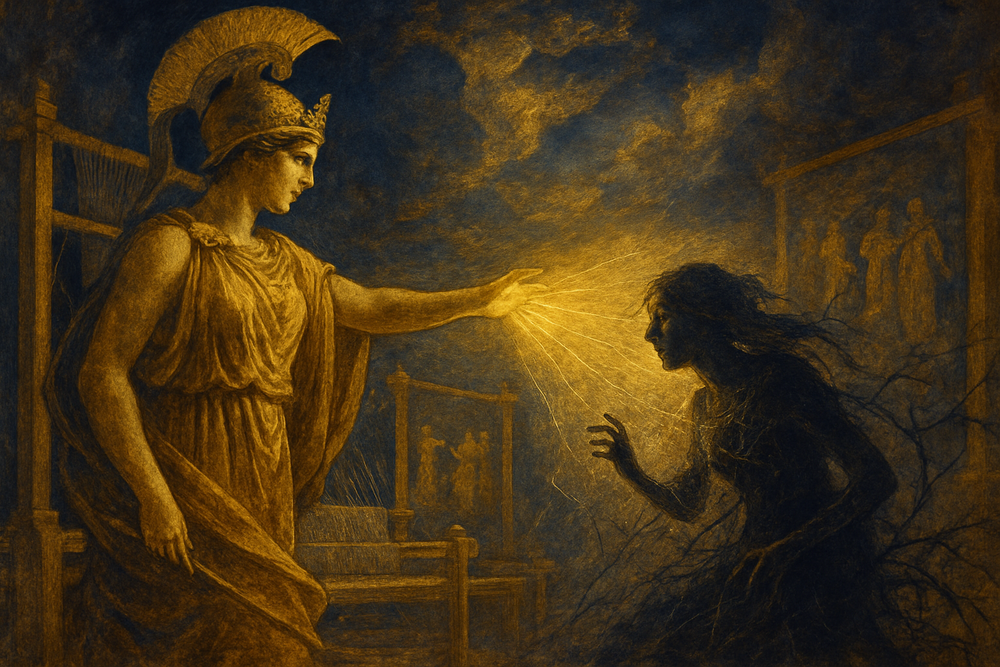
In ancient Lydia, there lived a young maiden named Arachne. She was an unparalleled weaver, and her tapestries were the talk of the town. However, her pride in her craft led her to boast that even Athena, the goddess of crafts, couldn’t match her skill. Word of this reached Athena, who decided to descend to the mortal realm and challenge Arachne to a weaving contest.
Medusa, once a stunning maiden, was a priestess in Athena’s temple. However, after an unfortunate incident with Poseidon in the sacred temple, Athena, in her fury, turned Medusa’s hair into serpents. From then on, anyone who looked directly into Medusa’s eyes turned to stone.
It’s a question that has puzzled scholars for generations. Some argue that Medusa’s punishment was a reflection of the societal norms of that era, where women bore the brunt of consequences, while others believe it displayed Athena’s impartiality to wrongdoing, irrespective of the perpetrator’s status.
Both these legends serve as a testament to Athena’s strong character and the intricate tapestry of relationships, challenges, and morals woven into the fabric of Greek mythology.
From the winding tales of ancient scrolls to the majestic artworks that adorn museum walls, Athena’s influence transcends the realm of mythology and firmly anchors itself within various facets of culture. The indelible mark she’s left over millennia showcases the lasting reverence and fascination civilizations have held for the Goddess of Wisdom.
Throughout literature, Athena stands as a beacon of wisdom, strategic warfare, and righteous indignation. She has played pivotal roles in epic tales like Homer’s Iliad and Odyssey. Often, she’s the guiding hand steering heroes towards their destiny, ensuring that wisdom and justice prevail against overwhelming odds.
Athena’s visage has been a favored subject in art for centuries. Classical sculptures such as the Athena Parthenos stood as a testament to her grandeur and divine stature. Frescoes, pottery, and mosaics from different eras depict her in various avatars, from a warrior goddess donning her Aegis shield to a serene entity bestowing wisdom upon mortals.
In today’s world, Athena’s legacy is robustly alive. Universities, legal institutions, and libraries, places of learning and justice, often adopt her symbol as a nod to her domain over wisdom. How often have you seen the emblem of an owl or a shield with the head of Gorgon on institutions representing knowledge and strategic defense? These are direct influences from Athena’s mythological attributes. Many modern military strategies still pull teachings from Athena-inspired tactics from ancient warfare, emphasizing the need for wisdom in conflict.
Over the course of history, the reverence for Athena has never waned, seamlessly transitioning from the oral tales sung by ancient bards to the digital discussions in modern chat rooms. Her essence, as a symbol of wisdom, strategic warfare, and righteousness, continues to inspire and guide even in today’s contemporary world.
While ancient civilizations once revered Athena for her wisdom and strategic prowess, modern audiences have found new ways to celebrate the iconic deity. Contemporary media and pop culture are rife with references to the Goddess of Wisdom, from big-screen adaptations to niche subcultures on the internet. Let’s explore the myriad ways Athena has been reimagined and revered in today’s bustling media landscape.
In the world of film and television, Athena’s character is often reshaped to fit various narratives. Be it a direct representation in mythological dramas or a nuanced character inspired by her attributes in modern thrillers, her essence remains unmistakable. Notable mentions include her depictions in movies like “Clash of the Titans” and series such as “Percy Jackson & the Olympians”.
Modern literature hasn’t shied away from celebrating Athena. Numerous authors have conjured worlds where Athena’s ideals are championed. Whether it’s young adult fiction, where protagonists embody her wisdom and strength, or scholarly works dissecting her ancient tales, the literary realm continues to be enriched by her presence.
The digital age has seen Athena transition into the world of video games. From strategy games where players build civilizations based on her teachings to action-packed titles where she stands as a guiding deity, Athena’s influence is unmistakable. Have you ever wielded Athena’s shield in “God of War” or sought her blessings in “Assassin’s Creed Odyssey”?
Pop culture’s reach extends to tunes and threads, with several artists and fashion designers drawing inspiration from Athena. Be it song lyrics echoing her tales or runway designs reminiscent of her classical Grecian attire, her touch is everywhere for those with a keen eye and ear.
In essence, Athena’s lore, once etched on temple walls and sung in Grecian amphitheaters, now thrives in pixels, prose, and pop culture rhythms. As long as creativity flourishes, so will the tales and tributes to the ever-inspiring Goddess of Wisdom.

The ancient world held Athena in high regard, building magnificent temples in her honor and establishing rituals to seek her blessings. From the towering Parthenon in Athens to lesser-known sanctuaries scattered across the Mediterranean, let’s journey through some of the most iconic places of worship dedicated to this wise and mighty deity.
| Temple/Sanctuary | Location | Historical Significance |
|---|---|---|
| The Parthenon | Athens, Greece | Undoubtedly the most famous temple dedicated to Athena, it stands atop the Acropolis and houses the majestic statue of Athena Parthenos, crafted by Phidias. |
| Temple of Athena Nike | Athens, Greece | An elegant structure near the entrance of the Acropolis, it celebrates Athena as the goddess of victory. |
| Temple of Athena Alea | Tegea, Peloponnese | Renowned for its unique architectural style and beautiful sculptures, this temple served as a sanctuary for those seeking refuge. |
| Temple of Athena Polias | Priene, Turkey | One of the best-preserved temples of its time, it showcases the classical Ionic order and has inscriptions detailing the temple’s construction. |
These temples weren’t merely architectural marvels; they were centers of spiritual and communal activity. Festivals like the Panathenaia in Athens were grand events, complete with processions, sacrifices, and contests, all in reverence to Athena. Pilgrims from distant lands would visit these sanctuaries, seeking wisdom, protection, or simply to pay homage to the goddess who had left an indelible mark on ancient civilization.
While many of these temples now lie in ruins, they remain testaments to the profound respect and admiration that ancient societies held for Athena. Their grandeur and intricate details continue to inspire modern architects, historians, and anyone with a penchant for the tales of old.
While Athena’s prominence shines in Greek mythology, various cultures around the globe possess deities that share striking similarities with the wise and war-ready goddess. Exploring these parallels not only broadens our understanding of Athena but also showcases the universal themes that various civilizations revered. Let’s delve into a few cultures and discover their counterparts of the Greek goddess of wisdom.
The Romans, heavily influenced by Greek culture, adopted many Greek deities into their own pantheon, often with a name change. For Athena, her Roman equivalent is Minerva. Like Athena, Minerva was celebrated as the goddess of wisdom, arts, and strategic warfare. The Romans, however, emphasized her association with craftsmen and artisans.
In the rich tapestry of Hindu mythology, Saraswati stands as the goddess of knowledge, music, arts, and wisdom. While she doesn’t bear the warrior aspect of Athena, the reverence for intellect and the arts draws a poignant parallel between the two deities. Saraswati is often depicted with a book and a musical instrument, emphasizing the importance of learning and creativity.
One of the earliest deities in the Egyptian pantheon, Neith, was a war goddess and a mother figure, often associated with weaving. Some tales suggest she was a creator goddess who wove the world into existence. Her multifaceted nature as a warrior, creator, and mother draws her close to Athena’s attributes in certain respects.
The Celts revered Brigid as a goddess of wisdom, healing, and craftsmanship. Particularly associated with poetry and inspiration, Brigid’s spheres of influence align closely with those of Athena, especially when considering the arts and intellect.
To witness such recurring themes of wisdom, warfare, and craftsmanship across varied mythologies is a testament to the universal values and ideals that ancient civilizations held dear. Whether it’s Athena in Greece, Minerva in Rome, or Saraswati in India, the embodiment of intellect and skill remains a constant, revered aspect in tales that have transcended time and borders.
Discover the realms governed by Greek gods and goddesses through our brief guide. Unveil their stories by exploring the links below.
Athena sprang fully grown and armored from the forehead of her father Zeus, deeming her the embodiment of his intellect and wisdom. Throughout various myths, her wisdom manifests as a mentor, strategist, and even peacemaker, making her the epitome of divine knowledge and prudence in the Greek pantheon.
Athena symbolizes wisdom applied through action, strategic thinking, courage, and independent feminine strength. She represents the idea that intellect and careful planning ultimately triumph over brute force, making her a popular symbol for clarity, discernment, and calm confidence under pressure.
Athena is most commonly associated with the color gray or silver-gray, echoing her epithet "gray-eyed Athena," as well as olive green, tied to her sacred tree. Some traditions link her to the number seven, representing wisdom, balance, and completion.
Beyond the owl, Athena is closely tied to the olive tree and its blossom, symbolizing peace and prosperity. The snake also appears in some depictions of Athena, representing protective wisdom, while the rooster occasionally symbolizes her vigilance and readiness for battle.
Many people who work with archetypal or goddess energy find Athena approachable because her domain is intellect and strategy rather than volatile emotion. She is often invoked for clarity before decisions, courage in conflict, and confidence in one's own competence, making her a grounding rather than overwhelming presence.
She was born fully grown from Zeus’s forehead after he swallowed her pregnant mother, Metis, and was considered a virgin goddess sometimes called "Pallas Athena." She is the patron deity of Athens, her sacred animal is the owl, and she famously assisted heroes like Perseus, Odysseus, and Hercules.
No — in Roman mythology, the counterpart to Athena is Minerva. While they share many attributes and are both associated with wisdom, Minerva is the Roman adaptation of the Greek Athena rather than a separate original deity.
According to one popular version of the myth, Medusa was a beautiful priestess in Athena’s temple who was assaulted by Poseidon within its walls. Athena transformed Medusa into a Gorgon as punishment, giving her snake hair and a petrifying gaze — a tale that intertwines themes of beauty, rage, and retribution.
Discover Helios, the Greek Titan sun god who drove his blazing chariot across the sky—his myths, symbols, and spiritual meaning ex…

Discover Gaia, the primordial Greek goddess of Earth—her origins, myths, symbolism, dream meaning, and how to honor her energy tod…
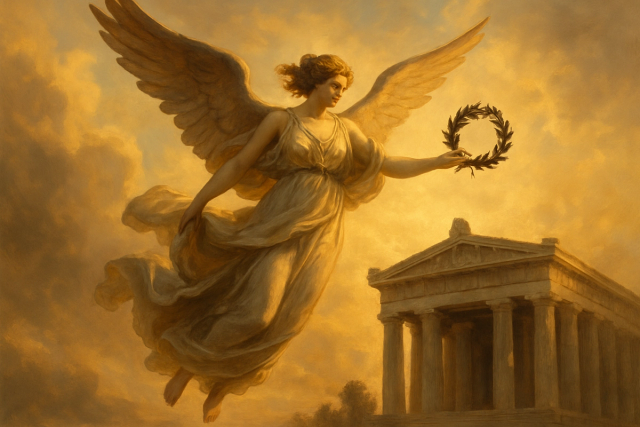
Discover Nike, the Greek goddess of victory — her myths, symbols, Roman parallel Victoria, and what she means in dreams and daily …