 Know
Know
Greek Mythology
Helios: The Titan God of the Sun in Greek Myth
Discover Helios, the Greek Titan sun god who drove his blazing chariot across the sky—his myths, symbols, and spiritual meaning ex…
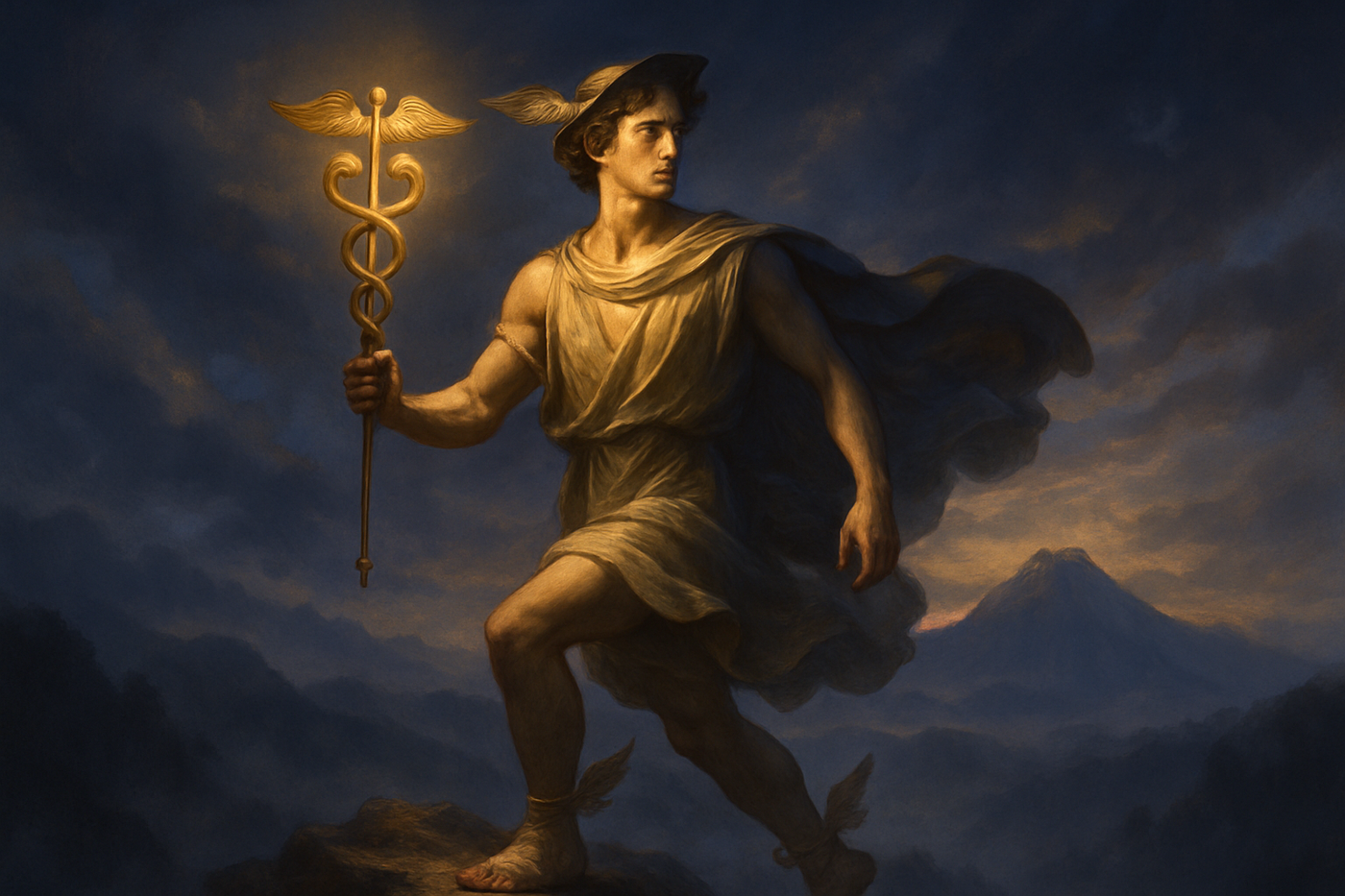
Hermes is the Greek god of messengers, travelers, trade, and boundaries — the fast, cunning son of Zeus and the nymph Maia. He served as Zeus's personal herald, ferried souls to the underworld as a psychopomp, and protected merchants, thieves, and athletes alike. Known to the Romans as Mercury, Hermes is instantly recognizable by his winged sandals and the serpent-entwined caduceus he carries. Few gods moved as freely between Olympus, earth, and the underworld as he did.
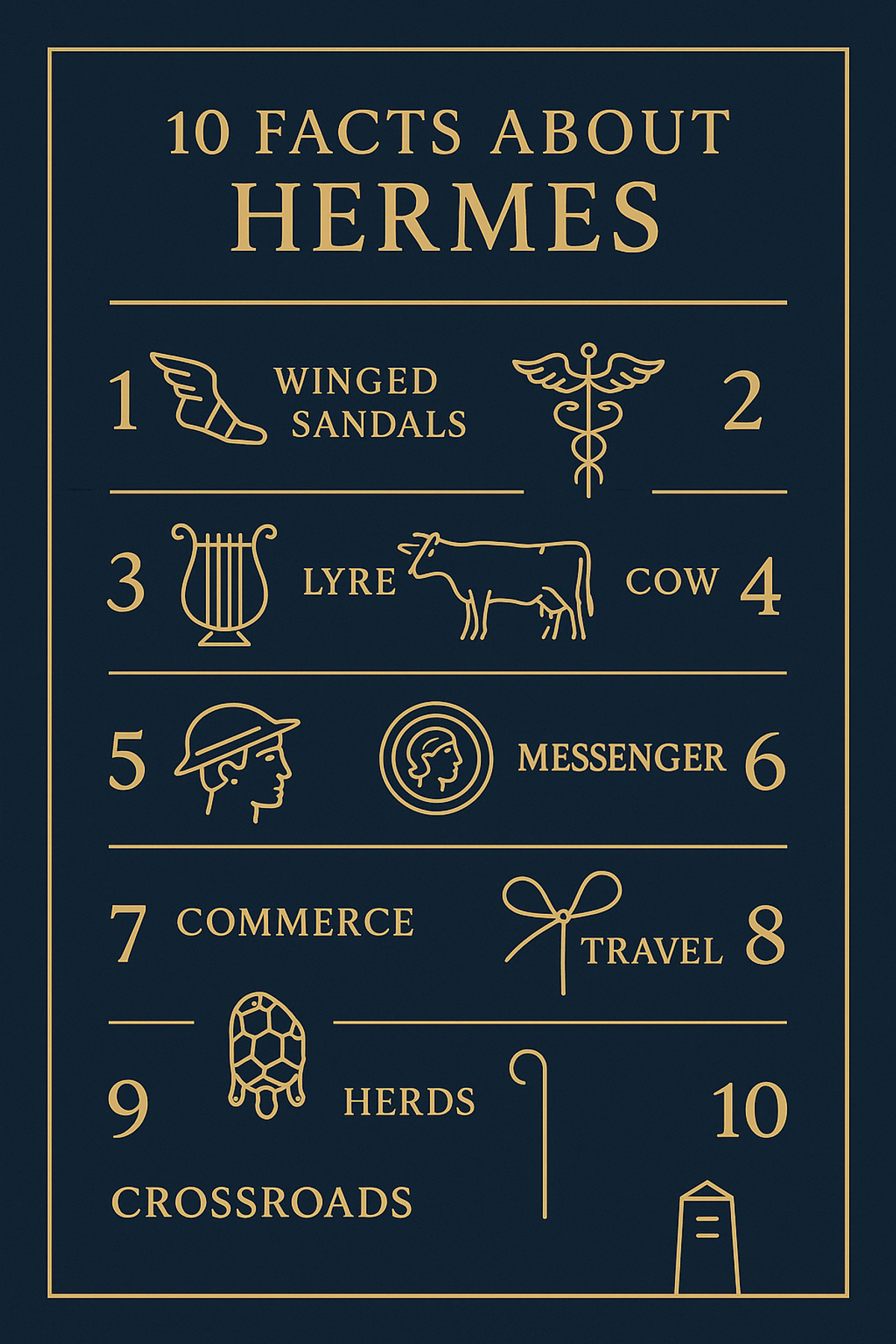
| Roman Name | Mercury |
| Parents | Zeus and Maia |
| Symbols | Caduceus, winged sandals, winged helmet (petasos), tortoise-shell lyre |
| Domain | Messengers, travelers, trade, thieves, boundaries, dreams, the Underworld |
| Notable Siblings | Apollo, Artemis, Athena, Ares, Persephone, Dionysus, Hercules (all half-siblings through Zeus) |
Among the pantheon of Greek deities, Hermes stands out as one of the most versatile and multifaceted gods. Often depicted with winged sandals and a caduceus, he is best known as the messenger of the gods. But Hermes’ significance extends far beyond mere messages.

As the son of Zeus and the nymph Maia, Hermes was born in a cave on Mount Cyllene in Arcadia, a region that played a pivotal role in his early worship. Arcadia, with its rugged landscapes and pastoral charm, became a central hub for the veneration of Hermes, especially in his role as the protector of herdsmen and travelers.
His diverse roles highlight the interconnectedness of various aspects of ancient Greek life. Whether ensuring a successful marketplace transaction, safeguarding a traveler’s journey, or guiding departed souls, Hermes’ presence was ubiquitous. His early worship centers in Arcadia, marked by herms (stone pillars with his carved likeness), became places of pilgrimage, underscoring his deep-rooted significance in Greek culture.
As we delve deeper into the world of Hermes, it becomes evident that his influence was not just limited to divine messages. He was a bridge between mortals and gods, between the living and the dead, and between commerce and spirituality. Truly, Hermes epitomizes the rich tapestry of roles and responsibilities that ancient Greek gods shouldered in the lives of their devotees.
Did You Know? Hermes was believed to have invented the lyre. According to legend, he created it using the shell of a tortoise and the intestines of a cow he had stealthily taken from Apollo. This act of cunning led to a bond between the two gods when Hermes gave the lyre to Apollo, who was deeply enchanted by its music.
While Hermes is widely recognized as the swift-footed messenger of the gods, his association with livestock and vegetation is a testament to his multifaceted nature and deep-rooted connection with the agrarian aspects of ancient Greek society.
From the earliest myths, Hermes was revered as the protector of herd animals, especially cattle and sheep. One of the most famous tales recounts his cunning theft of Apollo’s cattle when he was just a newborn. Using his wit and inventiveness, Hermes not only managed to steal the cattle but also cleverly covered his tracks. Though this act initially angered Apollo, the two gods eventually reconciled, further solidifying Hermes’ association with livestock.
But Hermes’ connection to the agrarian world wasn’t limited to animals. He was also linked with deities of vegetation. His association with Pan, the god of wild nature, and Demeter, the goddess of agriculture, highlights his role in the growth and protection of crops. This bond is evident in various rituals and festivals dedicated to Hermes, where offerings of fruits and grains were made to ensure a bountiful harvest.
Through these associations, Hermes emerges not just as a divine messenger but also as a vital force ensuring the prosperity and sustenance of ancient Greek communities. His dual role as the protector of both livestock and vegetation underscores the harmonious balance between nature and divinity in Greek mythology.
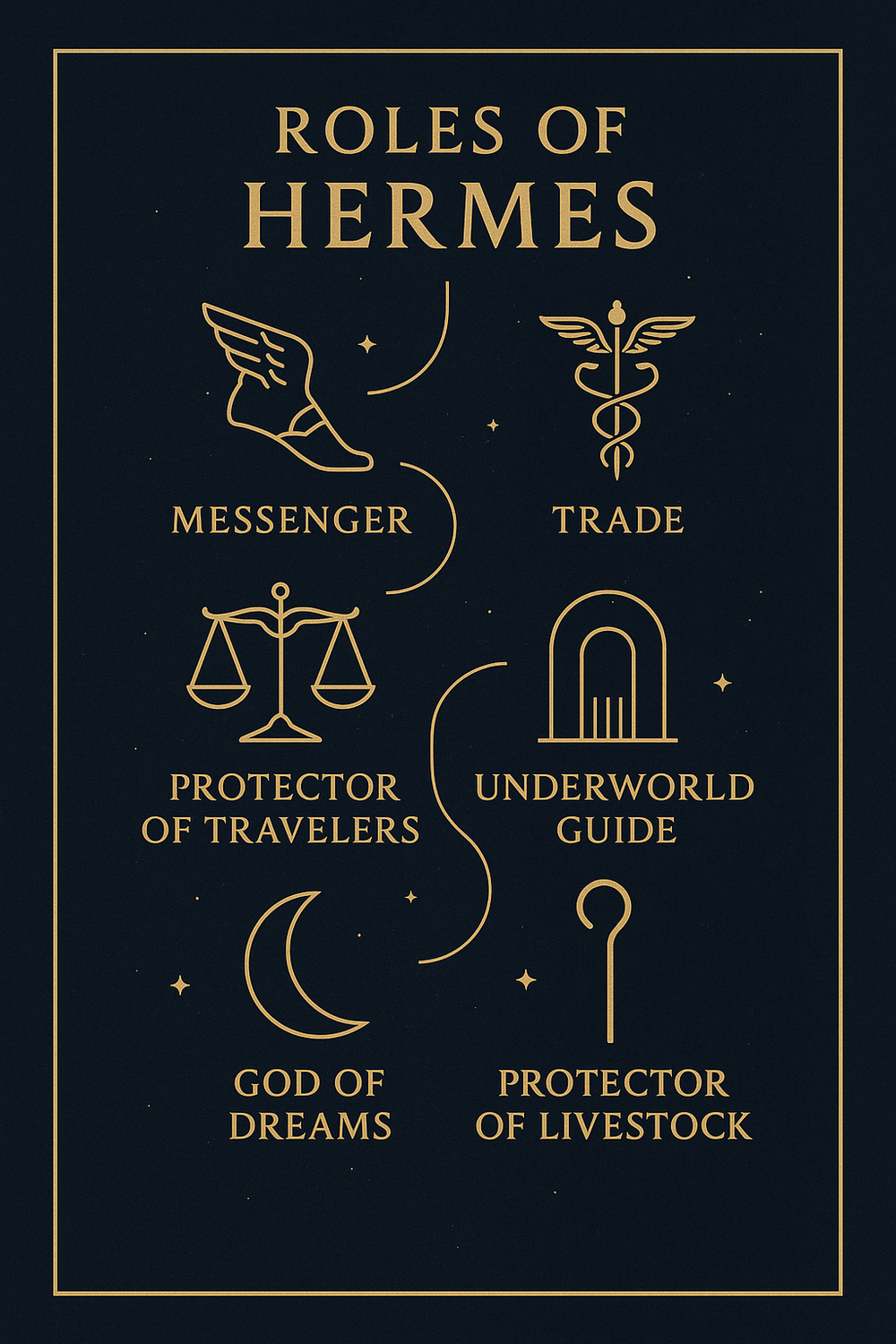
Among the myriad roles that Hermes undertook, two of the most intriguing are his duties as the guide to the Underworld and as the god of dreams. These roles, though seemingly contrasting, both revolve around the ethereal realm, bridging the gap between the conscious and the unconscious, the living and the dead.
Known as “Hermes Psychopompos” or “Hermes the soul guide,” he played a crucial role in guiding the souls of the deceased to the Underworld. This duty was not just about leading souls; it was about ensuring a smooth transition from the world of the living to the realm of Hades. With his golden staff, Hermes would gently guide the spirits, ensuring they found their rightful place in the afterlife. This role underscores Hermes’ versatility, as he moved seamlessly between the realms of gods, mortals, and the dead.
As the god of dreams, Hermes had the power to send messages and prophecies to mortals during their slumber. This role is closely tied to his function as a messenger god. But instead of delivering messages from one god to another or from gods to humans, in this capacity, he communicated through the medium of dreams. He would traverse the dream world, influencing the visions and dreams of mortals, often providing insights, warnings, or prophecies.
Both as the guide to the Underworld and the god of dreams, Hermes showcases his profound connection to the intangible realms. These roles emphasize his importance in not just the physical world but also in the spiritual and subconscious domains of ancient Greek belief.
The portrayal of Hermes in ancient art offers a fascinating glimpse into how perceptions of this versatile god evolved over time. From early representations as a mature, bearded figure to later depictions as a youthful, athletic deity, the artistic journey of Hermes mirrors the changing dynamics of Greek society and its evolving understanding of the divine.
In the earliest known depictions, Hermes was often portrayed as a mature man with a beard, wearing a traveler’s cloak and hat. This version of Hermes, known as “Hermes Propylaios” or “Hermes before the gate,” was a protector of travelers and gateways. His mature appearance symbolized wisdom and experience, attributes essential for a deity tasked with guiding and protecting.
As time progressed, the portrayal of Hermes underwent a significant transformation. He began to be depicted as a youthful, athletic figure, often shown in motion, emphasizing his role as the swift messenger of the gods. This youthful Hermes, with winged sandals and a petasos (a traveler’s hat), became one of the most recognizable figures in Greek art. The shift to a younger representation might be attributed to the increasing importance of athleticism and youth in Greek society, especially during the Classical period.
Through these artistic representations, one can trace the evolution of Hermes from a wise protector to a dynamic messenger, reflecting the multifaceted nature of his divinity and his enduring appeal in the visual arts of ancient Greece.
While Hermes is often celebrated for his role as the messenger of the gods, his family ties and relationships within the divine pantheon are equally intriguing. As a son of Zeus, the king of the gods, and Maia, a Pleiad nymph, Hermes was born into a lineage of power and prestige. But who were his offspring, and what significance did they hold in the tapestry of Greek mythology?
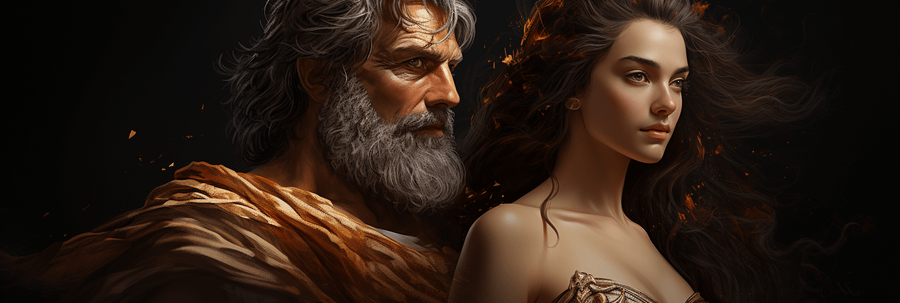
Zeus, the omnipotent ruler of Mount Olympus, had numerous affairs, but his union with Maia, a discreet and shy nymph, resulted in the birth of Hermes. Maia, one of the seven Pleiades, gave birth to Hermes in a cave on Mount Cyllene in Arcadia, away from the prying eyes of Hera, Zeus’s wife.
Hermes, like many gods of Olympus, had several children, each of whom held their unique place in mythological tales:
The children of Hermes, much like their father, played pivotal roles in various myths and legends. They not only expanded the rich tapestry of Greek mythology but also highlighted Hermes’ diverse influence. From the rustic charm of Pan to the cunning of Autolycus and the unique nature of Hermaphroditus, the offspring of Hermes added depth and dimension to the tales of ancient Greece.
Understanding Hermes’ family ties provides a more comprehensive view of his character and influence. It showcases how intertwined the lives of the gods were and how their stories, relationships, and offspring shaped the myths that have captivated audiences for millennia.
Did You Know? The name “Hermes” is believed to be derived from the Greek word “herma”, which refers to a pile of stones or a boundary marker. These markers, known as herms, often had a carved head of Hermes on top and were used to mark boundaries or crossroads.
While Hermes is deeply rooted in Greek mythology, his influence and presence extend far beyond the borders of ancient Greece. As civilizations interacted through trade, conquest, and cultural exchange, the tales of Hermes found their way into various cultures, often with unique interpretations and adaptations. Let’s journey beyond Greece and discover how different societies perceived and integrated Hermes into their mythological tapestry.
In Roman mythology, Hermes was identified with Mercury, the messenger god. Much like Hermes, Mercury was associated with communication, commerce, and travel. However, the Romans also venerated him as the god of financial gain, eloquence, and poetry. The famous Mercurial staff, known as the caduceus, became a symbol of trade and commerce in Rome, emphasizing his importance in the bustling Roman marketplaces.
While Hermes and the Egyptian deity Thoth were distinct entities, the two were often linked due to their shared attributes. Thoth, the ibis-headed god, was the Egyptian deity of writing, magic, and wisdom. Over time, as Greek and Egyptian cultures interacted, Hermes Trismegistus emerged as a syncretic deity, combining elements of both Hermes and Thoth. This fusion led to the creation of Hermeticism, a religious and philosophical tradition that sought to understand the mysteries of the universe.
In Norse mythology, Odin, the Allfather, bore some similarities to Hermes. Both were associated with knowledge, magic, and travel. Odin’s ravens, Huginn and Muninn, who brought him news from all over the world, can be seen as a parallel to Hermes’ role as the divine messenger. While the two deities had distinct origins and stories, the thematic overlaps are a testament to the universality of certain mythological archetypes.
While Hermes is quintessentially Greek, his essence and attributes resonate with various cultures worldwide. By examining his global interpretations, we gain insight into the shared human experience and the universal themes that transcend geographical and cultural boundaries.
The caduceus, a winged staff entwined by two serpents, is one of the most recognizable symbols associated with Hermes. But what is the story behind this emblematic staff, and why has it become so intertwined with Hermes’ identity? Let’s delve into the history and significance of the herald’s staff.
The origins of the caduceus can be traced back to ancient Mesopotamia, where it was a symbol of commerce and negotiation – two realms over which Hermes held dominion. The staff itself represents authority, while the serpents symbolize wisdom and renewal. The wings, often seen at the top of the staff, emphasize Hermes’ role as the swift messenger of the gods.
In Greek mythology, the caduceus was gifted to Hermes by Apollo. In exchange, Hermes gave Apollo the lyre, which he had just invented. This exchange symbolized a balance between the two gods: while Hermes held dominion over trade and communication, Apollo reigned over music and arts. The intertwining serpents on the caduceus also represent duality and harmony, echoing the balance between these two deities.
It’s essential to distinguish between the caduceus and the Rod of Asclepius, another ancient symbol featuring a single serpent wrapped around a staff. The latter is associated with Asclepius, the Greek god of medicine and healing. Over time, however, the caduceus has been mistakenly used as a symbol for medicine, especially in modern times, leading to some confusion between the two emblems.
Today, the caduceus is often associated with medicine, especially in the United States, due to its adoption by the U.S. Army Medical Corps in the early 20th century. However, purists argue that the Rod of Asclepius is the true symbol of medicine. Regardless of this debate, the caduceus remains a powerful symbol of Hermes and his multifaceted roles as a messenger, protector, and guide.
Understanding the caduceus provides a deeper insight into Hermes’ character and the values he represents. As we unravel the layers of symbolism behind this iconic staff, we’re reminded of the intricate tapestry of myths and meanings that make up the rich legacy of Greek mythology.
While each god in the Greek pantheon has a unique identity and set of responsibilities, the relationship between Hermes and Apollo stands out as particularly intertwined. These two deities, though distinct in their domains, share a series of myths and symbolic exchanges that highlight their complementary roles. The table below contrasts their domains, symbols, and roles at a glance.
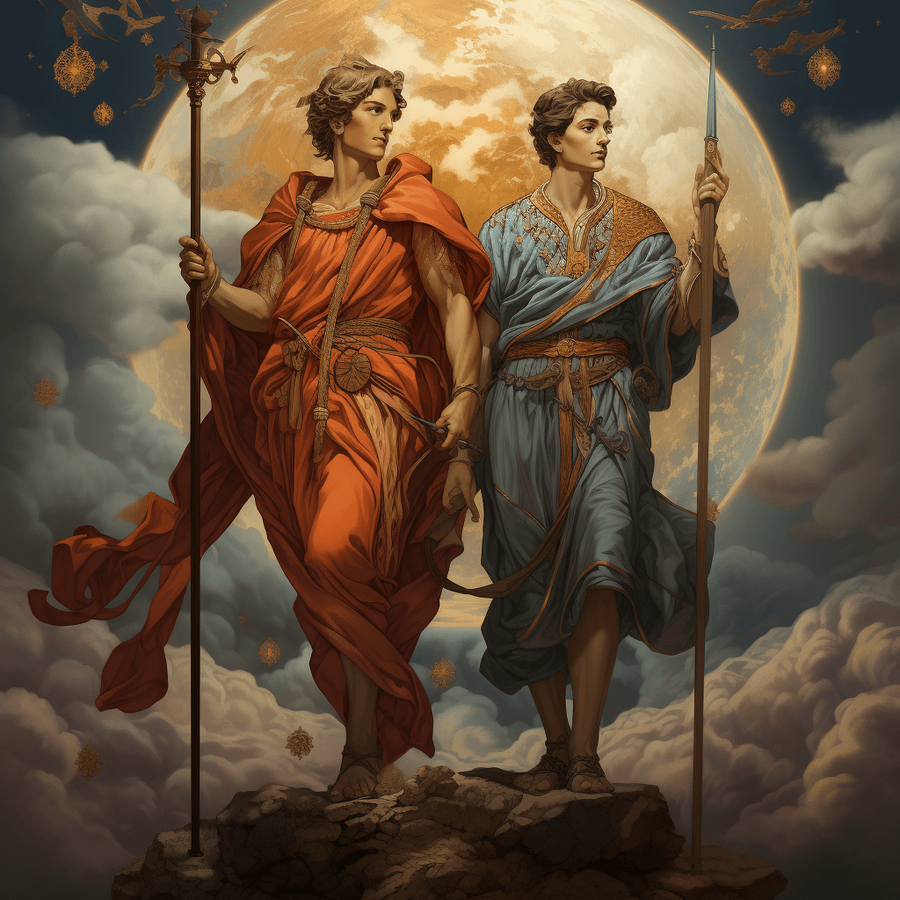
| Hermes | Apollo | |
| Domain | Trade, travel, communication, thieves | Music, prophecy, the sun, healing |
| Symbol | Caduceus, winged sandals | Lyre, bow, laurel wreath |
| Role | Messenger, guide of souls | Oracle, god of light and music |
One of the most iconic stories involving Hermes and Apollo is the tale of the lyre’s creation. As a newborn, Hermes crafted the first lyre from a tortoise shell. However, after stealing Apollo’s sacred cattle, Hermes used the lyre to appease the angered sun god. In admiration of the instrument’s beauty and sound, Apollo exchanged his herd for the lyre, marking the beginning of a bond between the two gods.
While Hermes is the god of trade, thieves, and communication, Apollo is the deity of music, prophecy, and the sun. Their domains might seem contrasting at first, but they often intersect. For instance, both gods play roles in guiding souls – Hermes as the conductor to the underworld and Apollo through his prophetic insights about life and death.
In ancient Greece, there were several temples dedicated to both Hermes and Apollo, emphasizing their interconnected worship. The dual temples often highlighted Hermes’ role as a messenger and Apollo’s as a seer, showcasing how communication and prophecy are two sides of the same coin.
Both gods have strong symbolic representations. Hermes is often depicted with his caduceus, representing his role as a messenger and protector. In contrast, Apollo is frequently shown with a lyre or bow, symbols of his dominion over music and light. These symbols, while distinct, often appear together in art and literature, underscoring their interconnected narratives.
The relationship between Hermes and Apollo is a testament to the intricate web of stories and relationships in Greek mythology. By understanding their shared myths and contrasting roles, we gain a deeper appreciation for the rich tapestry of tales that have shaped our understanding of these divine figures.
Step into the world of Greek mythology with our succinct guide. Find out more about the prominent gods and goddesses through the links below.
Hermes was the swift messenger god born to Zeus and Maia, famous for stealing Apollo's cattle as a newborn and inventing the lyre. He carried his iconic caduceus, guided souls to the Underworld, and was worshipped by travelers, merchants, and athletes. The Romans knew him as Mercury, and he fathered Pan and Hermaphroditus among other children.
Hermes is the Greek god of messengers, travel, trade, thieves, boundaries, and dreams. He also served as psychopomp, guiding the souls of the dead to the Underworld. His versatility made him one of the busiest and most widely worshipped gods on Olympus.
Hermes' primary symbol is the caduceus, a staff entwined with two serpents and topped with wings, representing his role as a messenger and guide. He is also recognized by his winged sandals and winged traveler's hat, the petasos.
Yes, Hermes is often called the messenger of Zeus, serving as his trusted herald to deliver messages and carry out tasks on his behalf. His speed and cunning made him ideally suited to move between Olympus, earth, and the Underworld on Zeus's orders.
Discover Helios, the Greek Titan sun god who drove his blazing chariot across the sky—his myths, symbols, and spiritual meaning ex…
Discover Gaia, the primordial Greek goddess of Earth—her origins, myths, symbolism, dream meaning, and how to honor her energy tod…
Discover Nike, the Greek goddess of victory — her myths, symbols, Roman parallel Victoria, and what she means in dreams and daily …