 Know
Know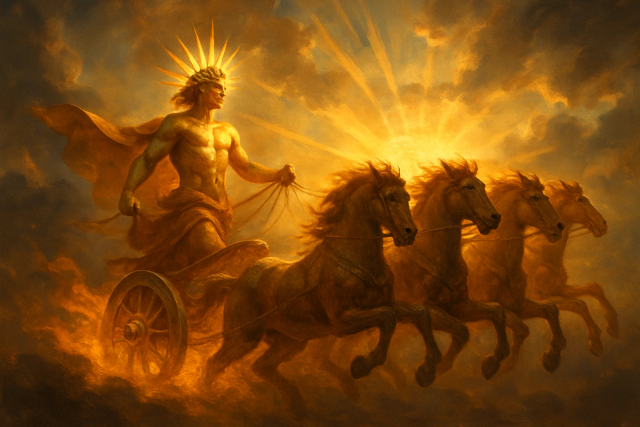
Greek Mythology
Helios: The Titan God of the Sun in Greek Myth
Discover Helios, the Greek Titan sun god who drove his blazing chariot across the sky—his myths, symbols, and spiritual meaning ex…
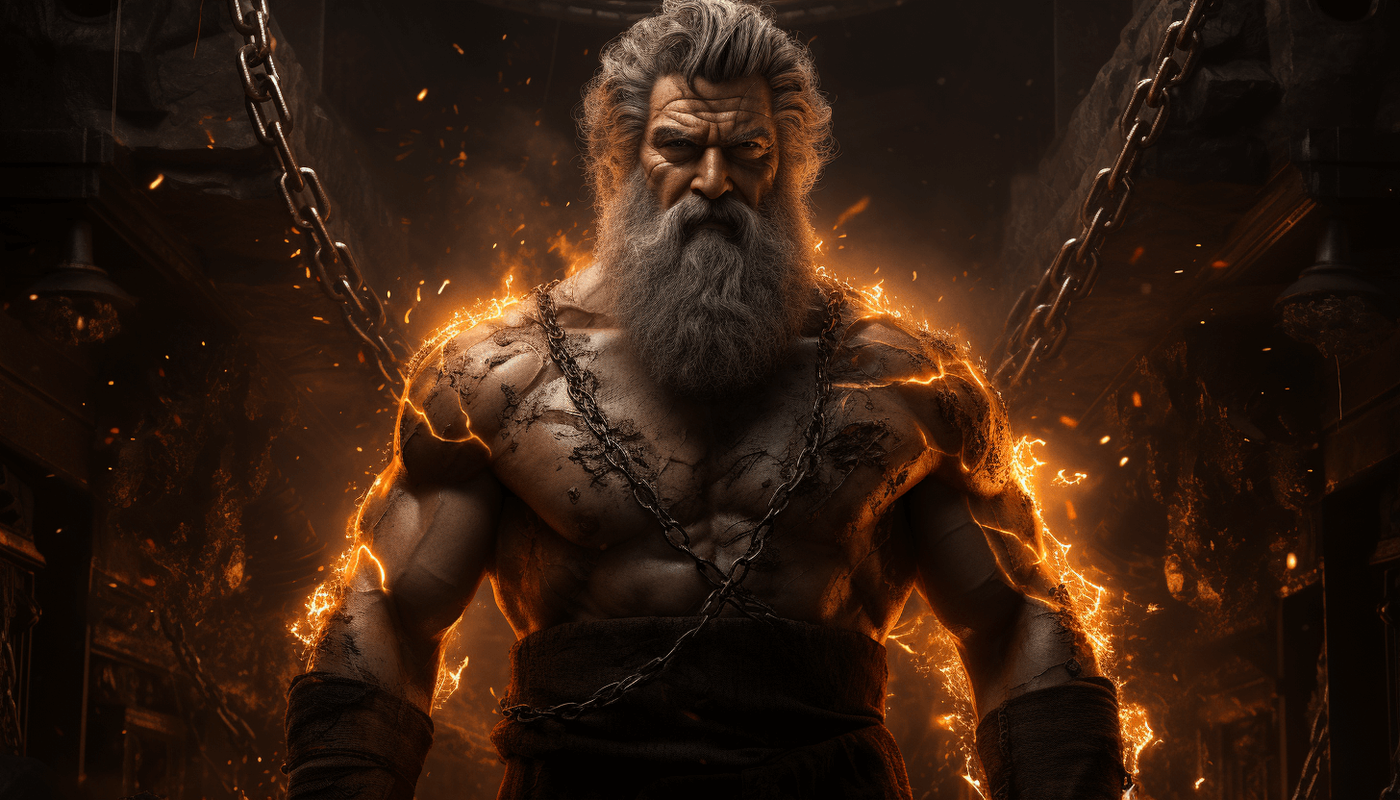
Hephaestus is the Greek god of fire, the forge, and metalworking — the master craftsman of Mount Olympus who forged weapons, armor, and magical artifacts for gods and heroes alike. Born to Zeus and Hera, he is also worshipped as the god of volcanoes and metallurgy. Despite being cast out from Olympus because of his lameness, Hephaestus returned through skill and determination, becoming one of the most respected — and most human — figures in the Greek pantheon. His forge, set within volcanic fire, remains a lasting symbol of resilience, craftsmanship, and creative transformation.
| Attribute | Detail |
|---|---|
| Domain | Fire, the forge, metalworking, volcanoes, craftsmanship |
| Symbols | Anvil, hammer, tongs, forge fire, volcano |
| Roman Name | Vulcan |
| Parents | Zeus and Hera (in most traditions) |
| Consort | Aphrodite (also Charis and Aglaea in other myths) |
Jump to a section:
Hephaestus, with his unmatched craftsmanship, occupies a unique niche in Greek mythology. Celebrated as the divine blacksmith, he forged not just weapons but also intricate tools and artifacts for gods and heroes alike. His prowess extends beyond mere crafting; Hephaestus is also the god of fire, volcanoes, and metallurgy. Despite facing challenges, including being cast out from Olympus due to his lameness, his resilience shines as he returns, solidifying his place among the gods. His iconic forge, often associated with volcanic fires, is a testament to his enduring spirit and unparalleled skill. Hephaestus remains an emblem of creativity, resilience, and the transformative power of fire.
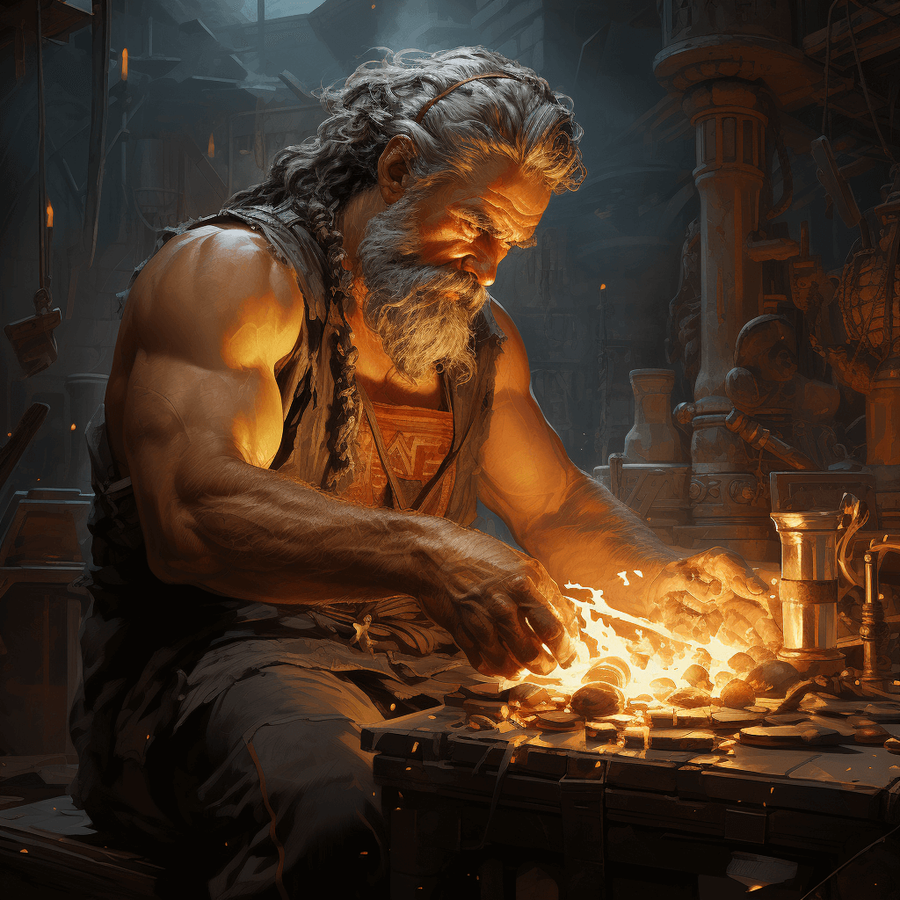
His creations weren't merely functional; they were imbued with magic and purpose. For instance, the shield of Achilles, one of his most famed creations, wasn't just a protective gear. It was a masterpiece, detailed with intricate designs that told stories, reflecting both the world of gods and men.
But Hephaestus's skills weren't limited to weaponry. He also crafted the magnificent palaces of the gods on Mount Olympus, showcasing his versatility. His forge, often depicted amidst volcanic mountains, was believed to be a place of wondrous creations, where fire and metal danced to the rhythm of his hammer.
Through his works, Hephaestus bridged the worlds of gods and mortals, bringing divine beauty and purpose to earthly realms. His legacy as the master craftsman remains etched in the annals of mythology, reminding us of the magic of creation and innovation.
The tale of Hephaestus, while deeply rooted in Greek mythology, begins its narrative far from the heart of Greece. His worship, intriguingly, can be traced back to the ancient lands of Asia Minor.
Asia Minor, a region rich in culture and history, embraced Hephaestus as a deity of craftsmanship and fire. Here, in the midst of ancient civilizations, his cult began to flourish. But what led to the migration of his worship to the heart of Greece, particularly Athens?
The answer lies in the interconnectedness of ancient cultures. As trade routes expanded and cities established alliances, cultural exchange became inevitable. The tales of Hephaestus, with their universal themes of resilience, creativity, and transformation, resonated with the Athenians. They adopted and adapted, integrating him into their pantheon and daily lives.
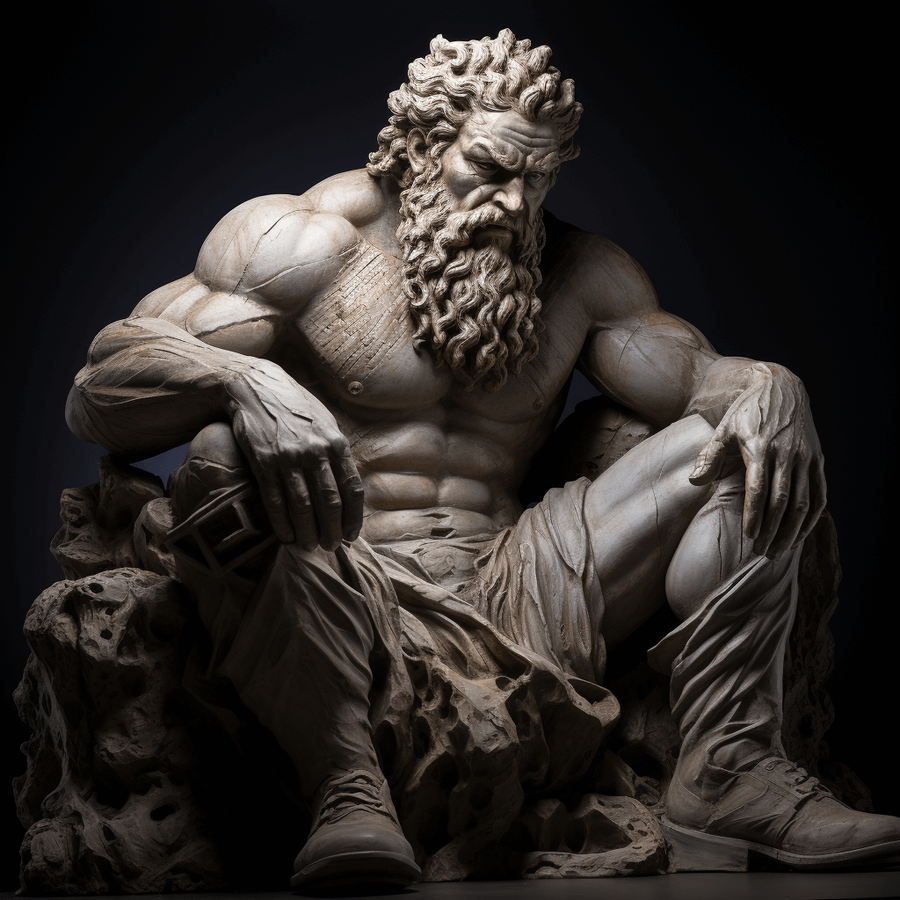
In Athens, Hephaestus's worship took on a grandeur of its own. The city, known for its artistic and architectural marvels, was a fitting home for the god of craftsmanship. Temples were erected in his honor, and festivals celebrated his myths and contributions. The Hephaestia, a festival dedicated to him, became a significant event, drawing worshippers from all corners of the city and beyond.
But what made Hephaestus's cult stand out? It wasn't just the grand temples or the elaborate festivals. It was the values and principles he embodied. In a society that revered excellence (arete) and honor (timé), Hephaestus, with his tales of overcoming adversity and mastering his craft, became a symbol of aspiration and inspiration.
As centuries passed, the influence of Hephaestus's cult permeated various facets of Greek society, leaving an indelible mark on its cultural, spiritual, and artistic landscape.
The tale of Hephaestus is not just one of divine craftsmanship and fiery forges. It's also a poignant narrative of rejection, resilience, and redemption. The myths surrounding his birth, exile, and triumphant return to Olympus offer a deeper insight into the character and essence of this unique deity.
Born to Zeus and Hera, the king and queen of the gods, one might assume Hephaestus's entry into the world was celebrated with great fanfare. However, the reality was far from it. Legend has it that upon his birth, Hera, displeased by his physical imperfections, cast him off Mount Olympus. This act of maternal rejection set the stage for a series of events that would shape Hephaestus's destiny.
While the fall from Olympus was tragic, it wasn't the end for Hephaestus. The sea nymphs, Thetis and Eurynome, found the young god and nurtured him in their underwater grotto. Away from the intrigues of Olympus, Hephaestus honed his skills, becoming the master craftsman we revere today. Was his exile, then, a curse or a concealed blessing? For in the depths of the ocean, away from the prying eyes of gods, Hephaestus found his true calling.
As years passed, Hephaestus's fame as a craftsman reached the heavens. But it was not just his skill that paved his way back to Olympus. In a bid to free his mother Hera, who was trapped by a magical throne he had crafted, Hephaestus demanded a place among the gods and the hand of Aphrodite in marriage. The gods, recognizing his worth and eager to have their disputes settled by his handiwork, welcomed him back.
In the grand tapestry of Greek mythology, Hephaestus's journey from exile to exaltation stands as a testament to the indomitable spirit that defines him. It's a reminder that challenges, however painful, can forge unexpected strength.
In the intricate web of relationships among the Greek gods, few are as compelling and multifaceted as that between Hephaestus and Aphrodite. This union, between the god of craftsmanship and the goddess of love and beauty, offers a fascinating glimpse into the complexities of divine relationships and their reflections in ancient Greek society.
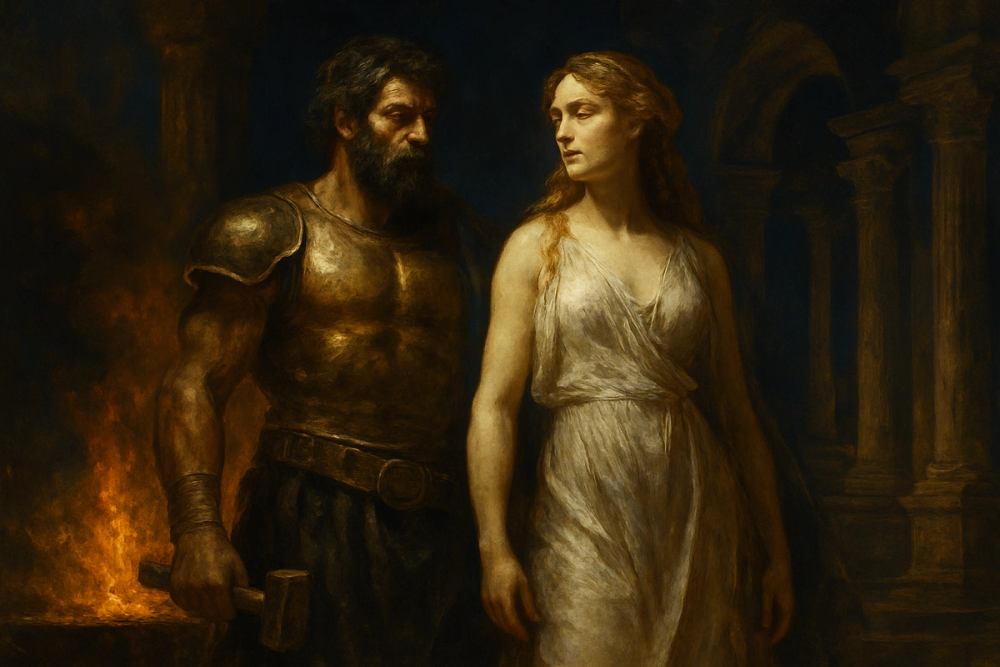
At first glance, Hephaestus and Aphrodite might seem an unlikely pair. He, with his rugged demeanor and focus on the forge, and she, the epitome of grace and allure. Yet, their marriage was orchestrated by the gods, not out of love, but as a means to an end. Hephaestus's demand for Aphrodite's hand in marriage was granted as part of his conditions to release Hera from a trap he had crafted.
The marriage, however, was not without its challenges. Aphrodite, known for her many dalliances, often found herself in the arms of other gods and mortals, most notably Ares, the god of war. How did Hephaestus react to these betrayals? In one famous tale, he crafted a net so fine and strong that it ensnared the lovers, Aphrodite and Ares, in a compromising position, making them the subject of ridicule among the gods.
| Aspect | Implication |
|---|---|
| Divine Jealousy | The tales of Hephaestus's reactions to Aphrodite's infidelities highlight the very human emotions of jealousy and betrayal, even among gods. |
| Power Dynamics | The relationship underscores the power dynamics at play, where Hephaestus's skills and intellect often clashed with Aphrodite's charm and allure. |
| Societal Reflection | The dynamics between Hephaestus and Aphrodite mirrored the societal norms and values of ancient Greece, offering insights into marital expectations and fidelity. |
The relationship between Hephaestus and Aphrodite wasn't just a tale of divine drama; it held a mirror to Greek society. Marriages were often arranged for strategic reasons, and fidelity was a complex issue, laden with societal expectations. Through the lens of Hephaestus and Aphrodite's tumultuous relationship, ancient Greeks explored themes of trust, honor, and the eternal dance between love and logic.
In the annals of Greek mythology, the union of Hephaestus and Aphrodite stands as a testament to the complexities of relationships, both divine and mortal. Their tales, while set among the gods, resonate with timeless themes that continue to captivate us to this day.
When it comes to divine craftsmanship, Hephaestus stands unparalleled in Greek mythology. His forge, echoing with the rhythmic beats of his hammer, birthed creations that were not mere objects, but symbols of power and authority. These divine tools and weapons, crafted meticulously for the gods, played pivotal roles in many a mythological tale.
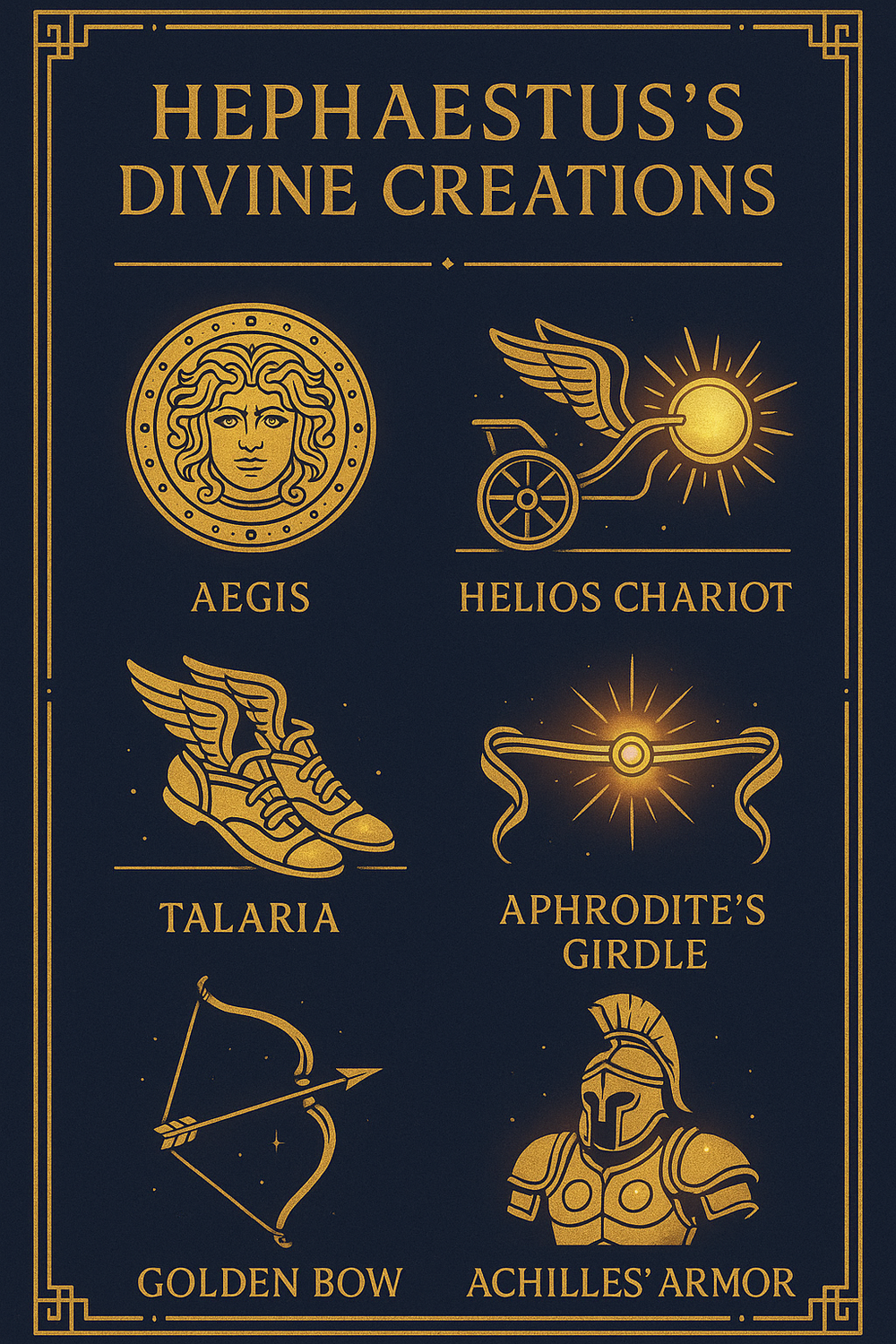
Perhaps one of the most iconic creations of Hephaestus, the Aegis, served as both a shield and protective cloak. Adorned with the head of the Gorgon Medusa and fringed with serpents, it was a formidable symbol of protection and power. While often associated with Zeus, it was also carried by Athena, the goddess of wisdom and warfare.
The fleet-footed messenger god, Hermes, owed his swiftness to a pair of winged sandals crafted by Hephaestus. These sandals, known as Talaria, allowed Hermes to traverse between the realms of gods, mortals, and the underworld with ease and agility.
The sun god, Helios, traversed the sky in a radiant chariot forged by Hephaestus. Made of gleaming gold, this chariot, drawn by fiery steeds, symbolized the passage of the sun across the heavens, bringing light to the world.
| Creation | God/Goddess | Significance |
|---|---|---|
| Golden Girdle | Aphrodite | A belt that enhanced the wearer's allure and charm, often worn by Aphrodite, the goddess of love and beauty. |
| Golden Bow and Arrows | Artemis and Apollo | Weapons that symbolized the hunt for Artemis and the power of prophecy for Apollo. |
| Armor of Achilles | Achilles | A masterpiece of protection, it played a crucial role in the Trojan War, safeguarding the legendary hero Achilles. |
Each creation of Hephaestus was imbued with purpose and magic, tailored for the deity it was intended for. These weren't just tools or weapons; they were extensions of the gods themselves, amplifying their powers and defining their roles in the pantheon. Through his craftsmanship, Hephaestus not only served the gods but also shaped the narratives of countless myths, leaving an indelible mark on Greek mythology.
The legacy of Hephaestus is not confined to the tales and myths of ancient Greece. His presence is vividly captured in the art of the time, offering a visual narrative that complements the oral and written traditions. From grand sculptures to intricate pottery, the artistic representations of Hephaestus provide a window into how the ancient Greeks perceived and honored this god of the forge.
One of the most prevalent depictions of Hephaestus is that of a bearded elder, showcasing him as a figure of wisdom and experience. This portrayal often emphasizes his role as a master craftsman, with the beard symbolizing not just age but also respect and authority. In such artworks, he is frequently shown with his tools, underscoring his divine profession.
Contrasting the image of the bearded elder is the portrayal of Hephaestus as a youthful smith. This representation captures the vigor and energy of a young craftsman, engrossed in his work. The emphasis here is on his physical prowess, highlighting the strength and skill required to mold metals and craft divine artifacts.
Regardless of age, certain themes and symbols are consistently associated with Hephaestus in art:
These symbols, when combined with his physical depictions, create a holistic image of Hephaestus, capturing both his divine essence and his very human challenges and triumphs.
The artistic representations of Hephaestus were not mere decorative elements. They played a pivotal role in Greek society, serving as educational tools, religious icons, and cultural touchstones. Through art, the ancient Greeks connected with their gods, and Hephaestus, with his relatable challenges and admirable skills, became a figure of inspiration for many.
In the vast panorama of Greek art, the depictions of Hephaestus stand out, offering insights into the god's multifaceted persona and his enduring influence on ancient Greek culture and beyond.
While Hephaestus's divine craftsmanship is well-documented in myths and art, the locations of his legendary workshops are equally intriguing. Often associated with fiery terrains, these workshops are believed to be situated within the heart of volcanoes. This connection between the god of fire and the natural volcanic phenomena offers a captivating blend of mythology and nature's raw power.

One of the most renowned locations associated with Hephaestus's forge is Mount Etna, located on the island of Sicily. This active volcano, with its frequent eruptions and molten lava flows, was believed to be the very workshop where Hephaestus, assisted by the Cyclopes, crafted weapons and artifacts for the gods. The rumblings of the volcano were often attributed to the sounds of his hammer striking the anvil, echoing through the depths of the earth.
Beyond Mount Etna, the island of Lemnos in the Aegean Sea holds significant importance in Hephaestus's lore. After being cast out from Olympus, it was on Lemnos that Hephaestus found refuge. The island, with its volcanic landscapes, became synonymous with the god, and local legends often spoke of underground forges and fiery caverns where Hephaestus honed his craft.
The association of Hephaestus with volcanoes isn't merely a product of captivating tales. Volcanoes, with their fiery eruptions and molten rock, can be seen as nature's own forges. The ancient Greeks, observing these powerful natural phenomena, found a fitting abode for their god of fire and metallurgy within these fiery mountains.
| Volcanic Location | Associated Myth |
|---|---|
| Mount Vesuvius | While more commonly associated with Roman myths, some tales suggest that Hephaestus had a secondary forge beneath this infamous volcano. |
| The Aeolian Islands | These volcanic islands, particularly Stromboli, were believed to house underground workshops of Hephaestus. |
Through these volcanic associations, Hephaestus's myths are grounded in the very landscapes of the ancient world. They serve as a testament to how the Greeks, in their quest to understand the world around them, wove nature into their mythological tapestry, creating a harmonious blend of lore and landscape.
In the intricate web of Greek mythology, familial relationships often play pivotal roles in shaping the narratives and destinies of gods and mortals alike. Hephaestus, with his unique position in the divine family, is no exception. His lineage and relationships offer a deeper understanding of his character and the dynamics of the Olympian pantheon.
As the offspring of Zeus, the king of the gods, and Hera, the queen of Olympus, Hephaestus was born into power and prestige. However, his birth was marred by tragedy. Due to his physical imperfections, he was cast out from Olympus, a stark reminder of the capricious nature of the gods. Despite this tumultuous start, Hephaestus's resilience and talent ensured his return to the divine realm, where he reclaimed his rightful place.
The union of Hephaestus and Aphrodite, the goddess of love and beauty, is one of the most intriguing pairings in Greek mythology. While their marriage was arranged, it was fraught with challenges, primarily due to Aphrodite's numerous affairs. Yet, this relationship also highlights Hephaestus's forgiving nature and his capacity for love and understanding.
Despite the complexities of his marital life, Hephaestus fathered several children, both divine and mortal. These offspring, each with their unique tales, further enriched the tapestry of Greek myths.
The relationships and offspring of Hephaestus are not mere anecdotes; they hold profound significance in understanding the god's character and influence. His lineage showcases a blend of resilience, creativity, and compassion, traits that resonate through the tales of his descendants. Whether it's the innovative spirit of Erichthonius or the mystical allure of the Cabeiri, Hephaestus's legacy is evident in the deeds and tales of his progeny.
Through the exploration of Hephaestus's family ties, we gain a holistic view of the god, not just as the master blacksmith but also as a father, husband, and a pivotal figure in the grand narrative of Greek mythology.
The tales of Hephaestus, while rooted deeply in Greek mythology, have resonated far beyond the borders of ancient Greece. His archetype, that of a master craftsman and a deity associated with fire and metallurgy, finds parallels in various cultures across the world. This universality underscores the timeless appeal and relevance of such figures in human civilization.
In Roman mythology, Vulcan stands as the closest counterpart to Hephaestus. Like the Greek god, Vulcan was associated with fire, metallurgy, and craftsmanship. He too had a forge and was revered as the patron of blacksmiths and artisans. Festivals like the Vulcanalia were celebrated in his honor, emphasizing his importance in Roman society.
Moving northwards, in Norse legends, we encounter Wayland the Smith. A master blacksmith, Wayland's tales are filled with themes of craftsmanship, revenge, and resilience. While not a direct parallel to Hephaestus, the essence of a skilled craftsman facing trials and tribulations resonates in both narratives.
Shifting our gaze to the Indian subcontinent, Agni, the Vedic god of fire, holds certain similarities with Hephaestus. While Agni's primary association is with fire and rituals, his role in crafting and the transformative power of fire draws parallels with the Greek god's attributes.
| Culture | Deity | Attributes |
|---|---|---|
| Roman | Vulcan | Fire, Metallurgy, Craftsmanship |
| Norse | Wayland the Smith | Blacksmithing, Revenge, Resilience |
| Vedic | Agni | Fire, Rituals, Transformation |
Exploring Hephaestus's presence in global cultures offers a fascinating insight into how different civilizations, while separated by geography and time, converge on similar archetypes. These shared narratives underscore the universal human fascination with creation, transformation, and the divine forces that govern these processes.
While Hephaestus's marriage to Aphrodite is legendary, his romantic entanglements were not limited to the goddess of love. Delving deeper into the annals of Greek mythology, we find references to other consorts of Hephaestus, each bringing a unique dimension to his character and narrative.
Among the lesser-known consorts of Hephaestus is Charis. Her name, translating to "Grace," is fitting, as she was one of the Charites, goddesses of charm, beauty, and grace. Their union symbolizes the harmonious blend of creativity and beauty, a testament to Hephaestus's multifaceted nature. Their marriage was celebrated with joy, and together they had a daughter, Pandora.
Aglaea, another of Hephaestus's consorts, was also one of the Charites. Her name means "Splendor," and she personified glory and magnificence. Their union underscores the idea that Hephaestus's creations were not just functional but also splendid in their design and craftsmanship.
The relationships of Hephaestus, beyond Aphrodite, offer a richer understanding of the god. They emphasize his appreciation for beauty, grace, and splendor, qualities that are often overshadowed by his craftsmanship and resilience. These unions also highlight the multifaceted nature of love in Greek mythology, where relationships were not just about passion but also about mutual respect, understanding, and shared values.
Did you know? While Aphrodite had numerous affairs, Hephaestus's relationships with other consorts like Charis and Aglaea were characterized by mutual respect and admiration, painting a different facet of the god's romantic life.
Exploring the lesser-known consorts of Hephaestus provides a holistic view of the god, revealing layers of his character that are often overlooked. It reminds us that in mythology, as in life, relationships are complex, multifaceted, and deeply reflective of one's character and values.
Beyond the myths, Hephaestus has become a powerful symbol in modern spiritual and personal-growth contexts. His story speaks directly to anyone who has ever felt like an outsider yet found strength through their own craft, offering a symbolic framework that goes far beyond ancient Greek religion.
Hephaestus was rejected for his physical difference, yet he never let that rejection define his worth. His journey — from cast-out infant to indispensable god — has made him an enduring symbol of resilience through imperfection. He represents the idea that our perceived flaws can become the very source of our unique strength.
Rather than being crushed by exile, Hephaestus transformed hardship into his greatest creative period, honing his craft in isolation before returning triumphant. This makes him a symbol of creativity forged in adversity — a reminder that difficult seasons of life often produce our most meaningful, lasting work.
As the god of both the forge and volcanic fire, Hephaestus embodies the "sacred fire" archetype found across many spiritual traditions: fire as a purifying, transformative force that destroys the old to make way for the new. Meditating on Hephaestus's fire can symbolize burning away self-doubt in order to create something authentic and enduring.
Immerse yourself in the tales of Greek gods and goddesses with our quick guide. Explore their distinctive stories by clicking the links below.
Hephaestus is the Greek god of the forge, fire, and metallurgy. He is celebrated for his unparalleled craftsmanship, creating divine weapons, tools, and artifacts for gods and heroes.
Hephaestus forged numerous iconic items, including the shield of Achilles, the Aegis shield, the winged sandals of Hermes, and even the first human woman, Pandora. His creations often held magical properties and were integral to various myths and legends.
Hephaestus is often referred to as the "lame god" due to his physical disability. According to some myths, he was born with this deformity, while others suggest he became lame after being thrown from Mount Olympus by Zeus or Hera.
Hephaestus symbolizes resilience through imperfection, creativity born from adversity, and the transformative power of sacred fire. He represents the idea that being cast out or different does not diminish one's worth — it can instead become the source of exceptional skill and inner strength.
There is no established classical or astrological tradition linking Hephaestus to Virgo or Capricorn; in Greek myth those signs are instead associated with other figures, such as Zeus and Amalthea (Capricorn) and Persephone or Astraea (Virgo). Some traditions also connect him to Vulcan, a hypothetical planet historically proposed near the sun, echoing his fiery domain.
Hephaestus is strongly linked with the element of fire and with metals themselves, especially iron and bronze, which were central to ancient forging. Crystals commonly associated with him include fire agate, obsidian (born of volcanic fire), and pyrite, all valued for their connection to transformation, grounding, and inner strength.
The Roman counterpart to Hephaestus is Vulcan. Like Hephaestus, Vulcan was associated with fire, metallurgy, and craftsmanship, and he was revered as the patron of blacksmiths and artisans in Roman culture.
In Slavic mythology, Svarog is the god associated with smithing, fire, and the celestial realm. He is often compared to Hephaestus and Vulcan due to his role as a divine craftsman and his association with fire.
The union between Hephaestus and Aphrodite is one of the most intriguing in Greek mythology. While Hephaestus was loyal, Aphrodite had numerous affairs, most notably with Ares, the god of war. Their complex relationship dynamics, filled with jealousy, betrayal, and reconciliation, have been the subject of numerous myths, plays, and artistic representations, highlighting the multifaceted nature of love and relationships in ancient narratives.
Discover Helios, the Greek Titan sun god who drove his blazing chariot across the sky—his myths, symbols, and spiritual meaning ex…
Discover Gaia, the primordial Greek goddess of Earth—her origins, myths, symbolism, dream meaning, and how to honor her energy tod…
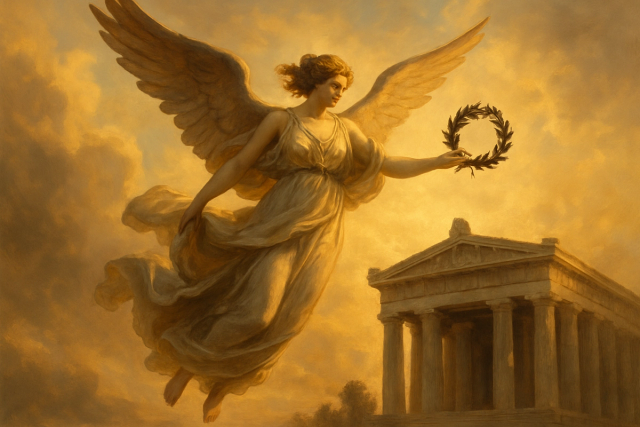
Discover Nike, the Greek goddess of victory — her myths, symbols, Roman parallel Victoria, and what she means in dreams and daily …