 Know
Know
Greek Mythology
Gaia: The Primordial Mother Earth Explained
Discover Gaia, the primordial Greek goddess of Earth—her origins, myths, symbolism, dream meaning, and how to honor her energy tod…
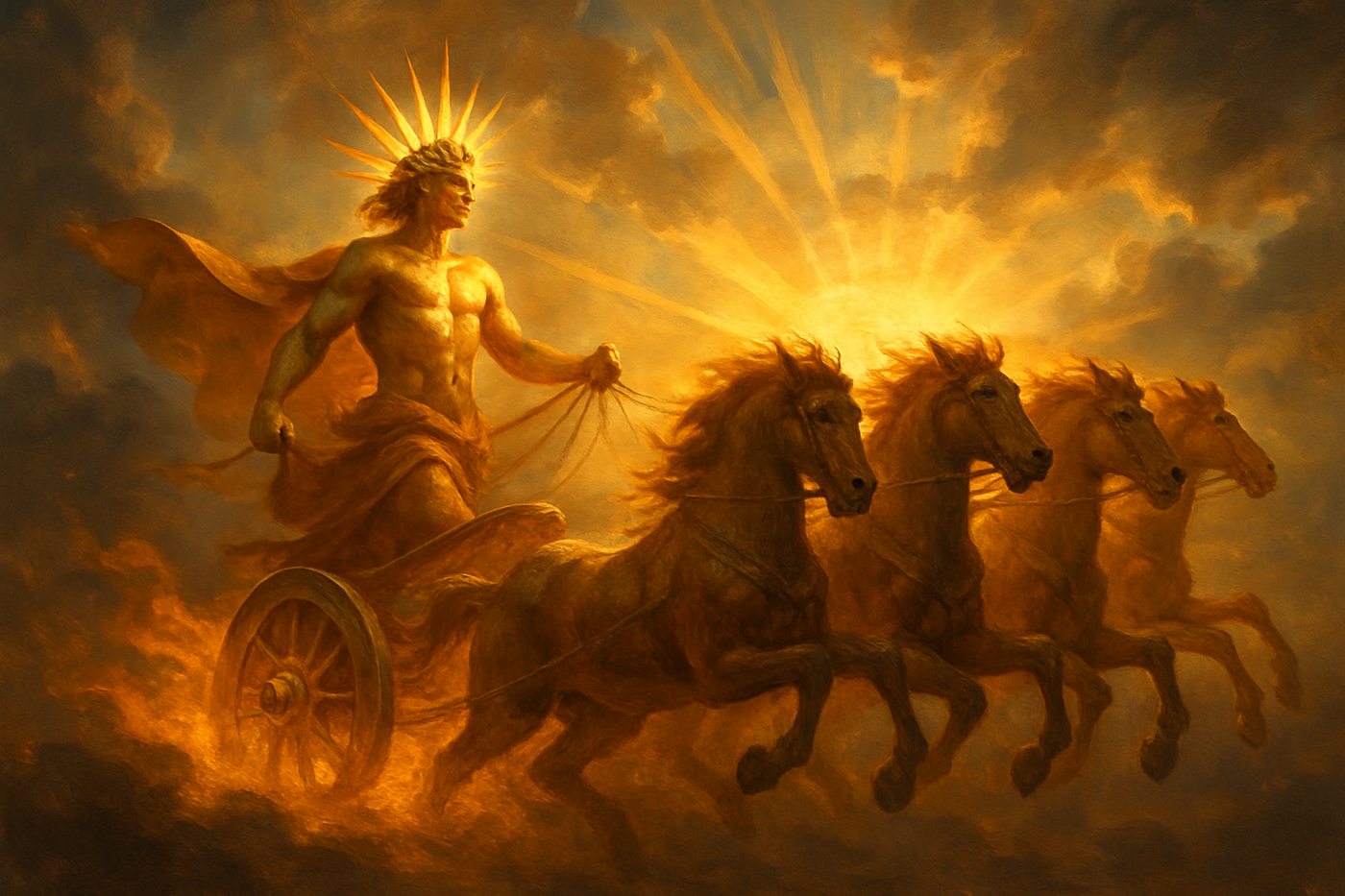
Helios is the Titan god of the sun in Greek mythology, believed to drive a fiery chariot pulled by four horses across the sky each day, bringing light from dawn to dusk. Unlike the Olympian gods, Helios belongs to the older generation of Titans and was worshipped as the all-seeing eye who witnessed everything happening on earth. He later became associated with, and sometimes merged into, the Olympian god Apollo, though the two remained distinct figures in earlier myth.
Picture the sky just before sunrise—that hush before the world catches fire with color. The ancient Greeks imagined a god behind that moment: a radiant charioteer rising from the eastern ocean, his crown blazing so brightly that mortals could barely lift their eyes to him.
Helios was not a god of thunderbolts or war. His power was quieter but inescapable—he simply saw. Every secret, every betrayal, every act of love or violence beneath the open sky passed beneath his gaze. To the Greeks, there was no hiding from Helios.
That idea alone makes him one of the most emotionally resonant figures in Greek mythology: a god who represents truth, exposure, and the impossibility of escaping the light.
Helios was the son of the Titans Hyperion and Theia, and brother to Selene (the moon) and Eos (the dawn). Together, this trio governed the celestial rhythm of day and night. Helios himself was imagined as a strikingly handsome god wearing a golden crown of sunbeams, driving a chariot of fire drawn by four immortal horses—Pyrois, Aeos, Aethon, and Phlegon—across the heavens from east to west.
At night, ancient poets said, Helios sailed back to his eastern palace in a golden cup or bowl, floating along the river Oceanus so he could rise again at dawn. This daily cycle made him one of the most literal, visible gods in the Greek pantheon—his presence was simply the sun itself.
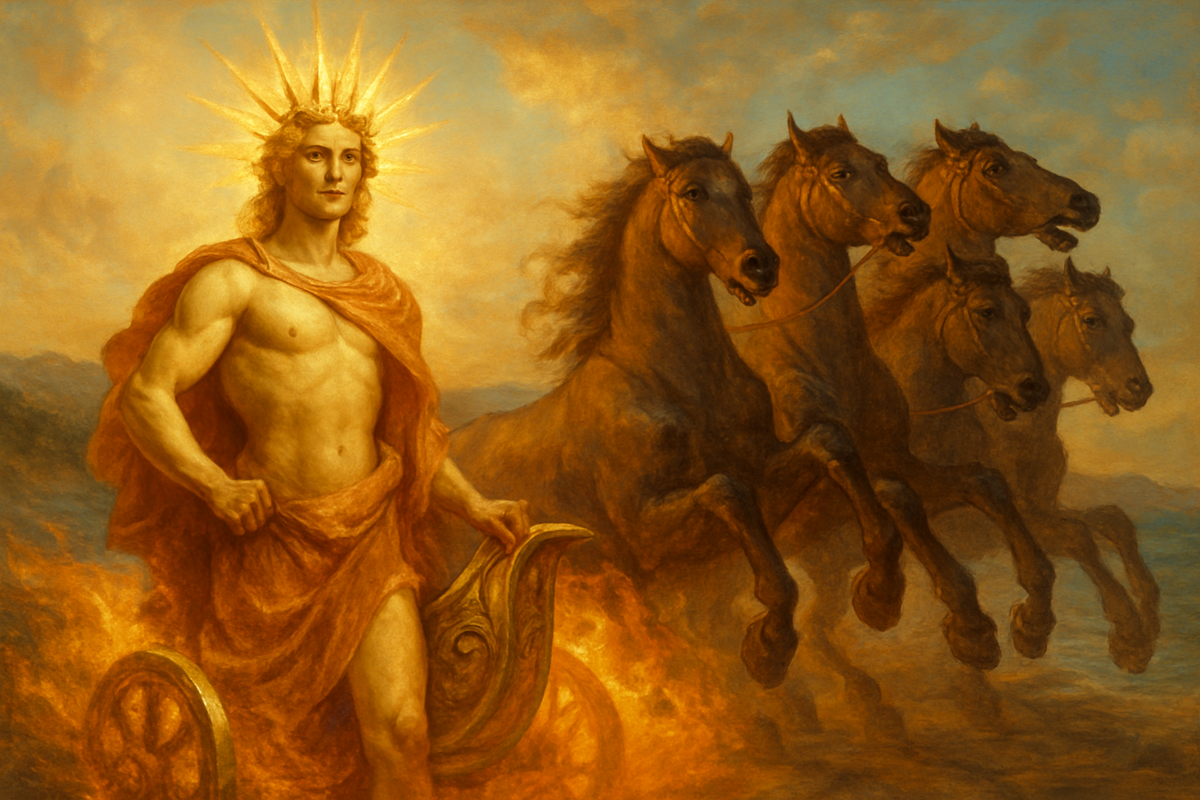
Because Helios belonged to the Titan generation, predating the Olympians led by Zeus, he occupied a strange middle position in Greek religion. He wasn't overthrown like Cronus, nor was he fully folded into the new Olympian order. Instead, he continued to be worshipped independently for centuries, most famously on the island of Rhodes, where he was the chief patron deity and where entire festival calendars were built around honoring him.
Many people confuse Helios with Apollo, and understandably so—by the Classical and Hellenistic periods, poets increasingly described Apollo driving the sun chariot. But in the earliest myths, they were separate: Helios was the literal sun, while Apollo governed music, prophecy, and light in a broader symbolic sense. Over centuries their identities blended in popular imagination and Roman adaptation, though religious cult practice often kept them distinct.
| Aspect | Helios | Apollo |
|---|---|---|
| Generation | Titan | Olympian |
| Domain | The literal sun and its daily journey | Music, prophecy, healing, light symbolism |
| Main cult center | Rhodes | Delphi, Delos |
| Symbol | Golden chariot, sunburst crown | Lyre, laurel wreath, bow |
| Parents | Hyperion and Theia | Zeus and Leto |
Several enduring stories reveal Helios's role as witness, judge, and sometimes tragic father.
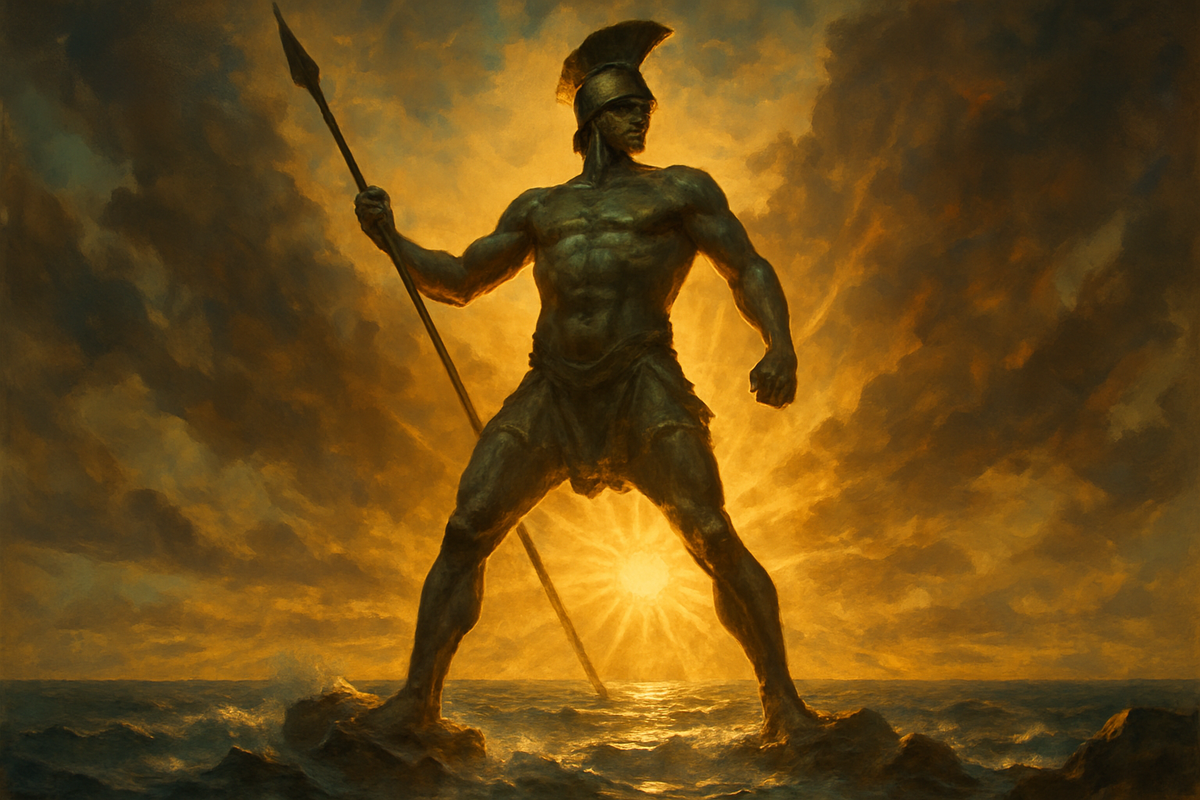
Helios's imagery is instantly recognizable in ancient art and coinage, especially from Rhodes, where the massive bronze statue known as the Colossus of Rhodes was built in his honor.
Beyond myth, Helios shaped real religious and artistic life. The anonymous Homeric Hymn to Helios praises him as a tireless, radiant charioteer, while Rhodian coins from the 4th century BCE stamped his sunburst face onto everyday currency. His most famous monument, the Colossus of Rhodes, stood roughly 33 meters tall near the harbor entrance and was counted among the Seven Wonders of the Ancient World until an earthquake toppled it around 226 BCE. These artifacts show Helios wasn't just a poetic figure—he was a civic identity.
Beyond mythology, Helios has come to represent several enduring spiritual ideas still meaningful today.
Because nothing escapes sunlight, Helios symbolizes the impossibility of hiding wrongdoing. Spiritually, invoking Helios's energy is often associated with seeking clarity, honesty, and the courage to bring hidden truths into the open.
As the literal source of daylight, Helios embodies raw vital energy—the force that sustains crops, warms the earth, and marks time itself. In this sense, he parallels solar deities across other cultures, such as the Egyptian god Ra, who likewise sailed a solar barque across the sky, and the Hindu god Surya, who rides a chariot pulled by seven horses through the heavens—both personifying the sun's life-giving power through a daily celestial journey.
Helios never skipped a day. His unwavering routine reflects a spiritual lesson about discipline, consistency, and duty—showing up fully, day after day, regardless of personal desire, much like Phaethon's disastrous attempt reminds us of the danger in taking on responsibilities we're not ready for.
In dream interpretation traditions influenced by classical symbolism, dreaming of a blazing chariot, an all-seeing golden figure, or an overwhelming sun can carry specific meanings:
You don't need to worship Helios to draw meaning from his mythology. Many people use solar symbolism in modern spiritual practice, journaling, or ritual:
The Rhodian cult of Helios was so significant that Rhodes held annual festivals called the Halieia in his honor, featuring athletic competitions comparable to those at Olympia. Centuries later, Roman culture absorbed Helios into the figure of Sol Invictus ("the Unconquered Sun"), a state-sponsored solar cult promoted heavily under Emperor Aurelian in 274 CE. Sol Invictus became so influential that its December 25th festival is often cited in debates about the symbolic timing of Christmas near the winter solstice. This cross-cultural echo shows how solar reverence—whether through Helios, Sol Invictus, or other sun gods—reflects a nearly universal human instinct to personify the force that makes life possible.
Compared to Olympians like Zeus or Poseidon, Helios's worship was less tied to political power and more tied to natural observation—he was less a god you negotiated with and more a cosmic fact you lived beneath.
Not originally. Helios was the Titan god literally identified with the sun, while Apollo was an Olympian god associated with prophecy, music, and later solar symbolism. Over time popular culture blended the two, but early Greek religion treated them as separate deities.
Helios is the Greek Titan god of the sun, responsible for driving the sun across the sky each day in a fiery chariot. He was also seen as an all-seeing witness to events on earth, making him associated with truth and oaths.
Helios was the son of the Titans Hyperion and Theia, and the brother of Selene, goddess of the moon, and Eos, goddess of the dawn. He fathered several children, including the tragic figure Phaethon.
Rhodes considered Helios its patron deity and central protector, celebrating him with the Halieia festival and eventually building the Colossus of Rhodes, a massive bronze statue in his honor that became one of the Seven Wonders of the Ancient World.
Discover Gaia, the primordial Greek goddess of Earth—her origins, myths, symbolism, dream meaning, and how to honor her energy tod…
Discover Nike, the Greek goddess of victory — her myths, symbols, Roman parallel Victoria, and what she means in dreams and daily …
Discover the true myth of Pandora, the first woman in Greek mythology, the real story behind her 'box,' and what it means today.