 Know
Know
Greek Mythology
Helios: The Titan God of the Sun in Greek Myth
Discover Helios, the Greek Titan sun god who drove his blazing chariot across the sky—his myths, symbols, and spiritual meaning ex…
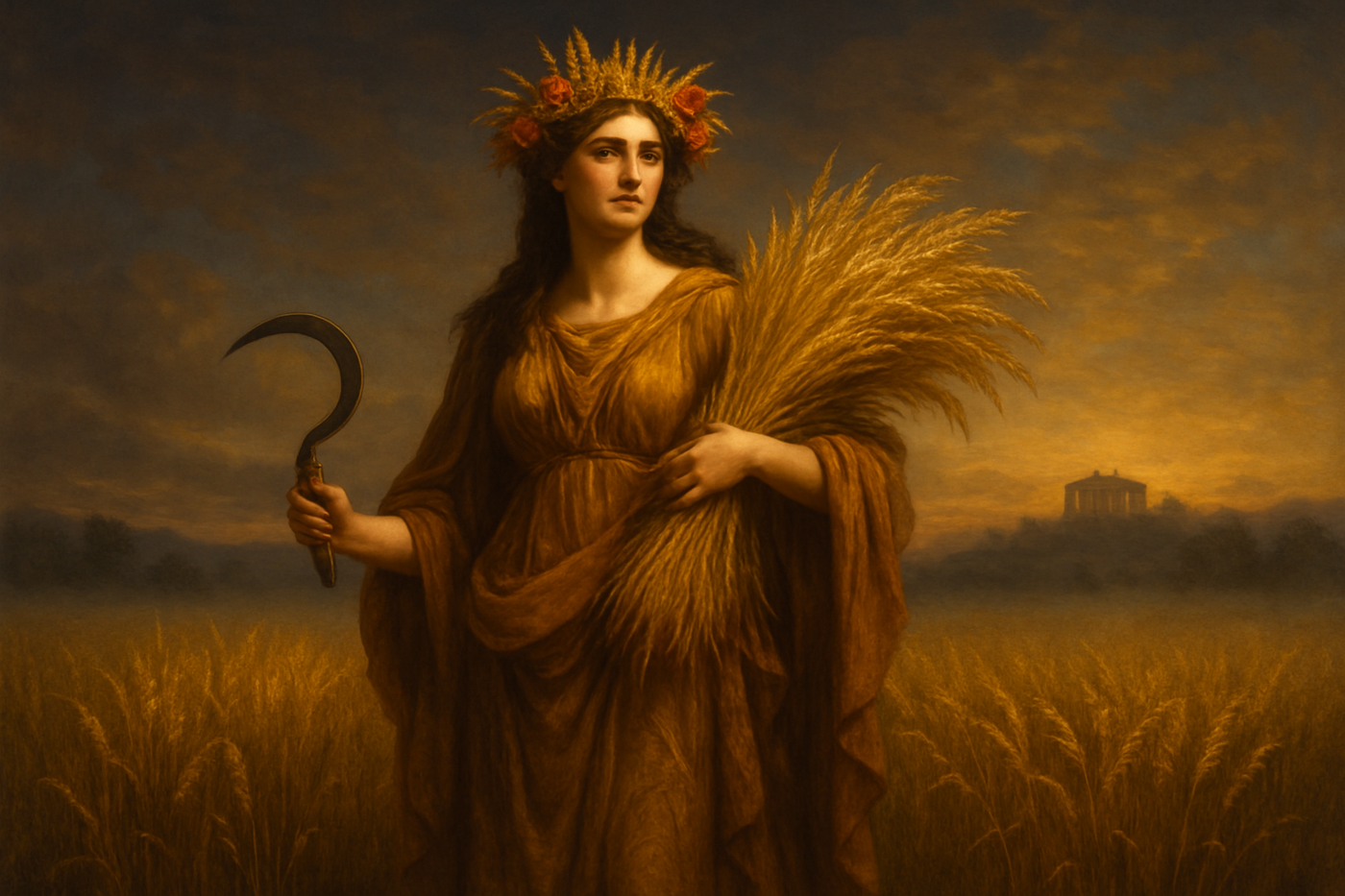
Demeter is the ancient Greek goddess of the harvest, agriculture, and fertility of the earth, daughter of the Titans Cronus and Rhea and mother of Persephone. As one of the twelve Olympians, she governed grain, the growing seasons, and the sacred bond between humanity and the soil. Her most famous myth — the abduction of Persephone by Hades — explains why the earth turns barren in winter and blooms again each spring, making Demeter one of the most enduring nature deities in Greek mythology.
Among the pantheon of ancient Greek deities, Demeter stands out as the emblematic figure of nature's bounty: not just any force of nature, but specifically the fruitful yield of the earth — the grains, the harvest, and the cycle of life and death that agrarian Greek society depended on.
| Attribute | Details |
|---|---|
| Parents | Cronus and Rhea (Titans) |
| Siblings | Zeus, Hera, Poseidon, Hades, Hestia |
| Consort / Notable Partners | Zeus, Poseidon, Iasion |
| Children | Persephone, Plutus, Arion |
| Roman Name | Ceres |
| Domain | Harvest, grain, agriculture, fertility of the earth |
| Symbols | Sickle, sheaf of wheat, cornucopia, torch |
| Sacred Plant / Animal | Barley and wheat; sacred animals include the pig and the snake |
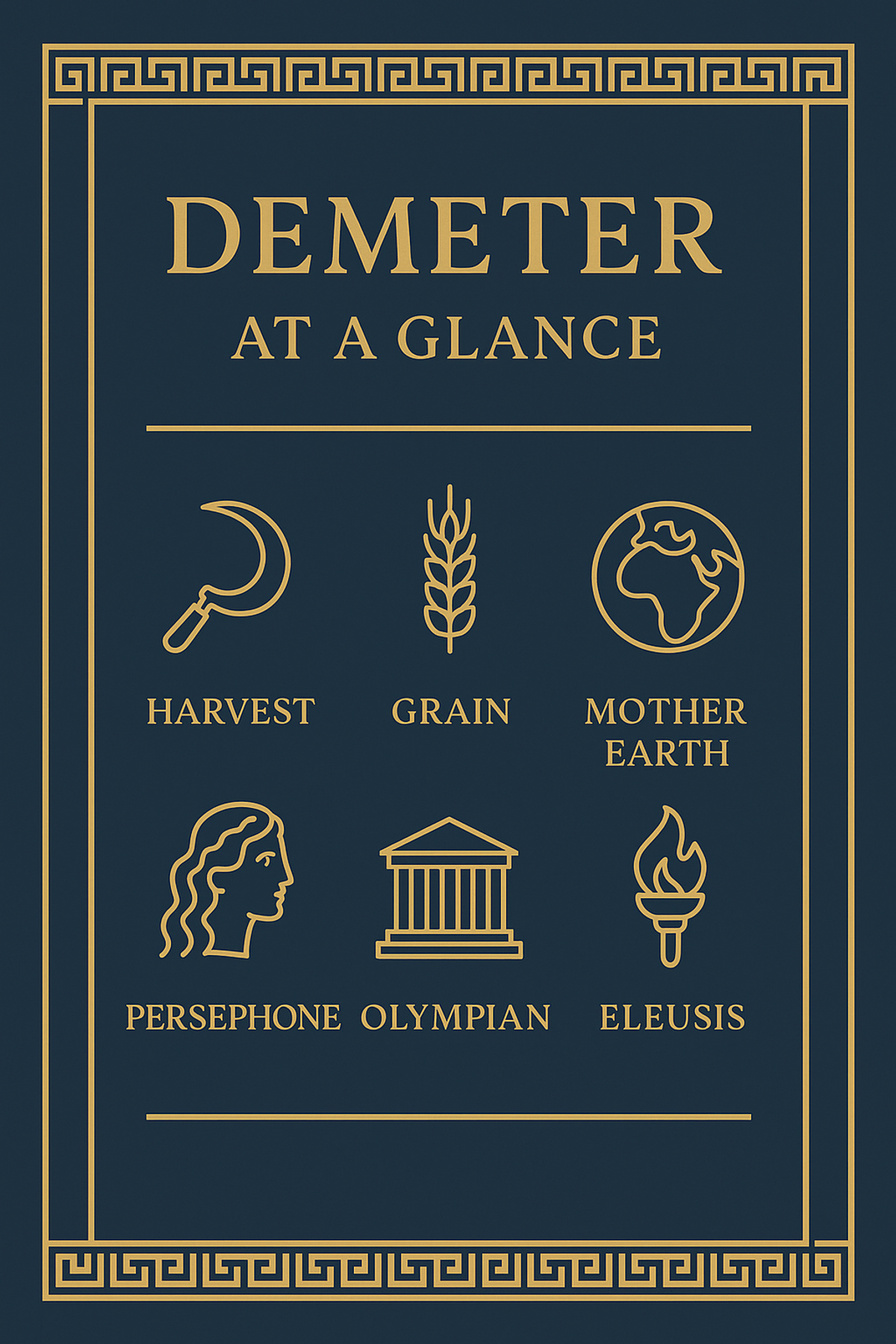
One long-standing theory holds that the name Demeter derives from 'gē mētēr,' or 'Mother Earth,' though other scholars trace the first element to a Cretan word for barley or grain, leaving the exact origin of her name unsettled. Rooted in ancient Greek traditions, her persona evolved over centuries, encompassing the hopes and fears of agrarian societies dependent on the unpredictable whims of nature.
Demeter's story, like the grains she governs, has roots that run deep and spread wide. Her origins shed light on her significance and offer a window into the very fabric of ancient Greek culture and its relationship with nature.
Demeter, a pivotal figure in Greek mythology, symbolized earth's fertility as the Goddess of the Harvest. Daughter of Titans Cronus and Rhea, she embodied the vital connection between humanity and nature, influencing agrarian societies deeply reliant on nature's cycles.
Demeter's place within the Olympian family explains much of her mythology, from her rivalry with Hades to her grief over Persephone. The table below maps her closest relations.
| Relation | Name(s) |
|---|---|
| Parents | Cronus and Rhea |
| Siblings | Zeus, Hera, Poseidon, Hades, Hestia |
| Consorts | Zeus (father of Persephone), Poseidon (father of Arion), Iasion (father of Plutus) |
| Children | Persephone (goddess of spring and the underworld), Plutus (god of wealth), Arion (divine horse) |
In the vast tapestry of Greek mythology, symbols often held profound meanings, acting as direct conduits to the essence of deities. Demeter, revered for her connection with the earth and agriculture, is frequently represented by symbols reflecting different facets of her divine nature.
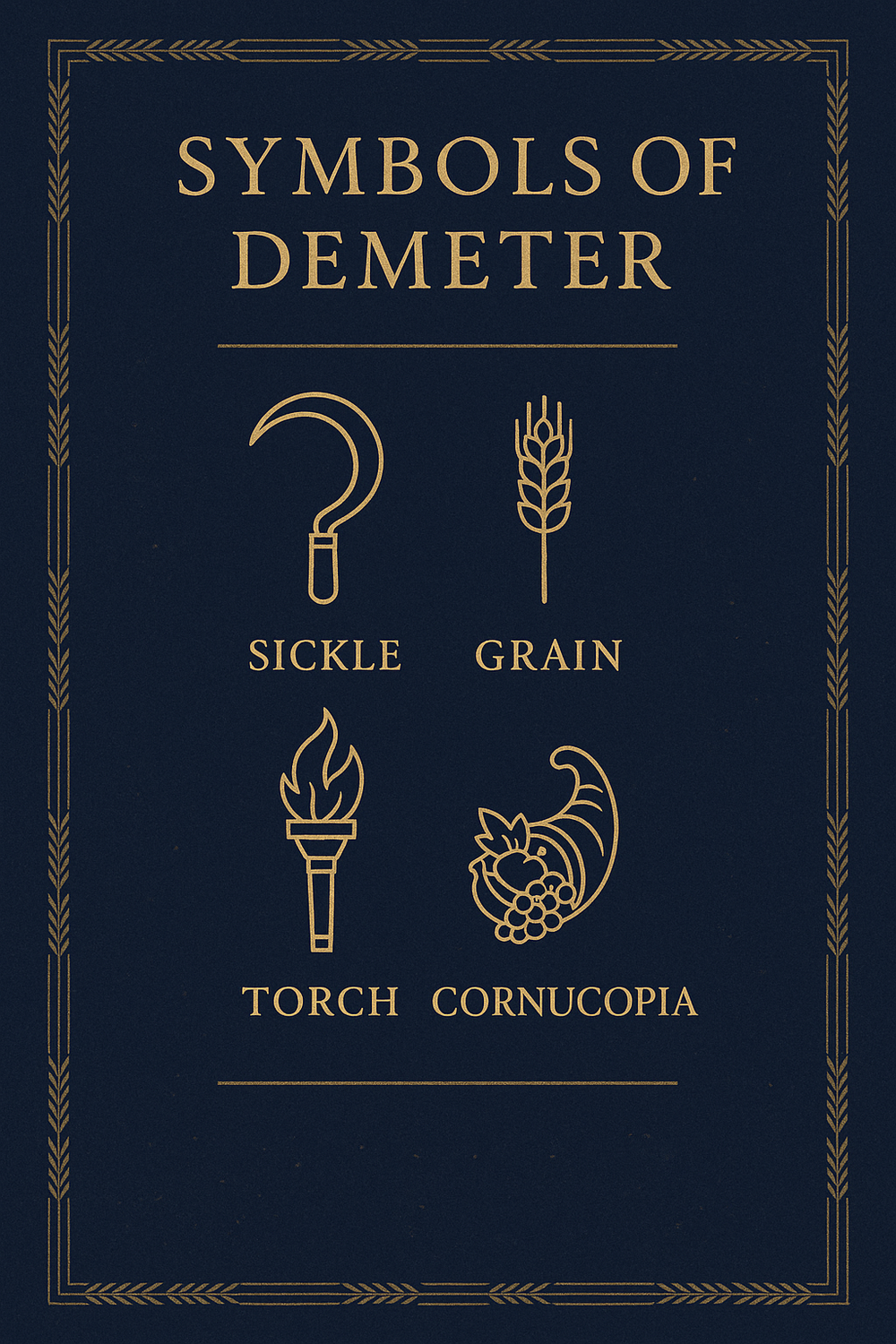
| Symbol | Description | Significance |
|---|---|---|
| Sickle | A curved blade used primarily for harvesting crops. | The sickle, reminiscent of the crescent moon, represents Demeter's role in agriculture and the cyclical nature of life. It signifies harvest, rejuvenation, and the unending loop of sowing and reaping. |
| Grains | Specifically wheat or barley depicted in various artworks. | Grains are a direct symbol of fertility, sustenance, and the nourishment Demeter provides to the world. They underscore her dominion over agriculture and her pivotal role in human sustenance. |
| Torch | A flaming torch, often shown in contexts related to her daughter, Persephone. | The torch illuminates Demeter's relentless quest for her abducted daughter and symbolizes hope, determination, and the enduring bond between mother and child. |

The ancient world, with its myriad of gods and rituals, held a special place for the Eleusinian Mysteries — secretive rites dedicated primarily to Demeter and her daughter, Persephone. Originating in the city of Eleusis, these ceremonies played a pivotal role in Greek religion, offering participants profound spiritual experiences and insights into the mysteries of life and death.
Eleusis, a city near Athens, became the epicenter of the Eleusinian Mysteries. It was believed that Demeter, in her grief-stricken wanderings after the abduction of Persephone by Hades, took refuge in Eleusis. There, she taught the locals the art of agriculture, symbolizing the cyclical nature of life and death.
Details of the Eleusinian Mysteries remain largely enigmatic. Participants were sworn to absolute secrecy, under the threat of severe penalties. This cloak of silence has preserved the sanctity and allure of the mysteries for millennia, making them one of the most intriguing aspects of ancient Greek religion.
Despite the secrecy, the influence of the Eleusinian Mysteries transcended ancient Greece. Philosophers, writers, and thinkers have drawn inspiration from these rites, seeing them as pathways to understanding the profound mysteries of existence. Even today, the allure of these ancient ceremonies continues to captivate our imaginations, beckoning us to delve deeper into the enigmatic world of Demeter and Persephone.
The pantheon of ancient Greek gods teemed with intricate relationships, betrayals, alliances, and rivalries. Demeter, the nurturing Goddess of the Harvest, was no exception. As she interacted with fellow Olympian deities — including her niece and nephew Athena and Apollo, both children of Zeus — her relationships shed light on her persona, offering deeper insights into the myths and stories surrounding her.
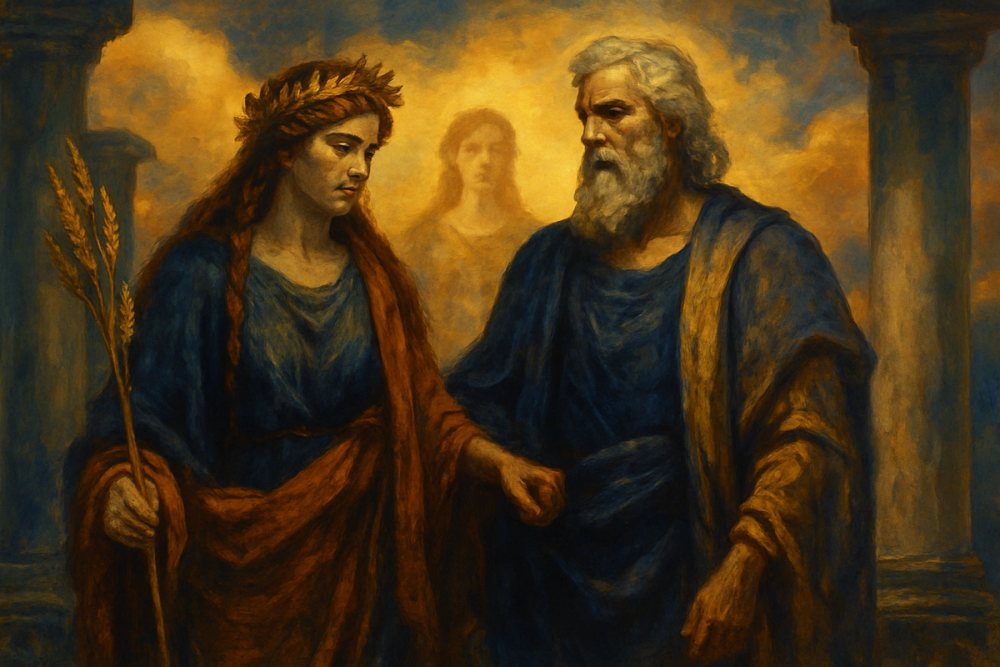
As siblings and prominent figures among the Olympian gods, Demeter and Zeus shared a relationship marked by both camaraderie and tension. Beyond their sibling ties, they became parents to the radiant goddess, Persephone. Yet it was Zeus's decision to allow Hades to abduct Persephone that caused a rift between the two, as Demeter roamed the earth in search of her beloved daughter.
The Lord of the Underworld, Hades, ignited Demeter's fury when he kidnapped Persephone. Demeter's ensuing grief led to the barrenness of the earth. The cold dynamics between the two represent the natural tension between life and death, growth and decay.
Their relationship was a turbulent one. At one point, to evade Poseidon's advances, Demeter transformed herself into a mare. However, the persistent sea god matched her transformation, resulting in the birth of their horse-child, Arion. This union, albeit complex, symbolizes the interconnectedness of land and sea.
Hera, the queen of gods, shared a bond of sisterhood with Demeter. Both powerful female figures in the Olympian pantheon, they often found common ground, especially when it came to their protective instincts toward their offspring.
Demeter's interactions with fellow gods and goddesses — including her extended family such as Ares, Aphrodite, and Hephaestus — not only defined her character but also enriched Greek mythology, weaving tales of passion, grief, love, and vengeance. These stories, transcending time, continue to influence art, literature, and culture, bearing testimony to the Goddess of the Harvest's indelible mark on human civilization.

In ancient Greece, where the reverence of gods and goddesses was an integral part of daily life, Demeter held a unique position. As the deity symbolizing grain and fertility, she was deeply associated with life-sustaining crops and the cyclical nature of life. The ways in which she was worshiped, and the temples dedicated to her, bore witness to her profound significance.
| Temple | Description |
|---|---|
| Eleusis Sanctuary | The most renowned temple of Demeter was in Eleusis, a small town near Athens. This sanctuary was the focal point of the Eleusinian Mysteries, a series of rituals and ceremonies dedicated to Demeter and her daughter, Persephone. |
| Cnidus Temple | Located in Asia Minor, this temple was an architectural marvel with intricate carvings portraying Demeter's legends and myths. |
| Temple of Demeter in Naxos | This temple was unique for being constructed entirely of white marble, standing as a testimony to the island's devotion to the harvest goddess. |
Devotees of Demeter had distinct ways of paying homage, ensuring the goddess's blessings for a bountiful harvest. Thesmophoria, a festival held in her honor, saw women planting seeds as a symbolic gesture, reaffirming the cycle of growth and decay. Offerings made to Demeter were predominantly barley, wheat, and sometimes honey — all staples of the ancient Greek diet.
While temples were central to her worship, Demeter's influence permeated daily Greek life. Farmers prayed to her before sowing seeds, and harvest festivals across regions celebrated her benevolence. This deep-seated reverence for Demeter was a tribute to her embodiment of maternal love and the natural cycles of life.
For the agrarian communities of ancient Greece, Demeter was more than just a figure of worship. She was the pulse of every sown seed, the promise of every harvest, and the heartbeat of every ritual that sought her blessings for bountiful yields.
It was widely believed that Demeter's moods influenced agricultural outcomes. A pleased Demeter would ensure that the earth was fertile, crops abundant, and the harvests rich. Her displeasure could result in failed crops, reflecting the time when she mourned the loss of Persephone.
Offerings to Demeter weren't merely ritualistic; they were intimate gestures of gratitude. Sheaves of barley, honeycombs, and fresh fruits were common. Beyond tangible offerings, hymns and songs in her honor resonated in the fields, invoking her grace.
The cyclic pattern of seasons — growth in spring and summer followed by the dormancy of autumn and winter — was deeply attributed to Demeter's annual emotional journey during Persephone's departure and return. Her influence was not limited to just the harvest; she was the very essence of the cyclical rhythms of nature.
While many are familiar with the iconic Greek goddess Demeter, fewer are acquainted with her Roman counterpart: Ceres. Both deities are predominantly associated with agriculture, but there are nuanced differences in their tales, worship, and cultural significance.
Demeter's lore is deeply intertwined with her daughter Persephone's abduction by Hades. The resulting despair led to barren lands, only to be revived when Persephone was allowed to return to her mother for part of the year. This myth explains the seasons and emphasizes Demeter's emotional connection to the fertility of the earth.
Ceres shares similar mother-daughter tales with Proserpina (the Roman version of Persephone), but the narratives don't hold the same central role in Roman mythology. Instead, Ceres was often portrayed as a benevolent and kind deity, ensuring the prosperity of crops without the deeply emotional Greek narrative.
In Greece, Demeter was integral to major festivals, particularly the Eleusinian Mysteries. Her emotional journey was mirrored in agricultural rites and was central to the Greek understanding of the seasons.
For the Romans, Ceres was part of daily life as the protector of agriculture, invoked for grain's prosperity. While the Greeks had elaborate festivals for Demeter, the Romans had a more practical approach, emphasizing Ceres's role in state functions and daily sustenance.
Both goddesses had magnificent temples dedicated to them, but their locations and architectural styles reflected their respective cultures' values. In Greece, Demeter's temples were often located in rural areas, aligning with her connection to the earth and fertility. Roman temples for Ceres, by contrast, were more urban, emphasizing her role in grain distribution and feeding the city's population.
| Aspect | Demeter (Greek) | Ceres (Roman) |
|---|---|---|
| Mythology | Deeply emotional tale tied to Persephone and the seasons | Less emotional emphasis, more focus on benevolence and prosperity |
| Cultural Role | Central to festivals and rites, explaining the seasons | Emphasis on daily sustenance and state functions |
| Temples | Rural locations, connection to earth and fertility | Urban settings, emphasizing grain distribution |
The echo of ancient Greece is still discernible in today's cultural milieu, and Demeter, with her rich tapestry of myths and significance, is no exception. Her legacy has transcended her ancient origins, permeating contemporary art, literature, and even fashion.
Many filmmakers and playwrights have drawn inspiration from Demeter's poignant tale of loss and reunion with her daughter, Persephone. Modern adaptations often emphasize themes of maternal love, resilience, and the inexorable cycles of nature.
Modern painters, sculptors, and digital artists often revisit Demeter's imagery, sometimes offering a fresh perspective. Current interpretations might depict her as a symbol of environmentalism, reflecting contemporary concerns about our planet's well-being.
From poetry to novels, Demeter's influence is palpable. Her story provides fertile ground for exploring complex emotions and relationships, and contemporary authors often use her tale as a metaphor for modern challenges.
The motifs associated with Demeter have found their way into fashion and design. Earthy tones, grain patterns, and seasonal shifts inspired by her myth have graced runways around the world, alongside jewelry featuring wheat sheafs or symbols of fertility.
The tale of Demeter's separation from Persephone is her most famous myth, but this bountiful goddess appears in numerous other stories, often overshadowed by her better-known narratives.
In one lesser-known myth, a man named Erysichthon cut down a sacred grove dedicated to Demeter. In retaliation, the goddess cursed him with insatiable hunger. No matter how much he ate, Erysichthon remained ravenous, leading to his eventual self-devastation — a stark reminder of the consequences of disrespecting nature.
Triptolemus, a mortal, was once favored by Demeter. In gratitude for his family's kindness during her search for Persephone, Demeter gifted him the knowledge of agriculture. Triptolemus traveled the world teaching humanity how to cultivate grain, a gift that transformed civilizations.
During her grief-stricken wanderings, Demeter served as a nurse to a mortal infant named Demophoon. Seeking to grant him eternal life, she secretly placed him in fire each night. When discovered by the child's mother, the ritual was interrupted, denying Demophoon true immortality.
| Story | Key Lesson |
|---|---|
| Erysichthon's Punishment | Respect the sanctity of nature and the divine. |
| Triptolemus and Agriculture | Generosity can usher in widespread prosperity. |
| Demophoon's Near-Immortality | Some gifts are not meant for mortals. |

The echoes of Demeter's myths and legends resonate even today, shaping many aspects of modern farming and harvest traditions.
Harvest festivals around the world, with roots in ancient celebrations dedicated to Demeter, serve as a testament to her lasting influence. They celebrate not only the produce but also the balance of nature and the bond between humans and the land.
The rise of organic farming practices mirrors Demeter's principles of nurturing and respecting the earth. By forgoing harmful pesticides and chemicals, farmers pay homage to the goddess's teachings, keeping the soil fertile and the crops pure.
Grains, the very emblem of Demeter, are celebrated in numerous cultures. These festivals, reminiscent of ancient rituals honoring the goddess, emphasize the importance of grains in sustaining life and civilizations.
These festivals, spread across different cultures and religions, underline the universal reverence for grain and, by extension, Demeter's legacy.
| Modern Practice | Link to Demeter |
|---|---|
| Harvest Festivals | Celebrating the bounty of the land and nature's cycles. |
| Organic Farming | Emphasizing natural and sustainable agricultural practices. |
| Grain Festivals | Highlighting the importance of grain as a life-sustaining force. |
Demeter's Roman counterpart is Ceres, from whom the English word "cereal" derives. While both goddesses govern grain and agriculture, Ceres's myths place less emphasis on grief and more on benevolence and civic prosperity.
Demeter's parents are the Titans Cronus and Rhea. Her siblings are Zeus, Hera, Poseidon, Hades, and Hestia, making her a founding member of the first generation of Olympian gods.
Demeter descends from Cronus and Rhea and is sister to Zeus, Hera, Poseidon, Hades, and Hestia. With Zeus she had Persephone, with Poseidon the horse Arion, and with the mortal Iasion the god Plutus.
Yes, Demeter is counted among the twelve Olympian deities in most classical traditions, ruling over the harvest, agriculture, and the fertility of the earth alongside her siblings and their children.
Greek mythology originated from ancient oral traditions, combined with the stories of early civilizations that interacted with the Greeks. Over time, these stories evolved and were influenced by historical events, other cultures, and the need to explain natural phenomena, and were later written down by poets like Homer and Hesiod.
Demeter is considered the goddess of the harvest because she was responsible for ensuring crop growth and the fertility of the earth. She was revered in ancient Greece as the deity who brought agriculture and sustenance to humanity.
Demeter is often represented by symbols associated with agriculture, such as wheat, grain, and the cornucopia (horn of plenty). These symbols reflect her role in ensuring bountiful harvests and prosperity.
Yes, Demeter is generally considered a benevolent and kind goddess. She was beloved by the ancients for bestowing the gift of agriculture and ensuring fruitful harvests, though like all gods she had moments of wrath, especially when her daughter Persephone was taken to the Underworld.
Demeter holds a unique place among Greek deities due to her direct impact on human survival and well-being. She was the reason for the seasons, and her myths explained the cyclical nature of life, death, and rebirth in agriculture.
Three significant powers of Demeter include control over plant growth and agriculture, the ability to grant fertility to the earth and ensure bountiful harvests, and the power to cause drought and famine as a form of punishment or when displeased.
Demeter's most profound love was for her daughter, Persephone. The myth of Persephone's abduction to the Underworld and Demeter's subsequent search is a testament to the depth of her maternal love.
Demeter is often associated with poppies, which grew alongside barley, one of her sacred crops. The narcissus flower is also linked to the myth of Persephone's abduction, making it another flower associated with Demeter.
In antiquity Demeter was not merely compared to a similar Egyptian goddess but was directly identified with Isis: Herodotus equated the two, and later writers such as Apuleius have Isis declare that she is worshipped as Demeter/Ceres among the Greeks. However, the goddess Isis shares some similarities with Demeter — both were deities of fertility and motherhood with profound love for their children, paralleling Demeter's love for Persephone.
Dive quickly into the mystical world of Greek gods and goddesses, including Ares, Aphrodite, and Hephaestus. Learn more about their realms by visiting the links below.
Discover Helios, the Greek Titan sun god who drove his blazing chariot across the sky—his myths, symbols, and spiritual meaning ex…
Discover Gaia, the primordial Greek goddess of Earth—her origins, myths, symbolism, dream meaning, and how to honor her energy tod…
Discover Nike, the Greek goddess of victory — her myths, symbols, Roman parallel Victoria, and what she means in dreams and daily …