 Know
Know
Animal Symbolism
Snake Symbolism: Spiritual Meaning & Significance
Discover what snakes truly symbolize spiritually—transformation, healing, danger, and rebirth—across cultures, dreams, and everyda…
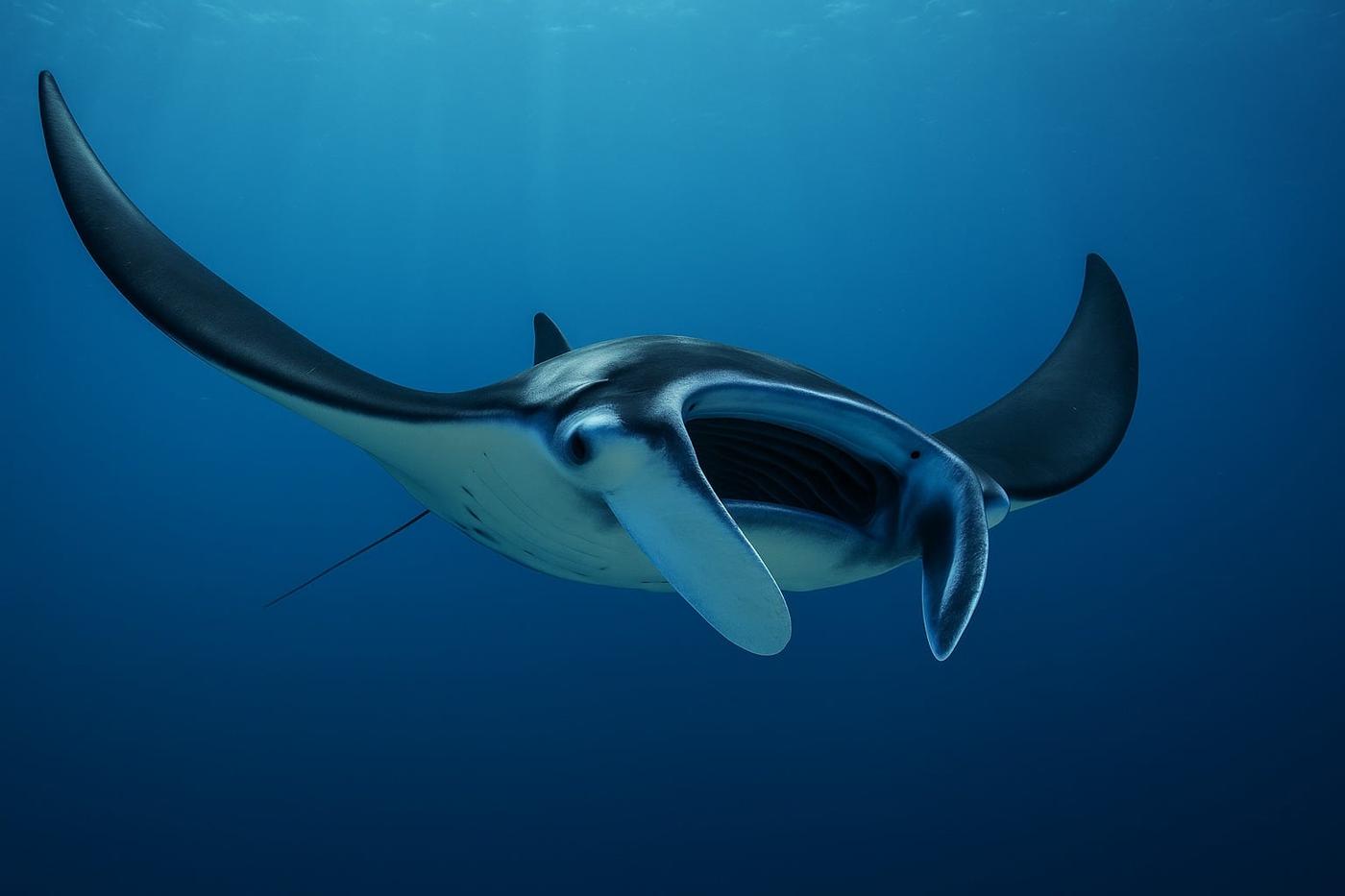
Manta rays symbolize grace, emotional flow, intuitive trust, and calm strength in the face of the unknown. As a spirit animal and totem, the manta ray teaches you to move through life's currents without resistance—trusting what you can't yet see.
They glide like underwater galaxies—silent, wide-winged, and ancient. A manta ray doesn't just move through the ocean. It dances with it. And in that dance lies a spiritual message that's captivated islanders, dreamers, and seekers for centuries.
If you've ever felt drawn to these gentle giants, there's a reason. The manta ray spirit animal shows up when you're learning to trust life's current, even when you can't see what's ahead. Let's dive deeper.
If the manta ray is your spirit animal, it's calling you to trust your emotional intuition and move through life without resistance, even when the outcome isn't clear. People with this spirit animal tend to be calm, empathic, and quietly powerful—drawn to solitude, yet magnetic to others. Its appearance in your life, whether in dreams, sightings, or sudden fascination, signals that you're being asked to release control and glide with your inner knowing.
Having the manta ray as your spirit animal isn't about chasing bigger or louder power—it's about recognizing the strength in softness. You likely feel things deeply, sense emotional undercurrents before others notice them, and find peace in quiet, expansive spaces rather than chaos or confrontation. This spirit animal doesn't push its way through obstacles; it simply adjusts course and keeps flowing, and that's the exact lesson it's offering you right now.
If several of these resonate, the manta ray isn't just an animal you admire—it's actively speaking to your emotional and spiritual journey right now.
A spirit animal tends to be personal and situational—it arrives at a specific moment to deliver a message you need right now, often around trust, surrender, or emotional flow. A totem, by contrast, is a lifelong guide reflecting your core character and the traits you carry throughout your journey, not just a single season. If the manta keeps reappearing briefly during a transition, it's likely acting as your spirit animal; if its qualities—quiet strength, empathy, graceful openness—have defined you your whole life, it may be your totem. We explore that deeper, lifelong connection in the Manta Ray Totem Meaning section below.
| Trait | Spiritual Meaning |
|---|---|
| Wide, open wings | Vulnerability, openness, and confidence in exposure |
| Slow, gliding movement | Flow, patience, and effortless progress |
| Deep-sea and surface travel | Balance between the physical and spiritual worlds |
| No stinger or defense | Trust, non-resistance, and inner security |
| Solitary yet social behavior | Independence paired with quiet magnetism |
| Filter-feeding nature | Taking in only what nourishes you emotionally |
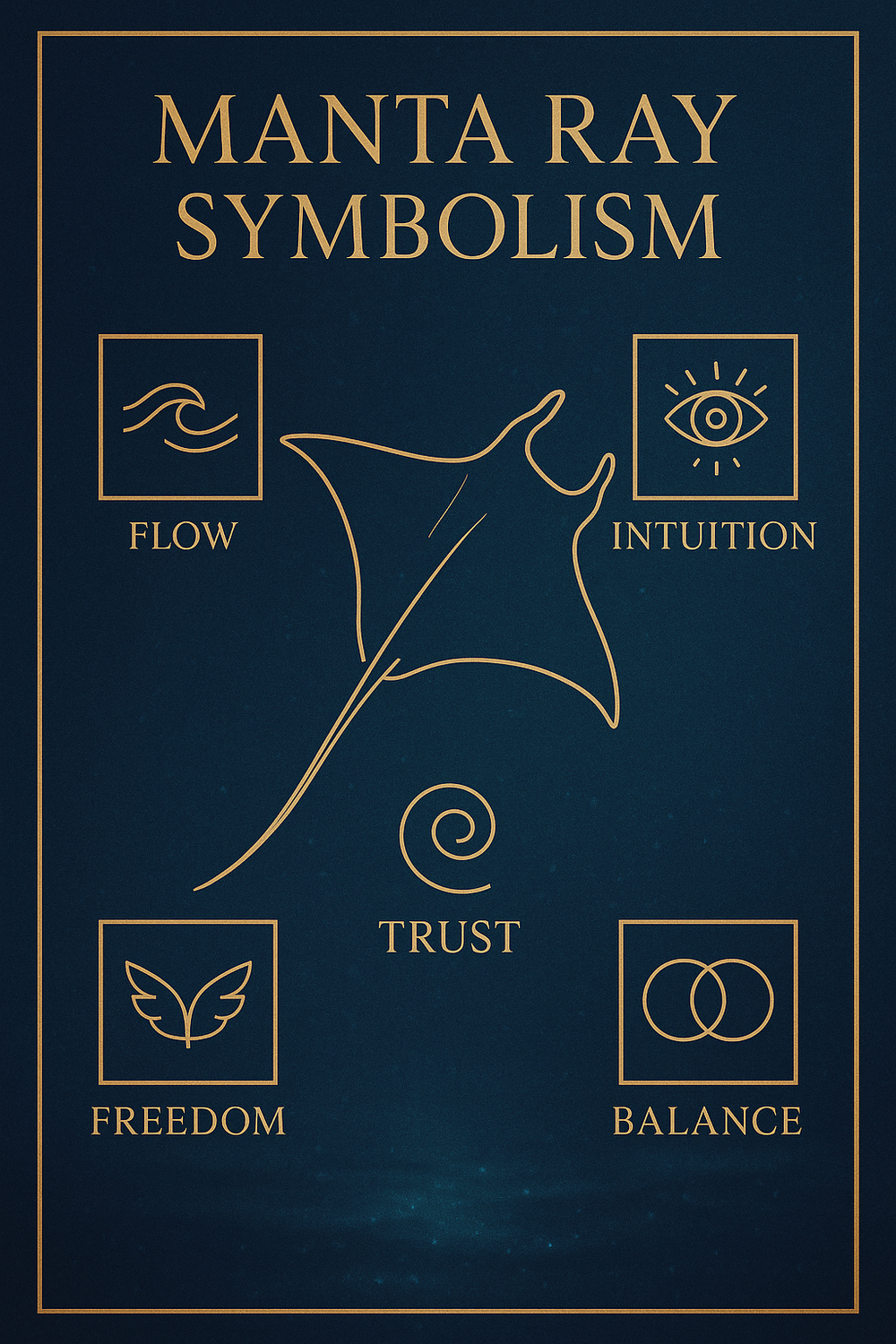
The manta ray's energy is all about moving without resistance. In the spiritual realm, it teaches us how to:
Its wingspan may be enormous, but the manta ray never crashes. It glides—much like a swan gliding effortlessly across still water. That's the key to its power—and yours.
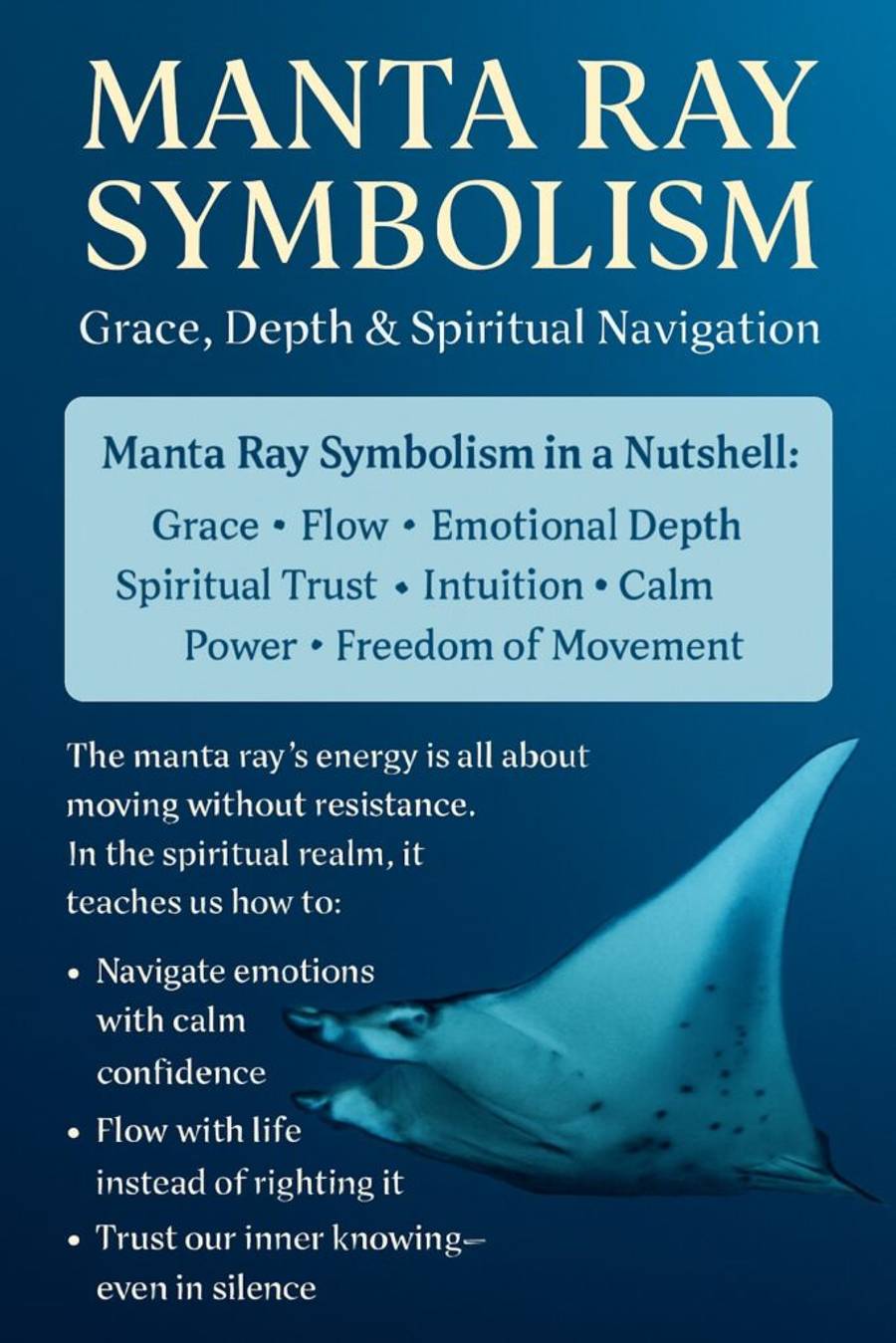
The manta ray spiritual meaning is deeply tied to trust and surrender. Not in the sense of giving up—but in flowing with what is, without panic. Mantas are huge, yet they move like whispers. They remind us that strength doesn't need to thrash. It can be soft, still, and incredibly effective.
This spirit animal often appears during times of emotional change, especially when you're being asked to:
"The manta doesn't rush—but it always arrives."
If you're feeling the call of the manta ray, you're likely being invited to stop resisting your path and instead, ride the wave with awareness, curiosity, and calm presence. Like the quiet nourishment of jellyfish symbolism, the manta reminds us that softness and power aren't opposites.
As a manta ray totem, this ocean guardian teaches life mastery through elegance. It's a totem of the unrushed, the watchful, and those who lead by example—not noise. In this sense, it shares kinship with sharp-eyed guides like the hawk, who watch quietly before acting with precision.
People with the manta ray totem often share some of these traits:
Unlike many sea creatures that dart or hide, the manta opens its whole body to the current. It doesn't shrink. It expands. This totem is perfect for anyone learning how to be seen—without losing peace. If you feel pulled toward multiple animal guides, it's worth exploring how the hummingbird's joyful lightness or the owl's quiet wisdom might complement the manta's steady flow in your own spiritual toolkit.
In Hawaiian tradition, the manta ray is known as hahalua, which means "two breaths." It's a poetic reference to the surface (air) and the deep (water)—and a reminder that we live in both worlds: the visible and the spiritual.
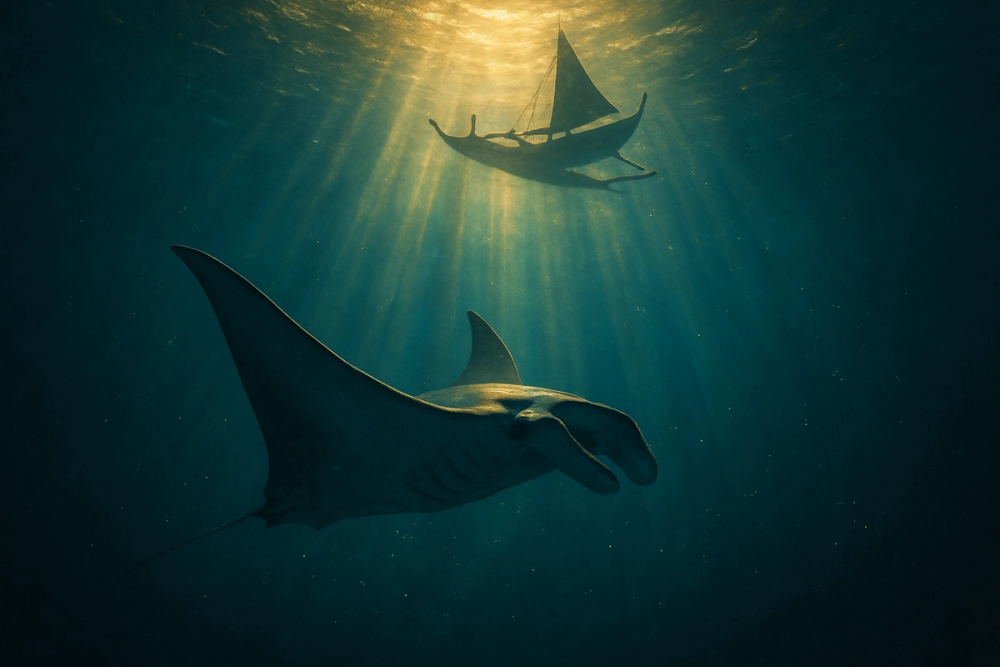
Mantas were seen as oceanic guardians. In Polynesian tradition, guardian spirits such as aumākua (often taking animal forms like sharks) and taniwha are said to protect and guide people, and some island communities extend similar reverence toward manta rays, though no specific documented myth describes manta rays guiding canoes or protecting souls. Warriors and healers alike respected their energy—believing it embodied both strength and serenity.
In this way, the manta symbol came to represent:
Manta ray imagery appears in some modern Polynesian-style tattoo art, where it is popularly associated with freedom, protection, and spiritual growth, but reference sources on traditional Polynesian tattooing do not document the manta ray as a historical motif with fixed symbolic meanings.
Coastal Native peoples of the Pacific Northwest hold whales and orcas in deep reverence, as seen in traditions like the Thunderbird and Whale story and accounts of killer whales serving powerful sea beings, though there is no documented tradition specifically involving rays in that region or comparable evidence for Gulf region tribes. In broader global traditions, from Japanese folklore to Caribbean coastal cultures, wide-winged sea creatures are frequently associated with protection, ancestral guidance, and safe passage across water—themes that echo strongly with the manta's Hawaiian meaning of moving between the seen and unseen.
| Trait | Manta Ray | Stingray |
|---|---|---|
| Defense mechanism | None—no stinger, relies on size and speed | Venomous barbed tail for protection |
| Typical behavior | Open, expansive, filter-feeds in open water | Buries in sand, ambushes prey, stays hidden |
| Symbolic core | Trust, openness, intuitive flow | Caution, hidden sensitivity, self-protection |
| Spiritual lesson | Move through life unarmored | Guard your emotional boundaries wisely |
| Energy type | Expansive and yielding | Defensive and watchful |
Stingrays typically defend themselves with a venomous, barbed tail spine, while manta rays have effectively lost this defense in practice — though the giant oceanic manta ray still carries a small, non-functional vestige of the ancestral sting barb, they do not sting. It floats freely, unarmed, and untamed. That's not weakness—that's confidence in one's direction.
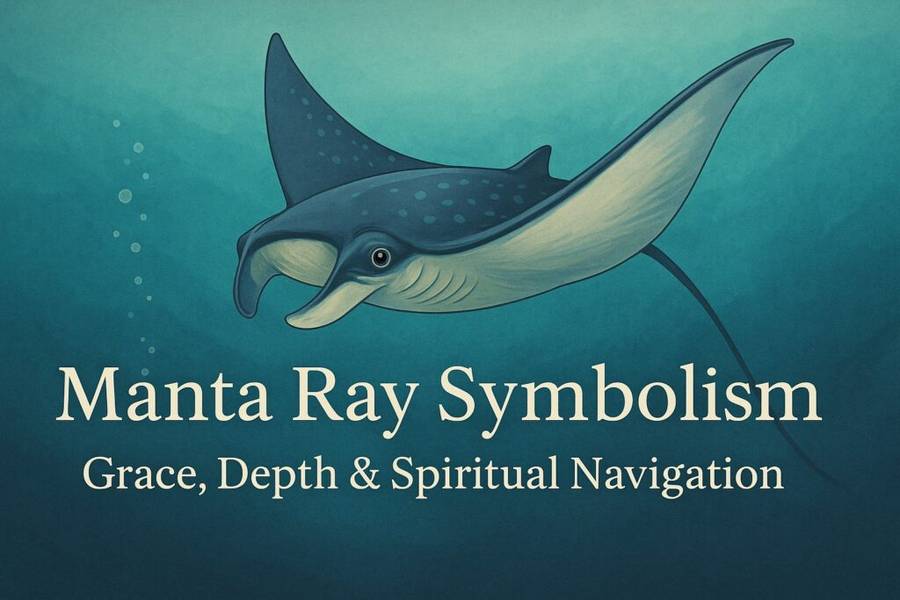
Manta rays naturally range in color from jet black to pale, almost white patterns on their underside—and these color variations carry their own layer of symbolic meaning. A black manta ray is often seen as a symbol of the shadow self: the hidden, mysterious, and unconscious parts of your emotional life that are ready to be integrated rather than feared. Its dark coloring doesn't represent negativity, but depth—an invitation to explore what lies beneath the surface of your thoughts and feelings.
A white or pale manta ray, by contrast, symbolizes clarity, spiritual illumination, and emotional purification. Seeing one—whether in dreams, art, or in the wild—can suggest you're entering a lighter, more transparent phase of your journey, where old confusion is starting to lift.
Together, black and white mantas mirror the same duality found in yin-yang philosophy: darkness and light aren't opposites at war, but two halves of the same graceful whole. If a black manta ray keeps appearing to you, it may be time to sit with your shadow rather than swim away from it.
When a manta ray shows up in your dreams, it's never random. These aren't everyday sea creatures—they're ancient symbols that glide into the subconscious with purpose.
So what does it mean to dream of a manta ray?
If the manta is gliding peacefully, it's a sign of alignment with your inner peace. But if it's hiding, tangled, or swimming in murky waters, you may be resisting something emotionally or spiritually important.
In any case, the manta's dream presence usually means: there's a deeper current beneath what you're feeling—and you're ready to explore it.
Spotting a manta ray in the wild—whether while snorkeling, diving, or simply watching from a boat—is considered a powerful spiritual sign in many coastal and New Age traditions. Because these encounters are rare and unforgettable, they tend to arrive at meaningful moments in a person's life, not by coincidence.
A real-life manta sighting is often interpreted as a nudge to:
Many divers describe an almost meditative calm settling over them the moment a manta glides close—a physical echo of the emotional surrender this creature symbolizes. If this happens to you, consider it confirmation that you're exactly where you're supposed to be, even if the path ahead is unclear.
Manta ray tattoos are popular in Polynesian, Hawaiian, and modern spiritual art. But they're not just decoration. Each curve and wave in a manta symbol carries meaning.
People often choose manta tattoos to express:
In Polynesian culture, manta rays are woven into larger tattoo compositions that tell a story—of protection, spirit journeys, or personal power. If you're drawn to a manta ray totem as body art, you're likely aligning with your intuition and a peaceful, quiet kind of strength.
It's one thing to connect with the manta ray spiritually—but another to protect it physically. Manta ray populations are declining, with the reef manta ray listed as Vulnerable and the giant oceanic manta ray listed as Endangered by the IUCN, primarily due to overfishing, alongside additional pressures like climate change. Their spiritual presence is being erased from the ocean itself, much as fragile creatures like the jellyfish face rising threats from warming, acidifying waters.
Organizations like Manta Trust and Marine Megafauna Foundation are working to preserve this majestic species, and many spiritual seekers are now blending eco-consciousness with symbolism.
"What if protecting the manta wasn't just environmental—but sacred?"
Whether through donation, education, or mindful tourism, part of honoring the manta ray symbolism is ensuring this gentle ocean guardian remains free—just as its spirit teaches us to be.
If the manta ray has been circling your awareness—through dreams, art, or sudden fascination—it may be your soul's way of saying: "Slow down. Let go. Trust where you're drifting."
Because not all strength looks like muscle or noise. Sometimes, it looks like a massive, winged creature gliding silently through saltwater, never in a rush—yet always going exactly where it's meant to.
The manta ray spiritual meaning centers on emotional flow, surrender to life's current, intuitive strength, and peaceful navigation through transformation.
If the manta ray is your spirit animal, you likely have deep emotional intelligence, value solitude and stillness, and are learning to trust yourself even in uncertainty.
Dreaming of a manta ray suggests you're undergoing quiet emotional shifts. It's often a call to let go of resistance and glide with your intuition.
A manta ray tattoo symbolizes emotional freedom, peaceful strength, and spiritual guidance—especially for those with ties to oceanic traditions or inner transformation journeys.
Yes. As a manta ray totem, it represents self-trust, intuitive leadership, and the power of still movement. It guides you to move through the world with grace, not force.
A black manta ray represents the shadow self—the hidden emotional depths you're being invited to explore rather than avoid. It's a sign of deep transformation happening below the surface, not a warning of misfortune.
Seeing a manta ray while swimming or diving is widely considered a sign of alignment, calm, and reassurance from the universe. It often shows up when you're being asked to trust your current path, even without knowing exactly where it leads.
Yes, in many coastal and Polynesian-influenced traditions, the manta ray is considered a good luck symbol associated with protection, safe travel, and spiritual guidance. Encountering one, especially unexpectedly, is often seen as a blessing rather than an omen of misfortune.
Discover what snakes truly symbolize spiritually—transformation, healing, danger, and rebirth—across cultures, dreams, and everyda…
Discover what raven symbolism means - from Norse gods to Native creator myths, dreams, omens, and how to respond when one crosses …

Discover what the eagle truly symbolizes spiritually — vision, freedom, divine messages, myth, and dream meaning explained.