 Know
Know
Symbols
Caduceus Meaning: History of the Winged Staff Symbol
Discover the caduceus meaning: Hermes' winged staff of two serpents, its Greek origins, medical mix-up with Asclepius, and spiritu…

Symbols of betrayal are the images, objects, and creatures that represent broken trust, hidden deceit, and sudden emotional harm. The most common things that symbolize betrayal include the dagger, the color black, the serpent, the kiss of Judas, and the broken mirror — each capturing concealment, sudden pain, or shattered trust across literature, myth, and culture.
Beyond these core five, the symbolic vocabulary of betrayal extends into nature and folklore, from the black rose and wilted flower to the fox, cuckoo bird, and scorpion's sting. In total, more than 15 distinct symbols appear across world cultures to represent this theme.
Each of these symbols draws from centuries of literature, religion, mythology, and folklore, offering a rich vocabulary for expressing the pain of broken trust. Below, we explore the origins and meaning of each in detail — and, just as importantly, the opposing symbols of loyalty and trust that stand in contrast to them.
Symbols have always played a pivotal role in literature, art, and culture, allowing for a deeper understanding and interpretation of themes and emotions. Among these symbols, the dagger and the color black stand out prominently when discussing betrayal.
In Shakespearean literature, the dagger is not merely a weapon but a potent symbol of betrayal, deceit, and impending doom. Its sharpness and stealthy nature make it an apt representation of betrayal’s sudden and unexpected nature.
“Is this a dagger which I see before me, The handle toward my hand?” – Macbeth, William Shakespeare

The color black, with its depth and absence of light, has often been associated with negative emotions and actions. In literature and art, black often symbolizes darkness, mystery, and the unknown, making it a fitting representation of deceit and betrayal.
In Renaissance paintings, a black background was often used to highlight the subject’s isolation or the secretive nature of the scene, subtly hinting at underlying themes of betrayal or deceit.
The dagger, with its sharp edge and concealed nature, can inflict sudden and unexpected harm, much like the act of betrayal. Its stealthy and deadly characteristics make it a fitting representation of deceit and betrayal.
While black has traditionally been associated with darkness, deceit, and mourning, it has also evolved to represent elegance, formality, and power in modern contexts. Its multifaceted symbolism showcases the depth and complexity of the color.
Throughout history, various symbols have been used to represent betrayal, drawing from religious texts, myths, and everyday objects. These symbols are powerful reminders of the profound impact of deceit and betrayal on the human psyche.
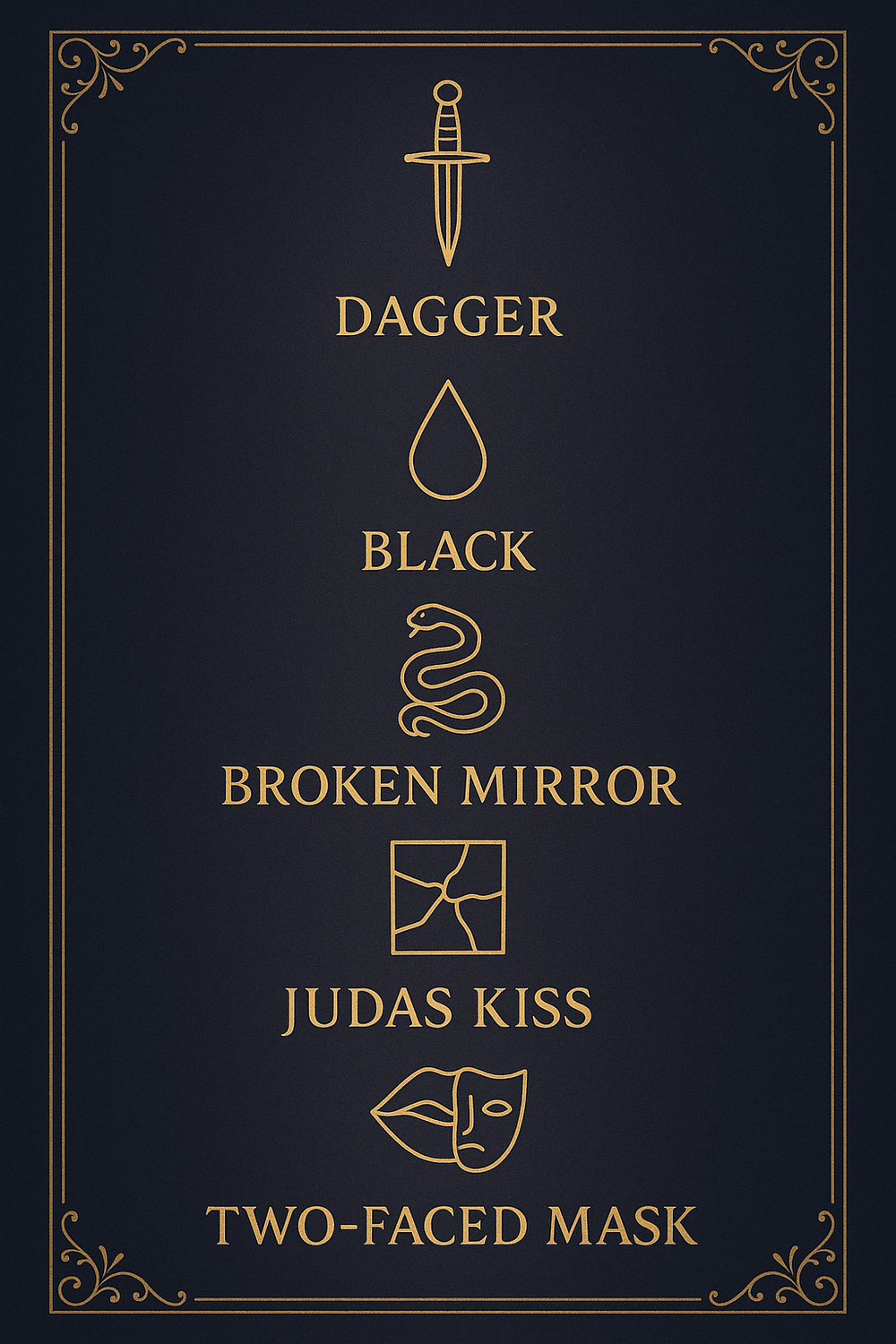
The serpent’s cunning and elusive nature has been a recurring symbol of betrayal in numerous religious and mythological contexts.
The act of kissing, generally a sign of affection, takes a dark turn in the biblical story of Judas Iscariot. His kiss to Jesus in the Garden of Gethsemane marked the ultimate betrayal, leading to Jesus’ arrest and crucifixion.
“And he that betrayed him had given them a sign, saying, Whomsoever I shall kiss, that same is he: hold him fast.” – Matthew 26:48
Mirrors, which reflect our true selves, become poignant symbols of betrayal when shattered. The fragmented reflections can represent a broken trust, distorted truths, and the splintered nature of relationships post-betrayal.
Breaking a mirror has been considered bad luck in many cultures, with some believing that the shattered reflection captures a piece of the soul, leading to seven years of misfortune.
The serpent’s elusive and unpredictable nature, combined with its potential to deliver a deadly bite, makes it a fitting symbol for deceit and betrayal across various cultures and religions.
The stark contrast between kissing, typically associated with love and affection, and the treacherous intent behind Judas’ kiss to Jesus amplifies the depth of his betrayal. This juxtaposition makes the act even more poignant and memorable.
Every symbol of betrayal has a counterpart on the opposite end of the emotional spectrum: a symbol of loyalty. Where betrayal symbols represent hidden harm and broken trust, loyalty symbols represent steadfastness, devotion, and enduring faith. Comparing the two side by side makes both easier to understand and remember.
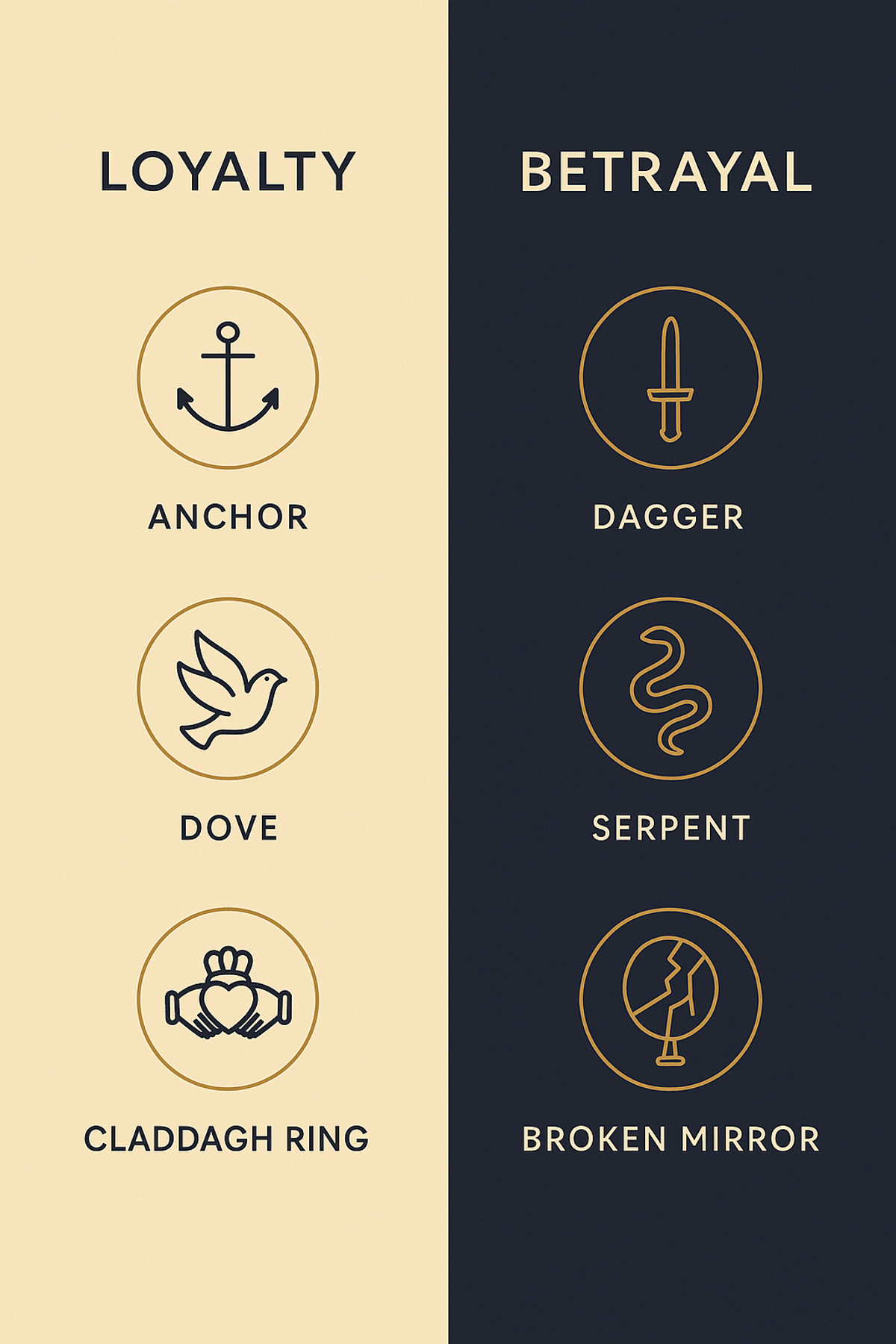
| Symbol of Loyalty | Symbol of Betrayal | What the Contrast Represents |
|---|---|---|
| Anchor | Dagger | Steady, grounded devotion versus sudden, hidden harm. |
| Dove | Serpent | Open peace and fidelity versus cunning and concealed deceit. |
| Claddagh Ring | Broken Mirror | Unbroken trust and friendship versus shattered, distorted truth. |
| Cross | Kiss of Judas | Faith and sacrifice versus affection used as a weapon. |
| Red or White Rose | Black Rose | Enduring love versus sorrow and farewell. |
This table directly answers a common question: what symbols represent loyalty? The anchor, dove, and Claddagh ring are the three most widely recognized answers, each rooted in centuries of maritime, religious, and folk tradition.
The Claddagh ring is one of the most enduring symbols of loyalty, its two hands clasping a crowned heart representing friendship, love, and unwavering loyalty. Traditionally worn in Ireland to signal one’s relationship status, the ring has become a global emblem of committed, trustworthy bonds — the direct opposite of the broken mirror or two-faced mask discussed above.
The anchor carries a similar message of steadfastness. Sailors historically relied on the anchor to hold their ship firm against shifting tides, and by extension it came to represent stability, hope, and loyalty that doesn’t waver under pressure — a fitting counterpart to the dagger’s sudden, treacherous strike.
Crosses have long served as symbols of faith and trust, representing a covenant that, unlike betrayal, is meant to never be broken. If you want a deeper look at how different cross styles carry distinct meanings of devotion and protection, see our full guide to different types of crosses and their meanings.
On the protective side, the hamsa hand is traditionally worn to guard against the evil eye, envy, and hidden ill intentions — making it a popular talisman for those who fear betrayal or deceit from others. Meanwhile, the yin-yang symbol illustrates the duality of trust and deceit within a single whole, echoing the same push-and-pull explored later in the Gemini and Pisces zodiac sections below.
The Claddagh ring's design — heart, hands, and crown — is said to represent love, friendship, and loyalty respectively, making it one of the few symbols that visually combines all three virtues opposite to betrayal.
Flowers have been used for centuries to convey positive and negative emotions with their delicate beauty and transient nature. When it comes to betrayal, certain flowers stand out as symbols of deceit, sorrow, and lost trust.

While roses typically symbolize love and passion, the black rose represents more somber emotions with its dark hue. It is often seen as a symbol of sorrow, farewell, and, in some contexts, betrayal. The very rarity and unnaturalness of a black rose can be likened to the rare but profound sting of betrayal.
Chrysanthemums, in general, are flowers of happiness and longevity. However, the yellow chrysanthemum carries a different meaning in certain cultures. It can represent slight love, neglected affection, or betrayal, especially in a romantic context.
A flower in full bloom represents the peak of beauty and life. In contrast, a wilted flower, with its drooping petals and faded color, symbolizes lost trust, affection, and the withering away of a once-cherished relationship.
Floriography, or the language of flowers, was a Victorian-era means of communication. Various flowers and floral arrangements were used to send coded messages, allowing individuals to express feelings that could not be spoken. This included messages of love, distrust, or even betrayal.
Flowers, with their diverse colors, shapes, and lifespans, mirror the range of human emotions. Their transient beauty, growth, and eventual wilting can be likened to human relationships’ various stages and emotions, making them powerful symbols.
Yes, the color of a flower can significantly alter its symbolic meaning. For instance, while a red rose often symbolizes love and passion, a black rose might represent sorrow or farewell.
Crystals and stones have been revered for their metaphysical properties and energies for centuries. Some are believed to offer protection against betrayal or help in healing from emotional wounds. Here’s a table detailing crystals and stones associated with the theme of betrayal:

| Crystal/Stone | Properties | Description |
|---|---|---|
| Obsidian | Protection | In crystal-healing tradition, obsidian is believed to offer protection against negativity and betrayal, though no scientific evidence supports these metaphysical claims. |
| Hematite | Grounding | This metallic stone is known for grounding energies and reflecting negativity, making it a shield against deceit and harmful intentions. |
| Smoky Quartz | Dispelling Negativity | In crystal-healing tradition, smoky quartz is believed to help dispel feelings of emotional betrayal and support emotional healing, though this is a belief rather than a scientifically demonstrated effect. |
| Black Tourmaline | Protection & Grounding | Black tourmaline is a powerful stone for protection against negative energies and psychic attacks, safeguarding against betrayal and deceit. |
| Malachite | Transformation | While malachite is known for transformation and growth, it also absorbs negative energies, helping one heal from the wounds of betrayal. |
Many ancient civilizations, including the Egyptians and Greeks, utilized crystals and stones for adornment and their perceived protective and healing properties, especially in contexts of trust and betrayal.
Individuals often wear these crystals as jewelry, carry them as talismans, or place them in their living spaces. The belief is that these stones can absorb, reflect, or dispel negative energies, offering protection against deceit and betrayal.
Many believe that crystals and stones absorb energies and, over time, can become saturated. Regular cleansing, either by smudging, under moonlight, or using saltwater, is recommended to rejuvenate their properties.
Animals, with their diverse behaviors and characteristics, have been used as symbols in various cultures to represent a range of emotions and actions, including betrayal. Here’s a numerical list of animals and their associated symbolism related to deceit and betrayal:
 The Hyena: With its scavenging nature and laughter-like calls, the hyena is sometimes seen as taking advantage of others’ misfortunes, making it a symbol of deceit and opportunistic behavior.
By contrast, the dove — one of the most widely recognized symbols of loyalty — represents open, peaceful devotion rather than hidden cunning, reinforcing just how differently animal symbolism can split along the loyalty-betrayal divide.
Throughout history, animals have been used in fables and parables to teach moral lessons, including trust and betrayal. Aesop’s fables, for instance, frequently utilized animal characters to convey the consequences of deceitful actions.
Animals, with their instinctual behaviors and patterns, often mirror human emotions and actions in a raw and unfiltered manner. Their characteristics and behaviors can easily relate to human virtues and vices, making them effective symbols in stories and myths.
No, the symbolic meanings of animals can vary widely across different cultures and regions. While a snake might represent deceit in one culture, it could symbolize wisdom or protection in another.
Every culture has its own set of symbols, stories, and concepts that revolve around the theme of betrayal. These symbols and tales reflect the values and beliefs of a particular society and offer insights into how different cultures perceive and interpret deceit and betrayal.

“Uragiri” translates to betrayal or treachery in Japanese. In Japanese culture, where honor and loyalty are deeply valued, betrayal is considered one of the gravest offenses. Symbols like the “kuro neko” or black cat are sometimes associated with deceit or bad luck. Additionally, certain Kabuki plays and traditional stories highlight the theme of betrayal, emphasizing its profound impact on relationships and honor.
Prometheus, a Titan, betrayed the gods by stealing fire and giving it to humanity. Though seen as a gift to humans, his act was a grave betrayal against Zeus. As punishment, Prometheus was chained to a rock where an eagle would eat his liver daily, only for it to regenerate and be eaten again the next day. This story not only underscores the consequences of betrayal but also highlights the complexities of deceit, where an act can be seen as treacherous by some and benevolent by others.
Native American folklore is rich with tales that impart moral lessons. Stories of deceit often involve animals as characters, teaching listeners about the consequences of betrayal. For instance, some tales speak of Coyote, a trickster figure who often deceives others but also faces the repercussions of his actions. These stories emphasize the importance of trust, the consequences of deceit, and the intricate balance of relationships.
While betrayal is universally recognized as a negative act, how it’s perceived, its consequences, and its lessons can vary widely across cultures. This diversity in interpretation showcases the richness of human thought and the multifaceted nature of deceit.
Cultural symbols and stories shape societal values by offering moral lessons and setting examples of desired or undesired behavior. Symbols of betrayal, in particular, serve as cautionary tales, emphasizing the importance of trust and the consequences of deceit.
While the specifics might vary, certain symbols, like the snake or the backstabbing act, are recognized in multiple cultures as representations of deceit. However, their interpretations and the stories surrounding them might differ based on cultural context.
The Zodiac, with its twelve signs, offers insights into personality traits, tendencies, and potential behaviors. While it’s essential to remember that not every individual of a particular sign will exhibit the same characteristics, certain signs have been traditionally associated with themes of trust, deceit, and betrayal.
Scorpio, represented by the scorpion, is often associated with intensity, passion, and secrecy. While Scorpios are known for their loyalty and deep emotional connections, their secretive nature can sometimes be misconstrued as deceitful. The scorpion’s sting, a defining characteristic of this sign, can symbolize betrayal’s sudden and unexpected nature.
Pisces, symbolized by two fish swimming in opposite directions, represents the duality of human nature. This sign is often associated with empathy, intuition, and sensitivity. However, the dual fish can also signify the constant pull between trust and deceit, making Pisces individuals prone to internal conflicts regarding loyalty and betrayal.
Gemini, represented by the twins, is synonymous with duality. Geminis are known for their adaptability, versatility, and communication skills. However, the twin symbol can also indicate dual intentions or perspectives. While Geminis are not inherently deceitful, their ability to see and understand multiple sides of a situation can sometimes be perceived as having shifting loyalties — a theme that echoes the yin-yang duality discussed earlier in the loyalty comparison section.
The Zodiac, as a system of astrology, dates back thousands of years and has been used by various cultures to gain insights into personality traits, predict future events, and understand human behavior. However, it’s essential to approach zodiac interpretations with an open mind, recognizing each person’s individuality.
The Zodiac offers general insights based on astrological interpretations. While some might find these insights resonating with their experiences, it’s crucial to remember that individual behavior is influenced by many factors and not solely by one’s zodiac sign.
Yes, in astrology, the position of planets, their movements (transits), and their interactions (aspects) can influence and modify the basic traits associated with each zodiac sign. For instance, a Scorpio with Venus in Libra might exhibit more harmonious and balanced relationship traits than a typical Scorpio.
Betrayal, at its core, is deceiving or disappointing someone with trust or faith in us. It’s a breach of trust, an act that can shatter the foundation of relationships, whether personal or professional. Betrayal can manifest in various forms, from infidelity in romantic relationships to backstabbing in professional settings.
Experiencing betrayal can lead to many psychological and emotional reactions. The aftermath of such an act can be profound and long-lasting.
The main symbols of loyalty include the anchor, the dove, and the Claddagh ring, along with the cross as a symbol of faith and devotion. Each represents steadfastness and unwavering commitment, standing in direct contrast to betrayal symbols like the dagger or broken mirror.
Honesty is commonly represented by open hands, the color white, and the scales of justice, all of which suggest transparency and fairness. The dove also frequently doubles as a symbol of honesty and peace, since it lacks the concealment associated with betrayal symbols like the serpent.
Symbols of loyalty, like the anchor or Claddagh ring, represent steadiness, open devotion, and trust that holds firm over time. Symbols of betrayal, like the dagger or broken mirror, represent sudden, hidden harm and the shattering of that same trust — making the two categories direct emotional opposites.
The dagger and the kiss of Judas are widely considered the most powerful symbols of betrayal, since both combine an element of surprise with deep emotional or physical harm. The serpent is a close third, thanks to its long-standing role in religious and mythological tales of deceit.
Discover the caduceus meaning: Hermes' winged staff of two serpents, its Greek origins, medical mix-up with Asclepius, and spiritu…

Discover what the Om symbol truly means—its Hindu, Buddhist, and Jain roots, dream symbolism, and how to use it in daily life.

Discover what the compass symbolizes across cultures — from spiritual guidance and moral direction to finding your true life purpo…